Table of Contents
If you've ever used headphones or a soundbar, you've probably come across something called 'virtual surround' . As the name suggests, you can experience surround sound with just two stereo speakers or a compact soundbar. But can 'virtual' replace 'real'? The answer is: not really .
What is virtual surround sound?
In theory, the technology promises to deliver the same experience as a 5.1 or 7.1 speaker system, but with just one pair of speakers or a soundbar. Sounds appealing, right? Because real speakers are expensive, bulky, and a pain to set up.
But if virtual technology really is a replacement, why are people still investing in traditional surround sound systems?
Virtual surround sound is based on psychoacoustics – that is, 'tricking' your brain into thinking sound is coming from multiple directions.
Sound engineers adjust the timing, phase, and frequency balance to make it seem like the sound is coming from behind or above your head. Since humans only have two ears, the brain has to process the small differences between the two to deduce the sound's location. Virtual surround takes advantage of this mechanism to simulate a 'multi-dimensional' experience.
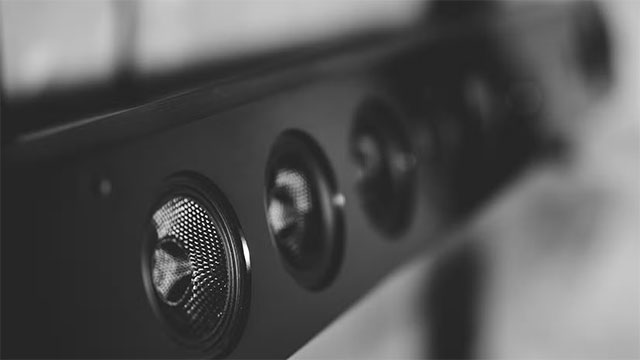
Why can't it be the real system?
The biggest problem: lack of physical speakers . Virtual technology only uses 2 speakers to simulate the work of 5 – 7 speakers, which means there are no separate sound channels , making it impossible to reproduce many details accurately.
Sound from behind is the hardest to fake, because the human ear is very sensitive to front-to-back directions. Sound from above, like a helicopter flying by in a Dolby Atmos movie, is almost impossible without ceiling speakers.
Room conditions also come into play. Real surround systems allow for room-specific speaker placement, while virtual surrounds are more limited.
When does virtual surround sound come in handy?
It can't replace a real surround system, but it's still useful. It helps expand the sound field , creating a more 'immersive' feeling than regular stereo.
- Headphones are the ideal environment, as they are unaffected by room acoustics. For example, Spatial Audio on AirPods makes for a very immersive movie-watching experience.
- Soundbars or computer speakers close to your ears can also be quite effective, as long as you sit in the right 'sweet spot'.
That said, this is not a good solution for watching movies with a large group of people, because the effect will be significantly reduced if the position is off.

Real alternatives
If you want true surround sound , there's no substitute for a real 5.1 or 7.1 speaker system, even the basic version.
Modern soundbars with separate drivers and clever designs that reflect sound off walls are also a compromise. Hybrid systems with wireless rear satellite speakers also provide a more compact 'surround' experience.
Virtual surround sound isn't a gimmick , but the name and marketing can be misleading. It's no replacement for real surround sound, but it has its merits — it can take your audiovisual experience to the next level without requiring a lot of equipment.
Final Thoughts
The key takeaway is that Is 'Virtual Surround Sound' Really Surround Sound? the Truth Surprising is easier to evaluate when its benefits, limitations, and real-world use are considered together. Review the details above before applying the information to a specific situation.
FAQ
What is the main point of Is 'Virtual Surround Sound' Really Surround Sound? the Truth Surprising?
If you've ever used headphones or a soundbar, you've probably come across something called 'virtual surround'. As the name suggests, you can experience surround sound with just two stereo speakers or a compact soundbar. But can 'virtual' replace 'real'?
What should you know about What is virtual surround sound??
In theory, the technology promises to deliver the same experience as a 5.1 or 7.1 speaker system, but with just one pair of speakers or a soundbar. Sounds appealing, right? Because real speakers are expensive, bulky, and a pain to set up.
What limitations should readers keep in mind?
The answer can depend on the product version, source, use case, and date of publication. Review the article's context and confirm time-sensitive details before applying the information.
Related Articles
 How to Test Surround Speakers on Windows 104 minutes read
 This Hidden Windows 10 Feature Will Bring Virtual Surround Sound4 minutes read
 Apple Is Quietly Developing Virtual Speaker Technology That Can3 minutes read
 The Truth About Virtual RAM on Android4 minutes read
 6 Surprising Defects Only Those Who Are Too Smart9 minutes read
 Surprising Facts About Plastic That Make Us Think7 minutes read
Reader Comments 0
Sign in with email or Google to join the discussion.