Table of Contents
Explore usb-a is due for retirement, including the key concepts, practical examples, important considerations, and useful guidance.
USB-A was iconic for nearly 30 years, from the days of USB 1.0 which only transferred data at 1.5 Mb/s to USB 3.2 Gen 2 reaching 10 Gb/s, or even 20 Gb/s with USB 3.2 Gen 2x2. The foundational role of USB-A in the computing industry is undeniable, but like Micro USB, its time is over. While USB-A may still be widely used in 2025, experts believe it's time for the tech community to move on to a new, more mainstream standard.
USB-C was introduced in 2014 and became widely popular from 2016, less than a decade after Micro USB. This connection standard is more compact, more powerful, and, most importantly, reversible—a seemingly simple advantage that has revolutionized the user experience. For example, having to check the correct orientation for a USB-A connector had become a nuisance.
USB-C was originally created for smartphones, where component space is extremely limited. But in 2016, when Apple launched the MacBook Pro, which uses only USB-C, the standard officially took the big stage. In fact, it's now harder to find a laptop with USB-A than one with USB-C.
However, while USB-C is very practical on thin and light devices, this standard should also be more prevalent on desktops. Almost all of our accessories today—webcams, keyboards, mice, USB receivers—use USB-C, but desktops often only have one or two USB-C ports, forcing many people to use adapters or expansion hubs.
At the same time, the widespread adoption of the USB-C standard on PCs also brings many clear benefits: superior data transfer speeds (up to 120Gb/s with Thunderbolt 5, or 40Gb/s with USB4 and 80Gb/s with the upcoming USB4 2.0), the ability to transmit images for display output, and the convenience of not having to rotate the cable to the correct orientation like with USB-A.
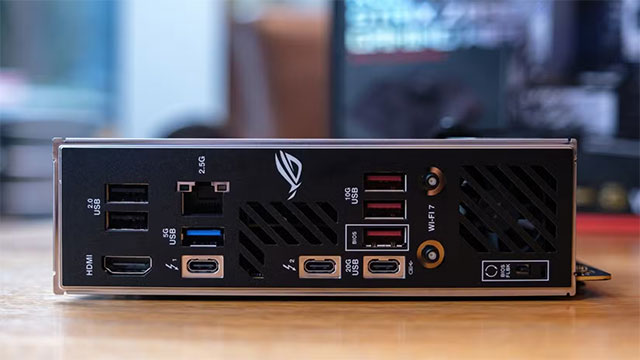
Overall, USB-A has had a commendable journey, but it's time for the "old man USB-A" to retire and make way for the "young man USB-C." Of course, eliminating USB-A immediately isn't feasible, but hardware manufacturers should offer more motherboard options that prioritize USB-C. In the long run, motherboards and even graphics cards being exclusively USB-C will lead to a unified standard.
USB-C is sometimes confusing due to its many different standards, but USB-A isn't much better, with a host of variants from 2.0 to 3.2 Gen 2x2. If USB-A can become a widespread standard despite its complexity, USB-C certainly deserves to do the same.
Not only is it faster, USB-C also supports power delivery of up to 240W over a single cable. Imagine a future desktop—thin, compact—that only needs a single USB-C dock to power and connect all peripherals. Users would no longer have to reach behind the computer case.
Fewer cables, more features, and easier to use—that's why we should seriously consider saying goodbye to USB-A and embracing a future entirely with USB-C.
Final Thoughts
Understanding usb-a is due for retirement makes it easier to evaluate the information and apply the most relevant recommendations. Focus on the key points above and verify details that may change over time.
FAQ
What is usb-a is due for retirement?
Explore usb-a is due for retirement, including the key concepts, practical examples, important considerations, and useful guidance.
What key points does this article cover?
The article explains the core concept, important considerations, and practical details readers should understand.
How can you use this information in practice?
Use the explanations to compare options, verify important details, and make a more informed decision. Apply the recommendations that best match your goals and situation.
Related Articles
 Common Pre-retirement Mistakes to Avoid Making6 minutes read
 Unexpected Discovery: Middle-aged Americans of This Generation3 minutes read
 The Basic Benefits That a Company Must Provide Their7 minutes read
 Switch in C: What to Know5 minutes read
 How Does the LAN Switch (LAN Switch) Work?7 minutes read
 What Does Astrology Say About Each Generation?9 minutes read
Reader Comments 0
Sign in with email or Google to join the discussion.