Table of Contents
Explore stop buying regular usb flash drives.
First, let's clarify one thing. Technically, all USB flash drives use NAND memory, the same type of chip found in SSDs. However, the difference lies in the speed and quality of the NAND. Most conventional USB flash drives use cheap, low-quality NAND that doesn't meet the standards for NVMe SSDs or even SATA SSDs.
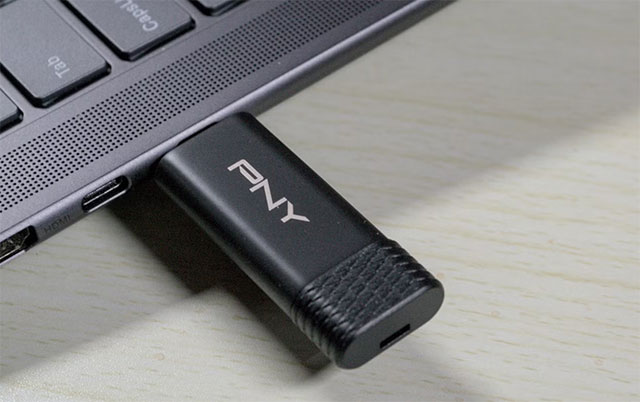
A typical USB flash drive uses low-quality NAND with a very small write cache, making it unable to maintain high speeds when copying large files, and its write durability is also very low compared to any SSD. In reality, most USB flash drives only achieve a maximum of about 150MB/s, with the highest-end models reaching 400MB/s. When writing large files of several GB or more, the speed often drops below 100MB/s due to the insufficient cache. With the cheapest NAND on the market, poor write durability is unavoidable.
This is where USB SSDs – also known as USB-based SSDs, stick SSDs, or Solid State Flash Drives (SSFDs) – demonstrate their superiority. Unlike regular USB drives, they use higher-quality NAND, allowing for data transfer speeds of up to 10Gb/s, equivalent to approximately 1,000MB/s.
Not only are USB SSDs faster, but they also maintain stable write speeds when copying large files thanks to their much larger cache memory. Some models even have DRAM cache and operate on the NVMe protocol – the foundation of today's fastest SSDs.
A prime example is the SK Hynix Tube T31. Inside its compact, USB-like body is a true M.2 NVMe SSD, complete with DRAM cache. When copying a massive 450GB file, the average write speed remained around 600MB/s, only dropping to 240MB/s after nearly 95% of the data had been written. This demonstrates its large cache memory of over 400GB – an extremely impressive figure for a device the size of a finger.
Such performance is even faster than any SATA SSD and surpasses many 10Gb/s portable SSDs, while its size is no different from a traditional USB flash drive.
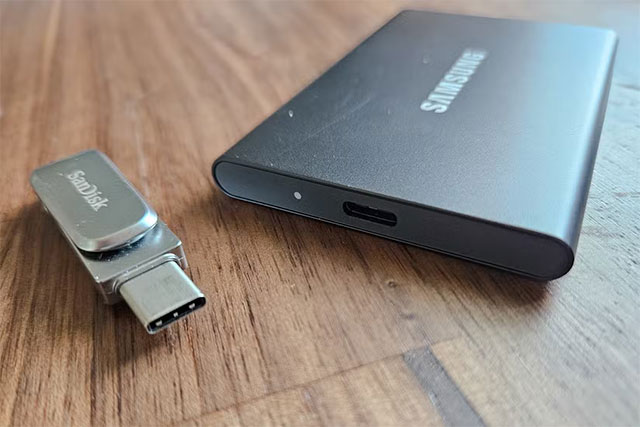
It's worth noting that USB SSDs aren't significantly more expensive than regular USB drives. Take the Transcend ESD310 USB SSD as an example; this model boasts speeds up to 10Gb/s. The 128GB version costs only $27, less than $10 more expensive than Samsung's premium BAR Plus. The 256GB version costs $40, only about $11 more than the BAR Plus of the same capacity.
The PNY PRO Elite V3 is even more accessible. The 128GB version is only about $25, while the 256GB version can be purchased for under $40.
In other words, for just a dozen extra dollars, you can get a cheap, compact 'USB' that offers near-SSD speeds, can be attached to a keychain, and copy large files in an instant.
In many cases, USB SSDs are even a more sensible option than portable SSDs. High-end USB SSD models are priced similarly to or lower than 10Gb/s portable SSDs, take up significantly less space, and offer comparable speeds when processing large files.
The TEAMGROUP X2 MAX is one example. The 1TB version costs around $101, comparable to many 10Gb/s portable SSDs. However, in return you get a device as small as a USB flash drive, but much faster and without the need for connecting cables.
So why buy a bulky, cable-equipped portable SSD when you can use a compact USB drive that offers comparable speed and is incredibly convenient to carry around?
Furthermore, the SK Hynix Tube T31 boasts DRAM cache and 10Gb/s speeds – features most portable SSDs lack – while the 512GB version costs only around $70. This is even cheaper than Samsung's USB BAR Plus 512GB, which only achieves around 400MB/s but costs $84.
With the advent of USB SSDs, traditional USB flash drives are becoming increasingly unconvincing. Even the slowest USB SSDs currently available achieve speeds of around 600MB/s, while only costing slightly more than cheaper USB drives that rarely exceed 150MB/s. The only reason to choose a regular USB drive is if you only need 64GB or less, since USB SSDs now typically start at 128GB.
While USB SSDs may need a few more years to become widespread, especially in the context of the 'RAM-pocalypse' impacting NAND storage products, it's clearly only a matter of time before traditional USB flash drives become obsolete.
Final Thoughts
Understanding stop buying regular usb flash drives makes it easier to evaluate the information and apply the most relevant recommendations. Focus on the key points above and verify details that may change over time.
FAQ
What is stop buying regular usb flash drives?
Explore stop buying regular usb flash drives.
What key points does this article cover?
The article explains the core concept, important considerations, and practical details readers should understand.
How can you use this information in practice?
Use the explanations to compare options, verify important details, and make a more informed decision. Apply the recommendations that best match your goals and situation.
Related Articles
 It's Time to Stop Buying Regular USB Drives by 2026: Explained6 minutes read
 7 Mistakes Easily 'Kill' SSDs9 minutes read
 Intel Produced SSD Drives Shaped Rulers, Wanted to Set a Record of Storage Capacity4 minutes read
 The Fastest Top 5 USB Flash You Should Buy10 minutes read
 5 Top USB Flash Drives Today: Best Options Compared6 minutes read
 Learn About Flash Memory Toolkit6 minutes read
Reader Comments 0
Sign in with email or Google to join the discussion.