Table of Contents
Mistakes are inevitable in life. In fact, humanity has witnessed some silly mistakes that changed history.
Mistakes are inevitable in life. In fact, humanity has witnessed some silly mistakes that changed history.

These men changed the world on a scale that is still felt today. They changed the fate of entire nations, starting a chain reaction that led to countless deaths, and sometimes, their mistakes led to centuries of oppression and racial hatred.
But there's a positive side to this too. Sometimes history doesn't change for the worse; it changes for the better. The important thing about mistakes is the lesson they teach, and sometimes it takes a big mistake for people to stand up, realize, and say, " Wait a minute. you can fix this. " That's the greatest inspiration you can find in human history.
Louis XVI and Marie Antoinette's Faulty Plan
The French Revolution was a bloody period in the country's past, where unrest led to the widespread use of the guillotine. King Louis XVI made his final trip there in 1793, with Marie Antoinette there a few months later, and France was changed forever.
Their deaths ushered in the Reign of Terror, which led to thousands of executions and the rise of Napoleon. But the thing is — they didn't need to die at all, and probably wouldn't have died if Louis XVI hadn't made a series of stupid decisions.
It all started when thousands of people stormed the Bastille in July 1789 to seize weapons. By October, they had captured the royals and taken them to the Tuileries Palace. But here's the thing—they weren't imprisoned. Louis and Marie Antoinette could have left at any time, but they didn't. It took them about two years to sneak out, but their escape plan was pretty unrealistic.
They rode in a large, conspicuous carriage, loaded with things like full dinner sets and wine trunks, and Louis sent away the only person who could help them: his wife's lover, Count Axel Fersen. Their ostentation made them easy targets for capture and escort back to the Tuileries Palace. Fersen then staged an escape with the help of the Swedish king, broke into the palace, and stayed with Marie for a day until Louis sent him away again. After some other twists and turns, the king was sent to the guillotine about a year later.
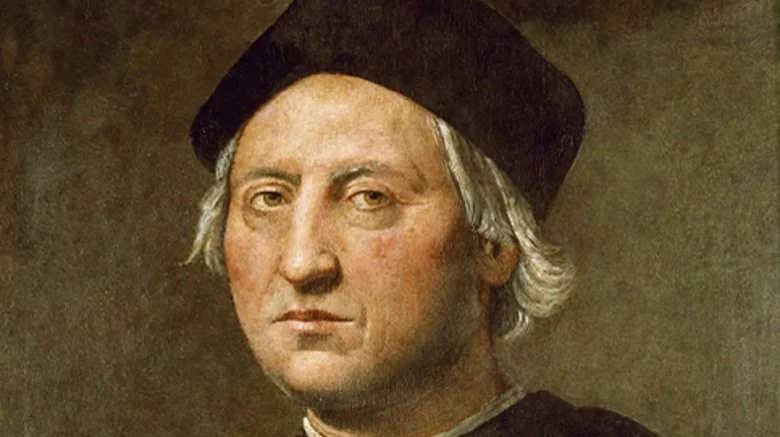
Columbus, who was bad at math, 'discovered' the New World
By now most of us know about Christopher Columbus's questionable tactics, and how his arrival in the New World began. But he only got there initially because he was bad at math and made mistakes in his navigational calculations, which inadvertently gave him a little more leverage when it came to funding his voyages.
IEEE Spectrum looked at Columbus's mathematical incompetence, starting with his calculations of latitude. While the ancient mathematician Eratosthenes set the standard that 1 degree of latitude equaled about 59.5 miles, Columbus claimed he preferred the findings of a medieval Persian geographer. Alfraganus said 1 degree equaled 56.67 miles, and that's not too far off, right?
Only, Columbus forgot that for the Persian geographer, a 'mile' was an Arabic mile, which equaled 7,091 feet. Eratosthenes was calculating a Roman mile, which equaled 4,856 feet. A huge discrepancy, and he didn't stop there. Columbus then combined the numbers and distances of explorers from Ptolemy to Marco Polo, added a bit of his own estimation, and completely messed up the location of the Indian archipelago. When he finished, his calculations had an impressive 58 percent margin of error, but they sounded good enough that he got funding and set off to 'discover' America.
Mistranslations cause problems in New Zealand
In 1840, representatives of about 125,000 Maori and about 2,000 settlers living in New Zealand signed the Treaty of Waitangi. In theory, the treaty was supposed to protect Maori rights, set rules for trade and missionary activities, and prevent foreign intrusions into the country. However, a major problem arose. When it was signed, the British signed an English version that was not entirely identical to the Maori version signed by the natives.
The treaty has three clauses, the last two of which have some major translation issues that should have been checked. At the heart of the issue is a dispute over whether the treaty gave the British government full control over Maori land. The English text says it did, but the Maori translation shows that it only allowed the British to use, not rule. This huge discrepancy led to a 19th century rife with land wars. These issues continued for decades, and despite efforts to clarify the treaty in 1975, they have persisted.
Erwin Rommel came home on the wrong day
Erwin Rommel was a fascinating figure, one of Nazi Germany's most brilliant commanders and a man the International Churchill Society has called " A thoroughly decent man ", largely because he tended to ignore many of Hitler's most dire orders. He was said to be a brilliant general and commanded a unit nicknamed the Ghost Division because it was so fast, so precise and so effective.
In the days before the Allied landings on the mainland, he went deer hunting and also went to Paris to buy shoes for his wife's birthday. After examining the tide tables and the approaching storms, he decided that the Allies would probably not attempt to cross the English Channel in such adverse conditions. Rather than stay in what would soon become the front line of the war, he returned to Germany for his wife's birthday on June 6. The LA Times reported that he was at home in Germany when he heard of the invasion a few hours earlier.

2 mistakes that caused the fall of the Berlin Wall
The fall of the Berlin Wall was one of the defining moments of the 1980s, and it only happened because of two easily avoidable mistakes. Tensions were running high, and in November 1989, members of the East Berlin Politburo decided that they needed to make concessions if they wanted to keep the peace. They took to the radio to make an announcement that they were supposed to slightly relax travel restrictions, but still reserve the right to refuse entry to anyone at any time.
That said, the press conference was a complete failure, and the content of the announcement was distorted, except for a few phrases, including "c Able for all citizens " and " Immediately, immediately ". The New York Times said people misunderstood it as freedom of movement, and the reason is understandable.
The second mistake was even crazier. As thousands of people gathered at border crossings they thought were open, Stasi officer Harald Jager called for reinforcements some 30 times in one night. When his superiors didn't believe him about the chaos they were facing—and at one point called him a " Coward ," Jager kicked open the doors, allowing people to pass through both ways, and starting the real fall of the Berlin Wall. all because his superiors made the stupid mistake of underestimating his efforts and his bravery.
FAQ
What should you know about silly mistakes that changed world history?
In practical terms, mistakes are inevitable in life. In fact, humanity has witnessed some silly mistakes that changed history.
Why does silly mistakes that changed world history matter?
The article highlights that these men changed the world on a scale that is still felt today.
What is the main takeaway?
The main takeaway is that they changed the fate of entire nations, starting a chain reaction that led to countless deaths, and sometimes, their mistakes led to centuries of oppression and racial hatred.
Related Articles
 Do Not Lose Your Job Because of Silly Mistakes7 minutes read
 Equation That Changed the World: Complete Guide11 minutes read
 Silly Mistakes When Using Laptops5 minutes read
 Chemical Reactions That Changed World History7 minutes read
 5 Silly Mistakes When Fixing Computers That Many People Still5 minutes read
 Steve Jobs Silly Mistakes17 minutes read
Reader Comments 0
Sign in with email or Google to join the discussion.