Table of Contents
The app works entirely on the device, so you don't need Wi-Fi or mobile data just to browse your photo library.
Many people assume that Google Photos is the only photo gallery app they need. It syncs across devices, backs up photos, and offers space-saving suggestions. Using it every day means relying on cloud servers and background processes that you don't have full control over. Many people don't realize how redundant these things are until they try an offline alternative.
The app works entirely on the device, so you don't need Wi-Fi or mobile data just to browse your photo library.
Many people thought Google Photos was perfect until they tried this app.
Another Google library, surprisingly
People have been using Google Photos for years, and it always seemed like the obvious choice. It backs up in the background, keeps your photo library intact across multiple devices, and makes finding old photos easy. Because it's pre-installed and does its job so well, many people never think about the other options Google offers for photos.
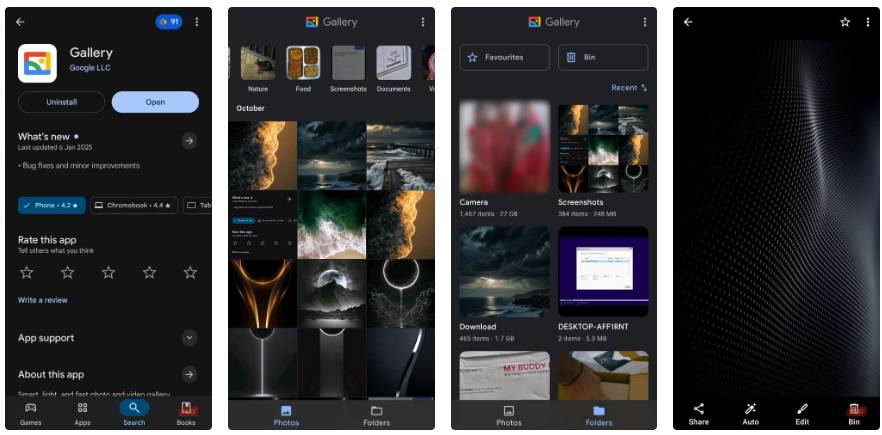
One day, while browsing the Play Store, someone came across an app called Gallery. It was listed as a Google LLC app, which was interesting because many people had never seen it on their phones. The description said it worked offline and managed photos locally without an account or syncing. Many people didn't install it to replace Google Photos, but simply wanted to understand why Google would create another photo gallery when most people already used cloud ones.
On first launch, it opens straight to your photo library, with no setup screens or backup prompts. The interface is simple and familiar. Each image is displayed in a grid, and a tab called Folders Reflects how everything is stored on the device. The menu is minimalist, with only the essentials— Settings, Bin , and Favorites —so there's nothing to distract from the photos. That impression deepens when you open the Folders Tab. Each section shows the number of photos and how much space they're taking up. On my phone, the Camera Folder contains 1,457 photos, taking up 27GB, and the Screenshots Section shows the number and size of individual photos.
Offline photo library outperforms the cloud
Faster when nothing has to be synced

The slight lag disappears once the photo library stops relying on the cloud. The photo library opens instantly, without pausing to confirm your account or check your backup status. Google Photos is also fast, but it still takes a while to reconnect, refresh thumbnails, or check if sync is enabled. This gap becomes more apparent when switching between the two apps. There are no banners asking you to re-enable backup, no space-free warnings, and no warnings about the 15GB that Google shares with Gmail and Google Drive.
The app processes photos on the device as your entire library and never asks to sync or upload anything in the background. You'll notice this even in small tasks. Deleting a cluttered folder or trimming a bunch of screenshots frees up space immediately because there's no upload queue in the background. Quick cuts or adjustments save in place and don't trigger a refresh. The app works similarly on low signal, airplane mode, or no network at all, so speeds never change when the signal changes.
With everything stored locally, privacy becomes the default.
Not everything needs cloud storage
Cloud storage is still useful for sharing, syncing across devices, and maintaining long-term backups. However, not all photo-related tasks require cloud storage. For easy browsing, freeing up space, and quick editing, an offline library is often faster and less distracting. Since it works entirely with local files, there are no storage alerts, background uploads, or upgrade prompts.
FAQ
What should you know about Google gallery?
In practical terms, the app works entirely on the device, so you don't need Wi-Fi or mobile data just to browse your photo library.
Why does Google gallery matter?
The article highlights that many people thought Google Photos was perfect until they tried this app.
What is the main takeaway?
The main takeaway is that many people didn't install it to replace Google Photos, but simply wanted to understand why Google would create another photo gallery when most people already used cloud ones.
Related Articles
 Google Launched Gallery Go, a Lighter Version of Google Photos3 minutes read
 7 Reasons Samsung Gallery Always Beats Google Photos9 minutes read
 How to Contact an Art Gallery14 minutes read
 Have You Created the Gallery Photo Gallery on Facebook?5 minutes read
 6 Things You Didn't Know You Could Do in the Samsung Gallery App6 minutes read
 Image Gallery in CSS: Image Library in CSS2 minutes read
Reader Comments 0
Sign in with email or Google to join the discussion.