Table of Contents
This updated guide answers the question 'What Is a Sinkhole? What Causes Sinkholes' with clear explanations and practical context. What is a sinkhole? What is a sinkhole? This article will give you the answer.
Beneath the surface of the earth are different layers of soil and rock. When the surface of the earth is no longer supported by anything underneath, it will cause subsidence and create sinkholes. These holes are often very deep, capable of "swallowing" everything from people, vehicles to houses.
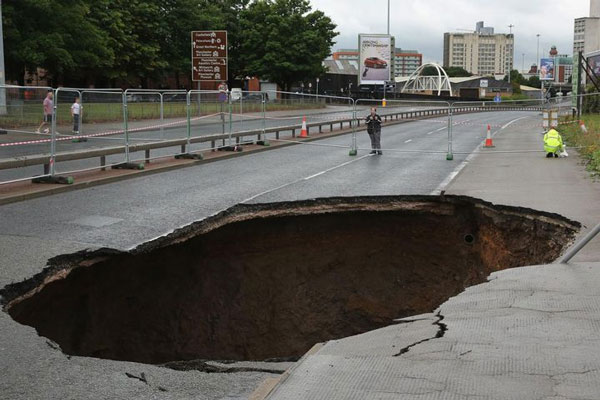
Sometimes, there may be a cavity forming under the ground surface that we are not aware of.
for instance, over time, limestone can be dissolved by water. Where the limestone once occupied, it gradually opens up, creating a space that can become a spectacular cave when large enough. But if these cavities exist too close to the surface, the top layer of land can suddenly collapse, creating a sinkhole.
Sinkholes Can Happen Anywhere.
The phenomenon of "death holes" is not uncommon in the world. It often occurs in areas with special geological structures such as soft ground; underground mines of stone, limestone or gypsum; or voids in the ground.
Erosion in the ground can take place over several years, but subsidence occurs very quickly and suddenly.
Along with natural causes, sinkholes can appear in other places and be created by human activities. for instance, sinkholes can appear in places where many coal mines have been dug and abandoned, in places affected by construction and groundwater pumping.
When encountering a sinkhole in real life, people should stay away from its edges because the edges can widen the hole.
In summary, sinkholes are mainly caused by water:
- Water dissolves minerals in rocks, leaving behind residue and voids within the rock. (This is called "weathering").
- Water washes away soil and debris from the pores in the rock.
- Lowering the water table can cause soft material in rock voids to lose their support, potentially leading to collapse.
- Changing the groundwater gradient (by removing or introducing water into the system) can cause loose material to flow out of the pores more rapidly and the surface to collapse in response.
- Any change to the hydrological system (adding water or removing water) causes the system to become at least temporarily unstable and can lead to a sinkhole.
- Sinkholes can result from seasonal changes in groundwater levels, freezing and thawing of the ground, and extreme rainfall (drought vs. heavy rain).
FAQ
What is a Sinkhole? What Causes Sinkholes?
a Sinkhole? What Causes Sinkholes refers to the concept, feature, product, or process explained in this guide. The main sections cover how it works and where it is useful.
Why is a Sinkhole? What Causes Sinkholes important?
Its value depends on the problem you are trying to solve. Understanding the benefits and limitations makes it easier to decide whether it fits your needs.
Is a Sinkhole? What Causes Sinkholes suitable for beginners?
Yes, beginners can start with the basic explanation and examples in this guide, then move to more advanced settings or techniques as their confidence grows.
Related Articles
 What Is DNS Sinkhole?9 minutes read
 The World's Strangest Landscapes: Complete Guide5 minutes read
 How to Play Pokémon GO on a Computer6 minutes read
 How to Play Pokémon GO on a Smartphone6 minutes read
 26 Types of Poké Balls Explained: Part 25 minutes read
 How to Earn and Use Stardust in Pokémon GO5 minutes read
Reader Comments 0
Sign in with email or Google to join the discussion.