Table of Contents
AI systems run in data centers filled with computing, networking, storage, and cooling equipment. Their environmental impact cannot be reduced to one fixed amount of electricity or water “per prompt.” The result changes with the model, hardware, response length, utilization, cooling design, climate, and electricity source.
Text generation, image creation, video generation, model training, and background data processing have very different demands. A useful assessment therefore states the system boundary and measurement period instead of presenting one universal number.
Where the electricity goes
Accelerators such as GPUs perform the model calculations, while CPUs, memory, storage, and network equipment move and retain data. Cooling equipment, power conversion, lighting, and other facility systems add overhead.

Data-center electricity is commonly discussed with power usage effectiveness (PUE), the ratio of total facility energy to the energy used by IT equipment. PUE helps describe facility overhead but does not show whether the computing work is efficient, useful, or powered by low-carbon electricity.
The carbon effect depends on when and where electricity is consumed. The same workload can produce different emissions on grids with different generation mixes. Renewable contracts may support new clean generation, but annual procurement totals do not necessarily mean that every hour of operation is supplied directly by carbon-free power.
Why data centers use water
Servers convert most of their electrical energy into heat. Facilities must remove that heat to keep equipment within safe operating limits.
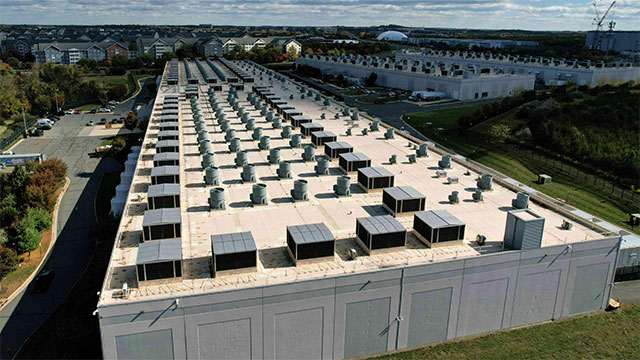
Evaporative cooling rejects heat by evaporating water. It can reduce electricity used for mechanical cooling in suitable weather, but much of the evaporated water is consumed rather than returned to the immediate watershed.
Closed-loop liquid systems recirculate coolant within the facility or equipment. They can sharply reduce on-site water consumption, but heat still has to be rejected somewhere, and the electricity supply may use water at power plants.
Air-cooled or dry systems use less on-site water but may require more energy or larger equipment, particularly in hot conditions. There is no universally best design; local water stress, climate, grid emissions, and workload density all matter.
Water withdrawal is not the same as water consumption
Withdrawal is water taken from a source, while consumption is the portion not returned to the same watershed in a readily available form. Reports may also distinguish potable water, reclaimed wastewater, and other sources.
A large annual number without these definitions can mislead. The same volume has different consequences in a water-stressed community and a region with abundant supply. Seasonal use and peak demand may matter more locally than an annual global total.
Why per-query estimates vary
A per-query estimate must allocate shared infrastructure across many users and make assumptions about utilization. It may include only electricity at the server, the whole facility, water used directly for cooling, or indirect water associated with electricity generation. Those are different measurements.
Prompt length, output length, model architecture, batching, caching, hardware generation, and media type all change the calculation. A short text response should not be compared directly with a long reasoning task or generated video.
Company estimates can be informative when the method is disclosed, but they should not be generalized to every model or provider. Likewise, an old estimate may not describe a newer data center or cooling system.
How to evaluate an environmental claim
- Check whether the figure covers training, inference, or both.
- Identify the model, task, hardware, location, and date.
- Determine whether electricity means IT energy or total facility energy.
- Distinguish water withdrawal from consumption and direct use from indirect use.
- Look for workload volume, uncertainty, and calculation method.
- Prefer measured, independently reviewable data over an unsupported comparison such as “bathtubs per query.”
Ways to reduce the impact
Operators can improve hardware utilization, use more efficient models, schedule flexible workloads when cleaner electricity is available, reuse waste heat, and select cooling appropriate to the local climate and water supply. Reclaimed water can reduce demand for drinking water when treatment and local conditions permit.
Developers can avoid unnecessary repeated generations, use smaller models for simple tasks, cache stable results, limit excessive output, and measure the energy and quality tradeoffs of their own application.
The need for transparent reporting
Communities need facility-level information about expected power demand, water source, seasonal consumption, backup generation, and infrastructure costs. Aggregate corporate sustainability reports may not reveal pressure on a particular grid or watershed.
AI's resource use is real, but a responsible discussion requires more than either alarming one-number claims or broad dismissals. Comparable definitions, local context, and independently verifiable reporting are necessary to judge the tradeoffs.
Related Articles
 2 Ways to Help Data Center Save Electricity3 minutes read
 The Wave of Opposition to AI Data Centers Is Heating up in the US -- What Are the Reasons Behind It10 minutes read
 Bring Data Centers to Space to Save Electricity4 minutes read
 Does Mini Fridge Cost Electricity? Tips for Using Mini Fridge6 minutes read
 Google and Microsoft Consume More Electricity Than an Entire3 minutes read
 Does the RO Water Purifier Use Electricity5 minutes read
Reader Comments 0
Sign in with email or Google to join the discussion.