Table of Contents
This updated guide examines How to Connect Android Wirelessly to the Projector and organizes the essential facts, background, and practical takeaways in clear American English.
To connect an Android device to a projector usually requires three things: WiFi access where you make the connection, a second hardware such as an adapter or laptop and application.
If you want to project your content on a larger screen but don't want to use a laptop computer, here are some options.
1. Chromecast
Chromecast is one of the easiest ways to transfer content on your phone screen to a projector. Chromecast and Android are both Google products, so they are easily compatible with each other.

To use this method, you need a Chromecast adapter for $ 35 (VND 805,000).
Step 1 : Turn on the projector.
Step 2 : Plug the Chromecast into the HDMI port on the projector.
Step 3 : Plug the power cord into the projector's USB port.
Step 4 : Download the Google Home app and connect your Chromecast to your phone.
Step 5 : Display your Android phone via Chromecast by clicking the cast button in the program you are using.
2. Miracast
Miracast is a media streaming device that functions similar to Chromecast. It allows you to send media files from your phone to a large screen for a more comfortable viewing experience.
To do this, both the projector and the phone must support Miracast. If only the phone supports connectivity, you will need to purchase a Miracast receiver. Many different manufacturers sell these receivers for around $ 40 (VND 920,000).

To establish a Miracast connection using an adapter:
Step 1 : Turn on the projector.
Step 2 : Plug the Miracast adapter into the HDMI port on the projector and the power cord into the projector's USB port.
Step 3 : Connect your Android device to Miracast by clicking the cast button in the program you are using.
3. Manufacturer's equipment
The projector may be able to connect to phones built into the manufacturer, making it a smart projector.
Look up the projector model number online to determine if your projector has this capability. If so, you should be able to specify specific instructions for connecting your phone to the projector.
4. ApowerMirror
Using an application like ApowerMirror is not technically a wireless option. Exactly this method is called wireless selling.
Call it wireless, because the projector and laptop are still connected with a cable like VGA or HDMI, but you're not tied to using a computer to control the presentation. You can still move with your phone.
This screen projection application has a number of useful features including full screen view, recording screen activity, screen capture and the ability to draw or write on the screen as a whiteboard (whiteboard). Recently, the manufacturer also launched a PowerPoint remote control device.
Here's how to use ApowerMirror to project an Android screen on a big screen.
Step 1 : Install the projector, attach the computer to the projector by a wired connection.
Step 2 : Install the ApowerMirror app on the desktop. When you click Download, the file will download directly without showing another page.
Step 3 : Download the app to an Android device.
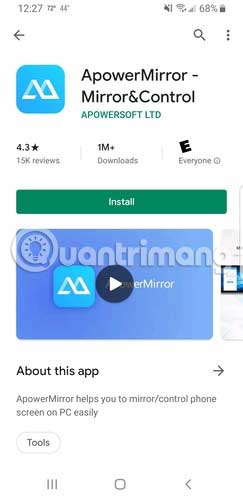
Step 4 : Connect your computer and phone to the same WiFi network.
Step 5 : Launch the application on the PC and on the phone.
Step 6 : Project the computer screen to your phone and you can control your computer from your mobile device. It will look like this on your phone.
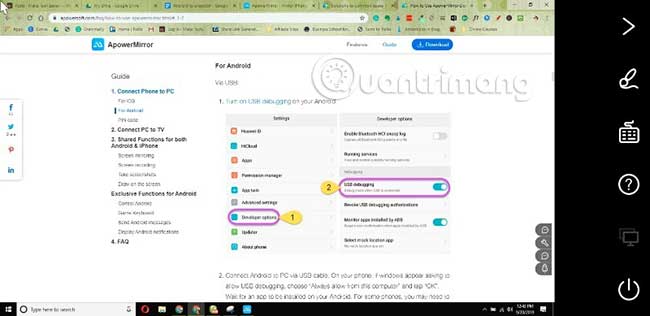
To use this program, you need a free account. There is an upgrade available if you find it useful and want more features.
You can use any of the methods listed above to wirelessly connect Android phones and projectors. This makes it easier to present your content on the big screen.
Wish you choose a suitable choice!
FAQ
What is How to Connect Android Wirelessly to the Projector about?
It provides a structured overview of Android, explains the main context, and highlights practical takeaways for readers.
Why does this topic matter?
Understanding the main concepts helps readers evaluate the issue, avoid common mistakes, and make better-informed decisions.
How should readers use this information?
Use the guidance as a practical starting point, confirm details that may have changed, and follow current product, safety, or security recommendations.
Related Articles
 How to Connect the Projector to a Computer, Laptop7 minutes read
 How to Connect a Phone to a Projector7 minutes read
 5 Popular Wireless Projectors to Connect to Laptops, Phones5 minutes read
 How to Connect a Mac to a Projector4 minutes read
 How to Connect a Tablet to a Projector6 minutes read
 Instructions for Connecting a Computer to a Projector9 minutes read
Reader Comments 0
Sign in with email or Google to join the discussion.