Table of Contents
Explore greenland's largest glaciers are melting at an incredible rate.
Scientists have long maintained that the primary cause of rising sea levels is melting ice and the expansion of oceans as the Earth warms. However, in just the last two decades, the rate of melting of these massive glaciers has been deteriorating extremely rapidly, exceeding even the worst estimates ever made.
To provide the most accurate statistics on this issue, a group of international scientists from Denmark and the UK collected and analyzed a range of research data obtained from the late 19th century to the present day to estimate the amount of ice that has melted from Greenland's largest glaciers, including Jakobshavn Isbrae, Kangerlussuaq Glacier, and Helheim.
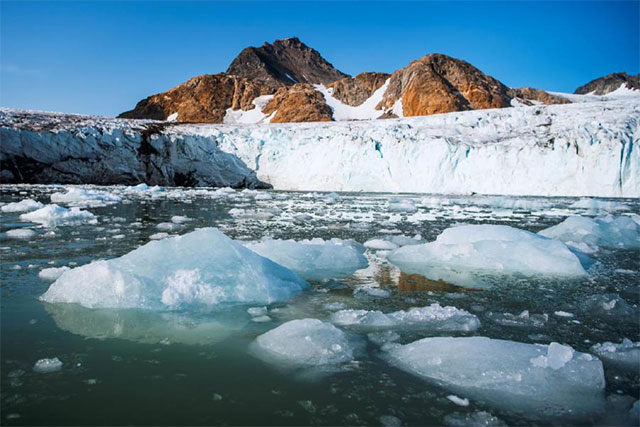
The research team found that the Jakobshavn Isbrae glacier dumped more than 1.5 trillion tons of ice into the Atlantic Ocean between 1880 and 2012, while Kangerlussuaq and Helheim lost 1.4 trillion and 31 billion tons of ice, respectively, during the same period. Thus, the ice melt from these three glaciers alone contributed more than 8mm to global sea level rise over the past 100 years.
According to scientists' predictions, if the current rate of global warming continues, by 2100, Jakobshavn Isbrae, Kangerlussuaq Glacier, and Helheim will continue to contribute an additional 9.1–14.9 mm to the rise in global sea level, which is significantly more than the rate of melting over the past century.
On a broader scale, the UN's Intergovernmental Panel on Climate Change (IPCC) has predicted that global sea level rise from all sources by 2100 will be between 30-110cm, depending on human-induced emissions, equivalent to the Earth warming by 3 degrees Celsius compared to pre-industrial levels.
"The worst-case scenario needs to be reassessed. The amount of ice lost could be three to four times greater than previously predicted for the glaciers considered in our study alone," said Dr. Shfaqat Abbas Khan from the Technical University of Denmark, the lead author of the research.
Previously, a study published in the journal Nature in September showed that if greenhouse gas emissions continue unabated, approximately 36 trillion tons of Greenland's ice will melt into the sea this century, enough to raise global sea levels by about 10cm.
Melting ice due to climate change is the main cause of rising sea levels, threatening the lives of coastal communities and especially wildlife that depend on ice, such as polar bears, penguins, and seals. In the future, the world will need to drastically reduce greenhouse gas emissions to mitigate the impacts of climate change and prevent ice melt. However, reality has shown that this is no easy task.
Final Thoughts
Understanding greenland's largest glaciers are melting at an incredible rate makes it easier to evaluate the information and apply the most relevant recommendations. Focus on the key points above and verify details that may change over time.
FAQ
What is greenland's largest glaciers are melting at an incredible rate?
Explore greenland's largest glaciers are melting at an incredible rate.
What key points does this article cover?
The article explains the core concept, important considerations, and practical details readers should understand.
How can you use this information in practice?
Use the explanations to compare options, verify important details, and make a more informed decision. Apply the recommendations that best match your goals and situation.
Related Articles
 Temperature Rises, Melting Glaciers Can Release Dangerous Viruses2 minutes read
 Glaciers Are Eroding the Earth Faster Than We Thought4 minutes read
 Warm Sea Currents Beneath the Arctic Ice Are 'Melting' the Thick4 minutes read
 Greenland Is Losing Ice in a New Way, NASA Warns4 minutes read
 Defeating the Blue Whale, This 37m-long Dinosaur Is the World's Largest Creature4 minutes read
 7 Best Heart Rate Monitor Apps in 20209 minutes read
Reader Comments 0
Sign in with email or Google to join the discussion.