Table of Contents
Explore the arctic hasn't been this warm in over 3 million years.
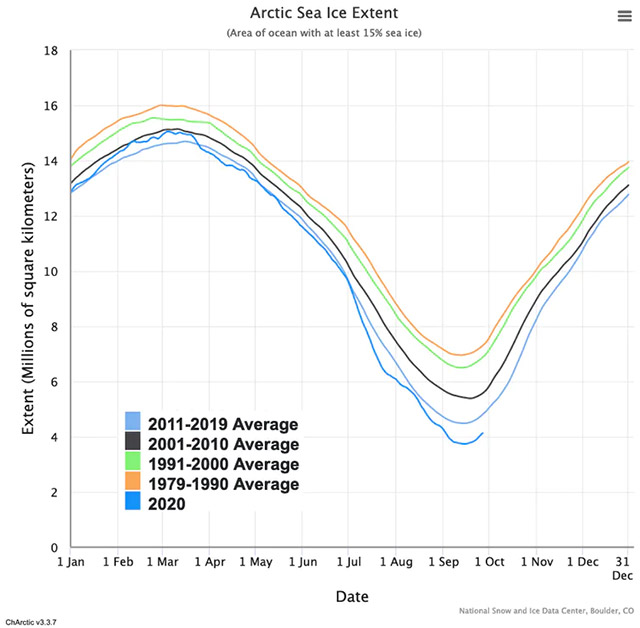
As the Intergovernmental Panel on Climate Change has pointed out, the concentration of CO2 in the Earth's atmosphere is currently at its highest level in human history – approximately 412 parts per million. Such a high concentration of CO2 in the atmosphere is thought to have only appeared as recently as 3 million years ago, during the Pliocene epoch.
Based on geological knowledge studying the evolution of Earth's climate and how it creates the conditions necessary for life, scientists believe that climate anomalies in the Arctic are a clear indication that climate change has been, is, and will continue to drastically alter our planet at an alarming rate. If global greenhouse gas emissions continue to rise, meaning that CO2 concentrations in the atmosphere become increasingly denser, the civilized world as we know it today could be dragged back to the Pliocene epoch 3 million years ago, with typical characteristics including higher sea levels, extremely unstable weather, frequent natural disasters, and ultimately leading to negative changes in the state of both the natural world and human societies.
What is causing the concentration of CO2 in the Earth's atmosphere to increase so rapidly?
In fact, natural processes throughout Earth's tectonic history have released significant amounts of CO2 into the atmosphere. However, other processes consume this CO2 to maintain the necessary balance for the planet, thereby stabilizing Earth's climate.
The primary system responsible for maintaining this balance is a natural global thermostat, regulated by rocks capable of chemically reacting with CO2 and dissipating it from the atmosphere.
Within the soil, certain types of rocks are constantly reacting and absorbing CO2, breaking it down into other materials. These reactions tend to accelerate with higher temperatures and greater rainfall. This is precisely the climatic condition that occurs when the concentration of greenhouse gases in the atmosphere increases.
Specifically, this natural temperature regulation system also possesses its own regulatory mechanism. When CO2 levels rise , temperatures increase, and rock weathering accelerates, more CO2 from the atmosphere is absorbed. If CO2 levels begin to decrease, temperatures cool down, and rock weathering slows down globally, the amount of CO2 absorbed will decrease again.
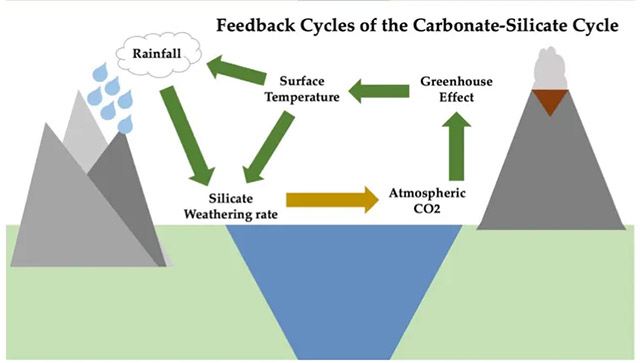
Rock weathering reactions are also more intense in areas with many exposed mineral surfaces. Examples include areas with high erosion rates or during periods when Earth's tectonic activity pushed rocks upwards, creating massive mountain ranges with steep slopes.
From a geological perspective, this temperature stabilizer operates quite slowly. For example, at the end of the Dinosaur Era, about 65 million years ago, scientists estimate that atmospheric CO2 concentrations were between 2,000 and 4,000 parts per million. It took over 50 million years for them to naturally decrease to around 400 parts per million during the Pliocene epoch.
Because natural changes in CO2 levels occur very slowly, so too do cyclical changes in Earth's climate system. Ecosystems have had millions of years to adapt, adjust, and respond harmoniously to climate change.
However, things only became abnormal when something called 'human civilization' emerged. Modern human activities produce such enormous amounts of CO2 that nature's absorption capacity cannot keep up, and this imbalance is an inevitable consequence. At the dawn of the Industrial Age in 1750, the amount of CO2 in the Earth's atmosphere was approximately 280 parts per million. And it only took humans 200 years to bring the Earth back to a level of CO2 density unprecedented in millions of years.
Returning to the issue of the Arctic, sea ice coverage in the Arctic Ocean during the summer is trending downwards. Scientists predict that the Arctic will be completely ice-free in the summer within the next two decades, which is clearly shocking news for many.
However, that's not the only evidence that the Arctic is warming. The alarming rate of ice melt in Greenland this summer is concerning. In early August, Canada's last remaining ice shelf, in Nunavut, collapsed into the sea. Numerous areas of the Siberian Arctic and Svalbard, a Norwegian island group in the Arctic Ocean, also reached record high temperatures this summer.
- The Earth has just recorded its hottest January on record.
Final Thoughts
Understanding the arctic hasn't been this warm in over 3 million years makes it easier to evaluate the information and apply the most relevant recommendations. Focus on the key points above and verify details that may change over time.
FAQ
What is the arctic hasn't been this warm in over 3 million years?
Explore the arctic hasn't been this warm in over 3 million years.
What key points does this article cover?
The article focuses on What is causing the concentration of CO2 in the Earth's atmosphere to increase so rapidly?, with practical explanations and examples.
How can you use this information in practice?
Use the explanations to compare options, verify important details, and make a more informed decision. Apply the recommendations that best match your goals and situation.
Related Articles
 Facts About Arctic Foxes You May Not Know4 minutes read
 Mini Ozone Hole Opens Over Arctic and, Yes, That's Kinda3 minutes read
 Top 9 Food to Keep Your Body Warm in Winter6 minutes read
 Tooth Turtles Can Last More Than 100 Million Years Ago4 minutes read
 Warm Sea Currents Beneath the Arctic Ice Are 'Melting' the Thick4 minutes read
 Is It Still Warm to Wear in Winter: Wear Warm Winter4 minutes read
Reader Comments 0
Sign in with email or Google to join the discussion.