Table of Contents
This updated guide explores Google is slowly losing the elements that once made them beloved with practical details, clear explanations, and useful takeaways. For many of us, Google was the gateway to the exciting world of the Internet. A clean, uncluttered homepage—an oasis in the chaos of the late 90s web. It was simplicity, efficiency, and elegance that made Google so popular.
The Golden Age of Google Search
Google's big breakthrough was the PageRank algorithm. Unlike other search engines of the time (which only counted the number of times a keyword appeared – which led to spammy results), PageRank measured the authority of a website based on the number and quality of links from other sites.
Not only is Google smart in its algorithms, it is extremely simple in its interface. While its competitors cram news and ads onto their homepages, Google only has its logo and a search bar. In the days of 'low-life' dial-up, this page loaded lightning fast – an advantage that made users 'fall in love'.
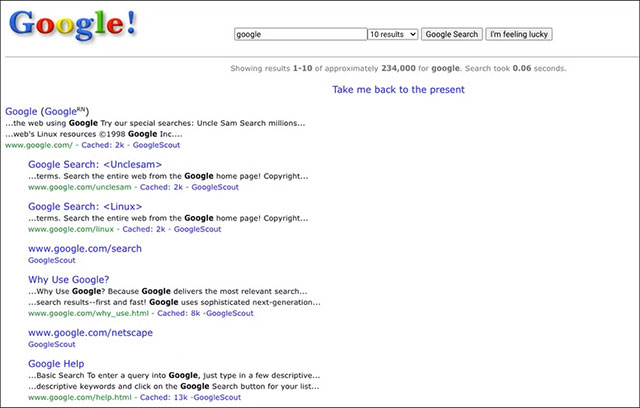
Google once rejected the ad-based search model. They still keep simple text ads. It is the combination of accurate results + smooth experience that has made Google the king. You can see that Google values these values:
- The "I'm Feeling Lucky" button goes straight to the first result – full of confidence in the algorithm
- Showing the number of results and search time as confirmation: "I help you find what you need – as fast as possible!"
Google Search Is Gradually 'losing Its Ego'
You've probably noticed that Google Search has changed dramatically. The results page is no longer the minimalist paradise it once was, but is now stuffed with ads, extra features that many people do not use, and a ton of links that make your scrolling tiresome.
In the past, Google wanted to get you quickly away from the search results page to the information you needed. Now, Google wants to lock you into its ecosystem.
This change was most evident at Google I/O 2025. CEO Sundar Pichai boasted: "Users are now searching more per session and typing longer queries!" He called it "progress". But think about it: This is a 'betrayal' of the foundational philosophy that Google was built on.
Since you cannot find what you're looking for on the first try, you have to fumble through the maze of results, trying to rephrase your question to suit the algorithm. So, innovation sometimes leads to frustration.
What About AI?
Google will justify: "AI Overviews prove we want you to get information quickly!". it is true that reading AI is faster than clicking links, but the accuracy is questionable. More importantly: AI is the solution to a problem that Google created. Still, the reality is different.
Google now generates answers instead of sending you to sources. Even with good AI, it is scary when a company controls information. We're asking Google for everything.
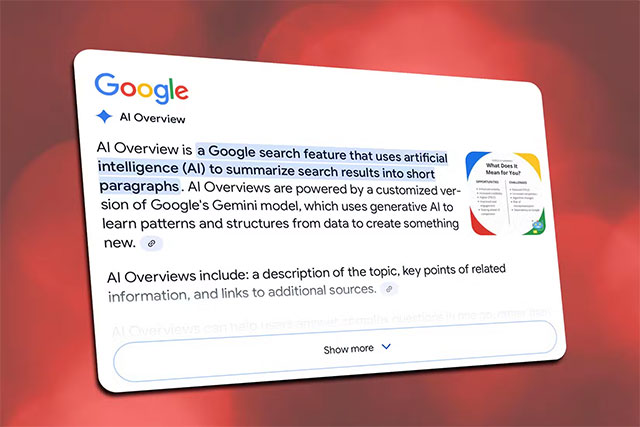
A company that revolutionized access to information with its speed, simplicity, and ease now deliberately prolongs the experience. The once efficient lighthouse is now a game of stalling – keeping you trapped in its ecosystem, whether you want it or not.
FAQ
What is the main takeaway about Google Is Slowly Losing the Elements That Once Made Them Beloved?
The key is to understand the core idea, compare the available options, and apply the practical guidance that matches your situation.
What should beginners know about Google Is Slowly Losing the Elements That Once Made Them Beloved?
Start with the essential steps and terminology. Avoid changing advanced settings until you understand how they affect performance, privacy, cost, or compatibility.
How can I use this information in practice?
Follow the relevant section in order, test one change at a time, and confirm the result before moving to the next step or recommendation.
Related Articles
 Google Wants to Monopolize Android?4 minutes read
 Google Confirmed That the Virus Scanning Feature Caused Chrome to Start Slowly and Provide3 minutes read
 Elements of the Form in HTML: A Practical Guide3 minutes read
 Devices Announced by Google at the Made by Google 2024 Event: What You Need to Know9 minutes read
 How to Logout and Logout Google Accounts Remotely to Avoid3 minutes read
 How to Restore Old Version of Google Sheets Without Losing Data3 minutes read
Reader Comments 0
Sign in with email or Google to join the discussion.