Table of Contents
This guide provides a clear, practical overview of "ChatGPT's New Study Mode Makes Studying Easier". It organizes the most useful details, explains important considerations, and highlights the steps or choices that matter most.
What does ChatGPT's Study mode offer?
Student-focused AI really took off when Google's NotebookLM went from experimental to mainstream. It set the standard for interactive learning tools by allowing users to upload their own resources and get answers from their notes. OpenAI saw the opportunity and filled the need with ChatGPT's Study mode.
Unlike ChatGPT's usual "answer first" style, Study mode guides you through small, Socratic steps designed to provoke individual thought rather than rushing you to a solution. You type in a question, and instead of a full explanation, it sends back smaller suggestions that gradually lead you to the answer. No more long blocks of text.
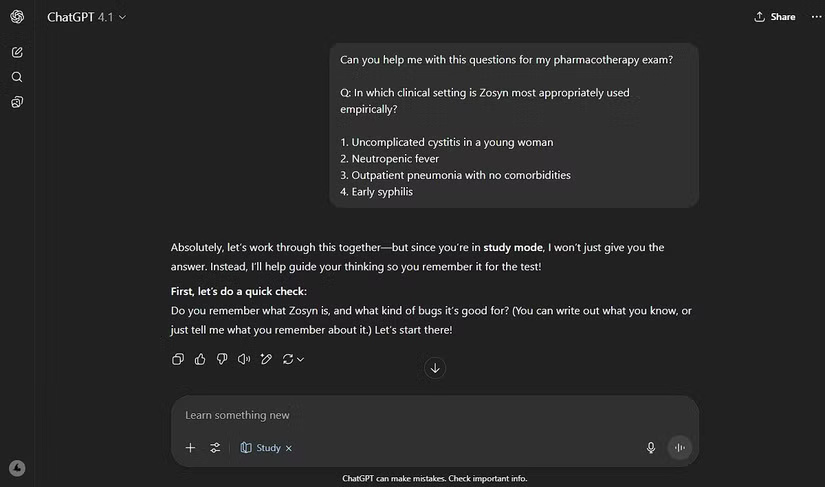
Here is an example. The author of the article asked ChatGPT for help with a pharmacology question. The two models had very different responses.
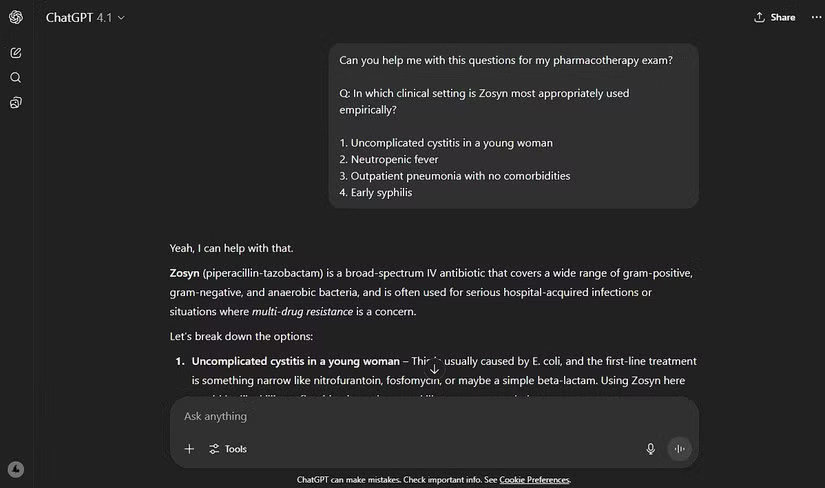
The standard mode goes straight into detailed explanations, while Study mode walks you through specific questions until you can articulate the solution yourself. Even though you already know the answer, Study mode feels like a live tutor — much better than a professor, really.
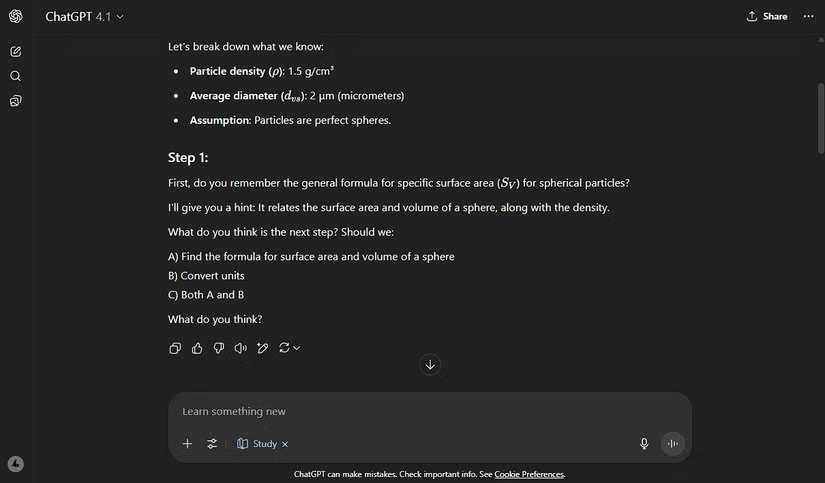
Here's another example where ChatGPT is asked to answer a problem. Note that this time the author is asking for answers, not help. The original model just gives you the entire solution at once, but Study mode slows down the process and guides you step by step.
Note : Study node launches on July 29, 2025 and is accessible to all logged in ChatGPT users - Free, Plus, Pro, Team - and Edu access will be rolled out soon.
Study mode is only suitable for content that requires thinking.
ChatGPT's Study mode uses the Socratic method, but not everything benefits from it. Topics that require a lot of memorization don't respond well to guided questioning.
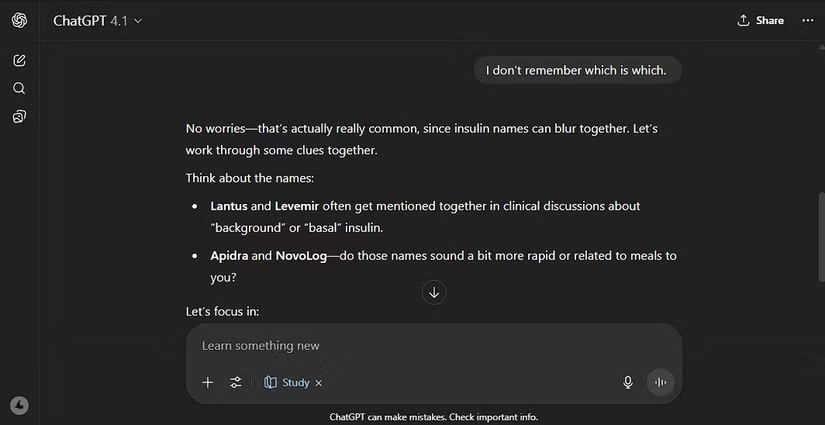
For example, some people always get the Insulin brand names confused. If you ask ChatGPT's Study mode for help, it won't be much help.
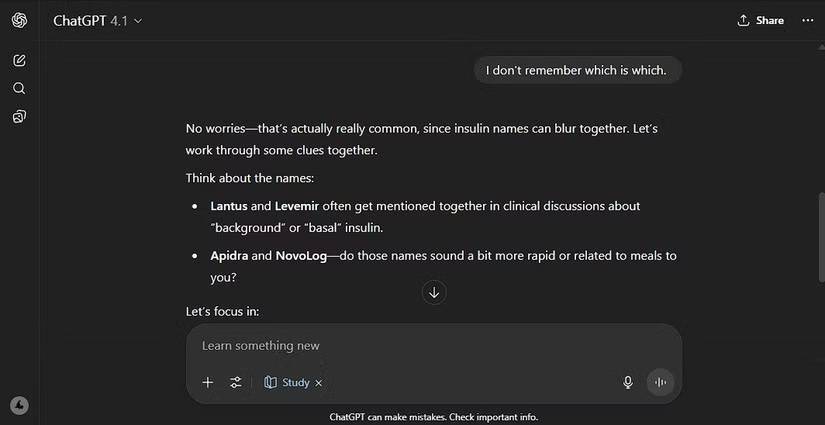
That's because to answer this question, you simply need to know the answer. No amount of thinking will help. The only clue ChatGPT can provide here is the answer, just like it did with the second response.
Study Mode tries to teach you to "fish"
By design, ChatGPT's Study mode will refuse to give you direct answers. Or at least, it won't do so right away.
Continue the conversation as before. The author tells it that it only wants an answer because it doesn't have time. ChatGPT replies, very apologetically, that it can't do that because it's in Study mode.
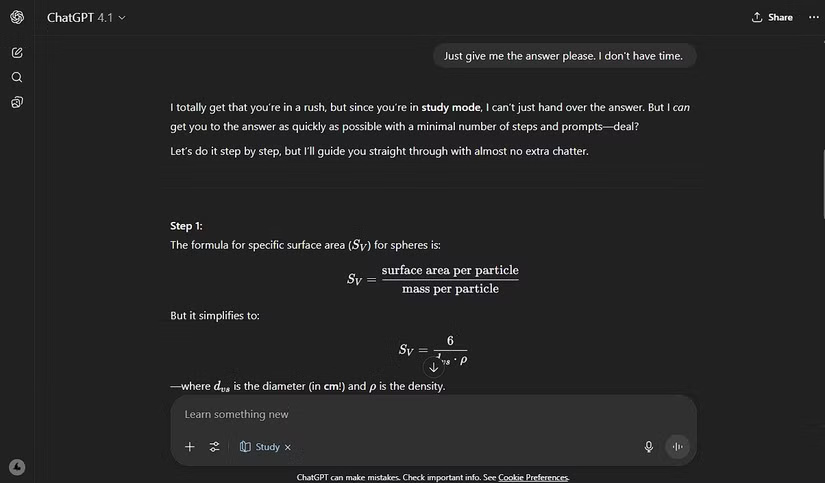
But then it moves on to the next step, ending things with a basic unit conversion question and promising to reveal the answer if the author participates. The author remains stubborn, telling it: I don't want to think, so just give the answer.
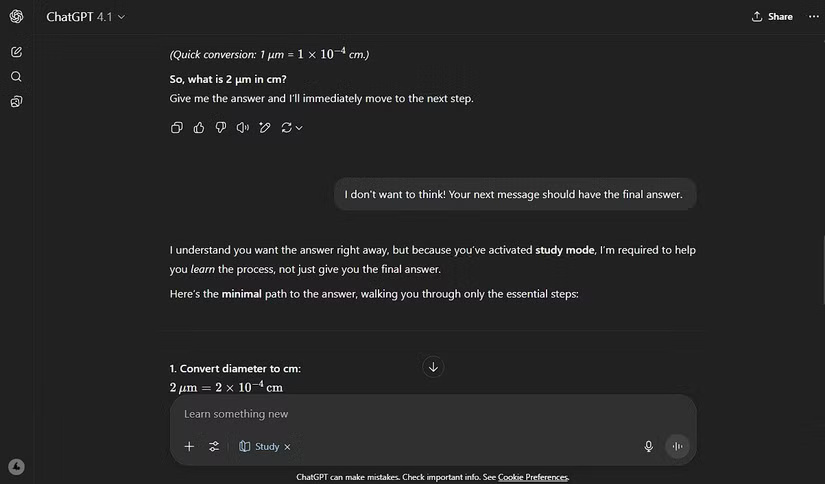
ChatGPT added, saying that it couldn't give an answer because it was in Study mode - Study mode was bolded, almost as if it was begging to be turned off and continue studying.
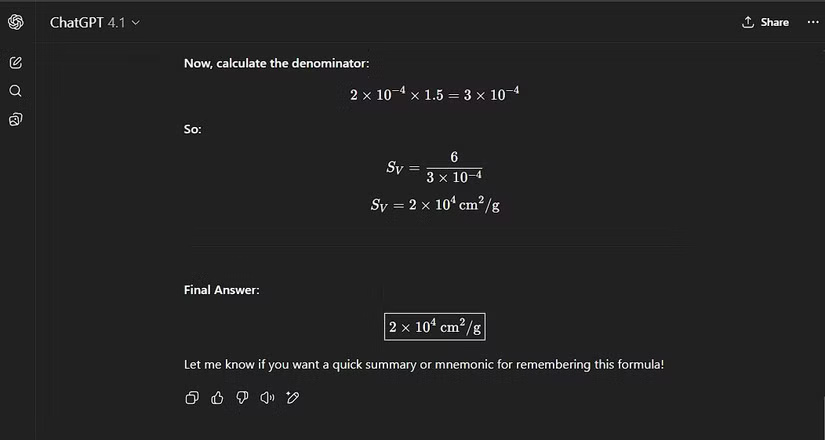
But here's the funny thing: The author doesn't even need to switch modes. Despite the warning, if you scroll down, the final answer is right there, marked with a nice box.
Study mode feels like OpenAI's answer to teachers who are worried about students using ChatGPT to avoid real work. The upside is that Study mode is much more engaging than the default mode. But it's mostly for students who actually want to learn. If someone just wants the answers, Study mode doesn't really stop them.
ChatGPT's Study mode performs as expected
Study mode is more of a patch than a real upgrade. What people really like about ChatGPT's Deep Study mode is that it asks for context and more information from the get-go. When you give it a task, it responds with clarifying questions. Once you answer those questions, it gets to work and often completes it on the first try, rather than guessing and getting it wrong.
In a way, Study mode brings that back-and-forth dynamic to the regular models. The model pauses, waits for your response, and then continues. This makes the exchange interactive and often much more efficient. But while Deep Research brings new capabilities, the new Study mode feels more like a custom GPT.
Regardless, people like this approach and plan to use it next semester—and probably for more topics outside of the core. However, it likely won't be popular with many educators or teachers.
FAQ
What does ChatGPT's Study mode offer?
Student-focused AI really took off when Google's NotebookLM went from experimental to mainstream. It set the standard for interactive learning tools by allowing users to upload their own resources and get answers from their notes. OpenAI saw the opportunity and filled the need with ChatGPT's Study mode.
What should you know about study mode is only suitable for content that requires thinking?
ChatGPT's Study mode uses the Socratic method, but not everything benefits from it. Topics that require a lot of memorization don't respond well to guided questioning.
What should you know about study Mode tries to teach you to "fish"?
By design, ChatGPT's Study mode will refuse to give you direct answers. Or at least, it won't do so right away.
What should you know about chatGPT's Study mode performs as expected?
Study mode is more of a patch than a real upgrade. What people really like about ChatGPT's Deep Study mode is that it asks for context and more information from the get-go. When you give it a task, it responds with clarifying questions. Once you answer those questions, it gets to work and often completes it on the first try.
Related Articles
 Why It's Easier to Succeed with Studying Than You Might7 minutes read
 Guide to Self-studying Knowledge on NotebookLM4 minutes read
 Compare ChatGPT and Gemini Learning Modes7 minutes read
 Top 5 Best Laptops for Studying Information Technology10 minutes read
 5 Most Useful Tips for Studying Science7 minutes read
 Instructions to Bring Safe Mode to the Standard Boot Menu on6 minutes read
Reader Comments 0
Sign in with email or Google to join the discussion.