Table of Contents
Discover why Google AI studio's generative media is a game-changer for marketers by 2025 and explore the main causes.
By 2025, for marketers, it will be more than just a tool; it will be a strategic imperative. Here's why!
What is Google AI Studio's Generative Media?
At its core, Google AI Studio allows developers and, increasingly, marketers to leverage advanced Generative AI models (like Gemini ) to create a wide range of media. Imagine an intelligent assistant that, following your precise instructions, can create:
- Customized ad copy & headlines : From short, concise taglines to long descriptions.
- Diverse visual content : From product mockups to lifestyle images, or even variations of existing graphics, based on your brand guidelines and desired aesthetic.
- Dynamic videos and animations : Short content perfect for social media or advertising campaigns.
- Personalized audio narration : Voice-over for ads, podcasts, or accessibility features.
The key here is not just innovation, but intelligent, context-aware innovation at unprecedented scale and speed.
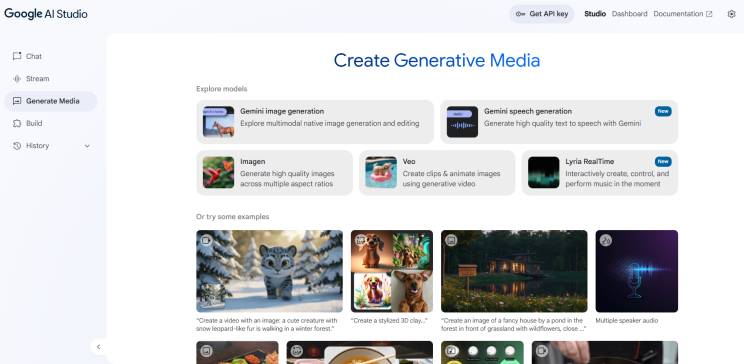
Game-Changing Impact for Marketers in 2025
By 2025, marketers will leverage Google AI Studio not as a novelty, but as an integral part of their workflow, realizing significant advantages:
1. Hyper-personalization at scale
The dream of truly one-on-one marketing has long been hampered by the sheer volume of content that needs to be created. Generative Media removes this barrier.
For example, imagine a retail brand instantly creating 100 unique email subject lines and accompanying banner ads, each optimized for the past browsing behavior of a specific customer segment, all in just minutes. This level of granular personalization dramatically boosts engagement and conversion rates, far beyond broad segmentation.
2. Unleash creative speed
Content production bottlenecks often slow down campaign launches and A/B testing. Artificial intelligence (AI) will dramatically speed up this process.
For example, with just a few suggestions, a social media manager can create five different image concepts and corresponding captions for a new product launch across Instagram, TikTok, and LinkedIn. Instead of waiting days to design and write ads, they can test which concept resonates most almost immediately, allowing for rapid iteration and optimization of real-time campaigns.
3. Unprecedented performance optimization
In addition to being creative, generative AI can be integrated with analytics to learn and improve, resulting in superior optimization capabilities.
For example, for a B2B lead generation campaign, marketers might create dozens of variations of a landing page headline or call-to-action button. AI can then analyze performance data (clicks, conversions) from initial tests and automatically create even more effective variations, dramatically improving conversion rates without the need for time-consuming manual adjustments. This turns A/B testing into A/Z testing.
4. Global reach with local flair
Expanding into new markets traditionally requires significant investment in localization – not just translation, but also culturally appropriate image and messaging. Generative Media makes this easy.
For example, a global e-commerce brand can instantly localize all product catalog descriptions and promotional images for dozens of languages and cultural nuances. AI can create culturally relevant contexts, rich models, and localized text, maintaining brand consistency while achieving local relevance at scale, significantly reducing costs and time to market.
The human factor is still paramount
It's important to understand that this isn't meant to replace human creativity or strategic thinking. Instead, Google AI Studio's Generative Media capabilities complement them. Marketers will shift from individual asset creators to strategic orchestrators, agile engineers, and ethical guardians. Human oversight, strategic direction, and a deep understanding of brand voice and target audience will remain critical to success.
By 2025, marketers who embrace and master these tools will be the ones driving unprecedented efficiency, personalization, and ultimately superior campaign performance. Are you ready to explore how these tools can transform your marketing efforts?
Final Thoughts
Understanding why google ai studio's generative media is a game-changer for marketers by 2025 makes it easier to evaluate the information and apply the most relevant recommendations. Focus on the key points above and verify details that may change over time.
FAQ
What is why google ai studio's generative media is a game-changer for marketers by 2025?
Discover why Google AI studio's generative media is a game-changer for marketers by 2025 and explore the main causes.
What key points does this article cover?
The article focuses on What is Google AI Studio's Generative Media?, Game-Changing Impact for Marketers in 2025, 1. Hyper-personalization at scale, with practical explanations and examples.
How can you use this information in practice?
Use the explanations to compare options, verify important details, and make a more informed decision. Apply the recommendations that best match your goals and situation.
Related Articles
 What Is Generative AI?9 minutes read
 5 Ways Generative AI Is Ruining Social Networks: What You Need to Know8 minutes read
 TOP Generative AI Tools and Applications by Field10 minutes read
 5 Security Risks of Generative AI and How to Prepare to Address Them11 minutes read
 Why Is the New Arduino Uno R4 a Game Changer for Manufacturers?7 minutes read
 Review the Strange and Confusing Game Ads in History3 minutes read
Reader Comments 0
Sign in with email or Google to join the discussion.