Table of Contents
Two new studies by Professor Stefano Profumo, University of California (Santa Cruz), have proposed unprecedented hypotheses for how dark matter might form. Dark matter is currently one of the biggest mysteries of science: it accounts for about 80% of all matter in the universe, keeps galaxies from falling apart and directly affects the way they rotate. Observations of the large-scale structure of the universe as well as the cosmic microwave background radiation have both shown its existence. But until now, scientists have not known what particle dark matter is or how it came into existence.
'Mirror world' and dark baryons
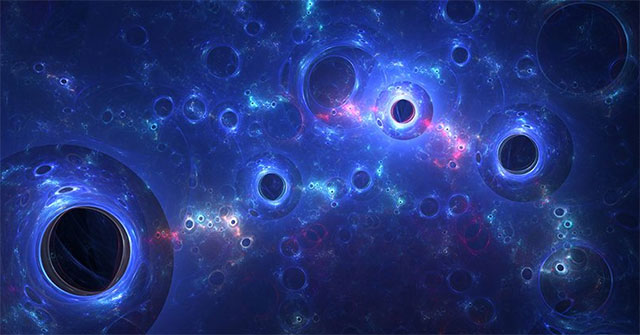
In a paper published on July 8, Profumo focuses on the concept of a 'hidden sector' – a kind of 'mirror version' of our universe, with its own particles and forces, obeying the same physical laws but completely invisible to humans. The idea is based on quantum chromodynamics (QCD) – the theory that explains how quarks bind together into protons and neutrons using the strong nuclear force. In the hidden sector, there could exist a 'dark QCD' with dark quarks and dark gluons, forming heavy particles called dark baryons .
Theoretical models show that under certain conditions (quark mass ratio, temperature of the dark region, color number N…), dark baryons can collapse into ultralight black holes, with masses of only a few hundred times the Planck mass. If these remnants are stable, they could serve as candidates for dark matter. The study also puts a limit of N ≤ 100 on scenarios where these particles make up all of the dark matter.
Dark matter from the 'cosmic horizon'
In another paper published in May, Profumo asked whether dark matter could have formed at the very edge of the universe – the 'cosmic horizon' – during the brief period of accelerated expansion after inflation.
According to this model, the expansion, while not as extreme as inflation, is still faster than radiation or ordinary matter could cause. The cosmic horizon then has a temperature that is inversely proportional to its size, creating conditions for the formation of stable particles. Depending on the equation of state (between pressure and energy density) and the temperature at which this phase ends, the mass of dark matter produced can range from 10 keV to near the Planck level.
' Both mechanisms are highly speculative, but they open up closed computational scenarios that do not rely on traditional dark matter particle models – which have increasingly been hampered by poor experimental results ,' Professor Profumo said.
Final Thoughts
The development covered in this article is worth following, but specifications, dates, and feature details may change until the relevant company or organization publishes an official confirmation.
FAQ
What is the main development covered in this article?
Two new studies by Professor Stefano Profumo, University of California (Santa Cruz), have proposed unprecedented hypotheses for how dark matter might form.
What should you know about 'Mirror world' and dark baryons?
In a paper published on July 8, Profumo focuses on the concept of a 'hidden sector' – a kind of 'mirror version' of our universe, with its own particles and forces, obeying the same physical laws but completely invisible to humans.
Is every reported detail officially confirmed?
Not necessarily. Product leaks, preview builds, research reports, and early announcements can change. Confirm important specifications, dates, and availability through an official source before making a decision.
Related Articles
 Scientists Have Finally Discovered the Mystery of Dark Matter in4 minutes read
 Dark Matter, Dark Energy and Unexplored Mysteries1 minutes read
 After All the Mysterious Material That Occupies More Than Half4 minutes read
 Dark Energy: New Discovery Turns Our Understanding of the Universe into Over5 minutes read
 Elements of the Universe3 minutes read
 Astronomers Create the Most Accurate Map of All Matter in the Universe3 minutes read
Reader Comments 0
Sign in with email or Google to join the discussion.