Table of Contents
Explore a 'ghost galaxy' has been discovered 300 million light-years from earth.
Most galaxies in the universe glow brightly with billions of stars. However, there exists a rare group that is almost 'invisible' due to its extremely low surface luminosity. These galaxies contain very few stars, and the majority of their mass is dark matter, making them incredibly difficult to detect.
One of the most remarkable examples recently recorded is CDG-2. This may be one of the most heavily dark matter-dominated galaxies ever identified. (Dark matter is an invisible form of matter that neither reflects, emits, nor absorbs light.) This discovery was published in The Astrophysical Journal Letters.
Find galaxies through globular clusters
Because they emit very little light, these types of galaxies are almost impossible to observe directly. Researcher David Li from the University of Toronto (Canada) and his team used sophisticated statistical methods to search for patterns instead of relying on brightness.
They focused on globular clusters – dense, spherical clusters of stars that often orbit larger galaxies. The tight clustering of globular stars could serve as indirect evidence for the existence of a faint galaxy behind them.
Using this strategy, the team identified 10 previously known low-surface-luminescence galaxies, and also discovered two new candidates that could belong to the 'dark galaxies' group.
To confirm one of the two candidates, astronomers used data from three major observatories: NASA's Hubble Space Telescope, the European Space Agency's (ESA) Euclid Space Observatory, and the Subaru Telescope in Hawaii.
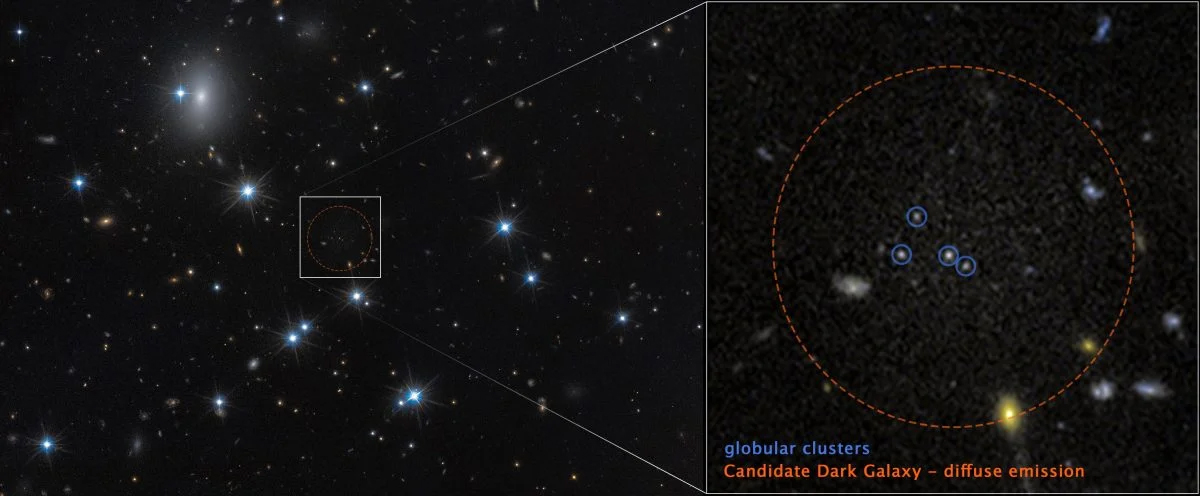
High-resolution images from Hubble reveal four closely spaced globular star clusters within the Perseus Cluster galaxy, located approximately 300 million light-years from Earth.
By combining data from Hubble, Euclid, and Subaru, the research team discovered a faint, elongated halo surrounding these four star clusters. This faint halo is compelling evidence that a previously unobserved galaxy lies beneath the surface.
David Li stated: "This is the first galaxy discovered solely based on its globular cluster. Under the most conservative assumptions, these four clusters represent the entire globular cluster system of CDG-2."
A galaxy contains up to 99% dark matter
Initial estimates suggest that CDG-2 has a luminosity equivalent to about 6 million sun-like stars. The four globular clusters alone account for approximately 16% of the galaxy's total visible light.
What's even more striking is that approximately 99% of CDG-2's total mass – including both ordinary matter and dark matter – appears to be dark matter.
Much of the ordinary matter needed to form stars, primarily hydrogen gas, was most likely 'stripped away' through gravitational interactions with neighboring galaxies within the Perseus cluster.
Globular clusters are extremely dense and tightly bound by gravity. This stability makes them less susceptible to gravitational tidal forces, allowing them to survive for extended periods and serve as reliable 'landmarks' for identifying faint galaxies like CDG-2.
As sky survey programs expand, with the participation of missions such as Euclid, NASA's Nancy Grace Roman Space Telescope, and the Vera C. Rubin Observatory, astronomers are increasingly leveraging machine learning and advanced statistical techniques to process the massive amounts of data collected.
The Hubble Space Telescope has been operating for over 30 years and continues to deliver discoveries that help us understand the universe better. It's a collaborative project between NASA and ESA. NASA's Goddard Space Flight Center in Maryland is responsible for operating the mission, with support from Lockheed Martin Space in Denver. The Space Telescope Science Institute in Baltimore – operated by the Association of Universities for Astronomy Research – oversees Hubble's scientific operations for NASA.
Final Thoughts
Understanding a 'ghost galaxy' has been discovered 300 million light-years from earth and contains up to 99% dark matter makes it easier to evaluate the information and apply the most relevant recommendations. Focus on the key points above and verify details that may change over time.
FAQ
What is a 'ghost galaxy' has been discovered 300 million light-years from earth and contains up to 99% dark matter?
Explore a 'ghost galaxy' has been discovered 300 million light-years from earth.
What key points does this article cover?
The article focuses on Find galaxies through globular clusters, A galaxy contains up to 99% dark matter, with practical explanations and examples.
How can you use this information in practice?
Use the explanations to compare options, verify important details, and make a more informed decision. Apply the recommendations that best match your goals and situation.
Related Articles
 Smallest Galaxy Ever Discovered: Like a Human but Only the Size of a Grain of Rice8 minutes read
 The Discovery of the 'second Earth' Can Exist Only 4.2 Light-years5 minutes read
 Largest 'super-Earth' Ever Discovered, 200 Light Years Away3 minutes read
 The End of the Earth Actually Happened About 250 Million Years Ago8 minutes read
 What Has Changed After 250 Million Years: Earth1 minutes read
 Discover the Terrible War Between Two Giant Black Holes3 minutes read
Reader Comments 0
Sign in with email or Google to join the discussion.