Table of Contents
This updated guide explores the moment a wandering black hole 'swallows' a star with practical details, clear explanations, and useful takeaways. Black holes are the hungry monsters of space: super-dense objects that suck in anything that gets too close and tear it apart. Astronomers using the Hubble Space Telescope recently caught a black hole tearing apart and swallowing a star, creating a huge burst of radiation.
This burst of radiation, called a tidal disruption event (TDE), helped researchers pinpoint the black hole's location. The TDE, named AT2024tvd, is special for a rare reason: while most supermassive black holes are located at the center of a galaxy, this one was wandering about 2,600 light-years from the center.
" The usual location for a supermassive black hole is the center of a galaxy, such as the Milky Way's Sagittarius A (Sgr A), " explains Yuhan Yao (University of California, Berkeley), who led the study. " But this time, the black hole is not in a familiar location. This is the first TDE detected outside the center of a galaxy using optical observations. "
Along with Hubble, the team also used NASA's Chandra X-ray Observatory and the NRAO Radio Telescope to track the TDE.
Initially, a black hole is a dark, invisible object. When a star gets too close, the black hole's immense gravity stretches the star into a 'spaghettified' shape. The star's material forms a cloud disk that rotates around the black hole and is quickly swallowed up, emitting flashes of radiation ranging from X-rays to radio waves—a sign that the black hole is not at the center of the galaxy, as expected.
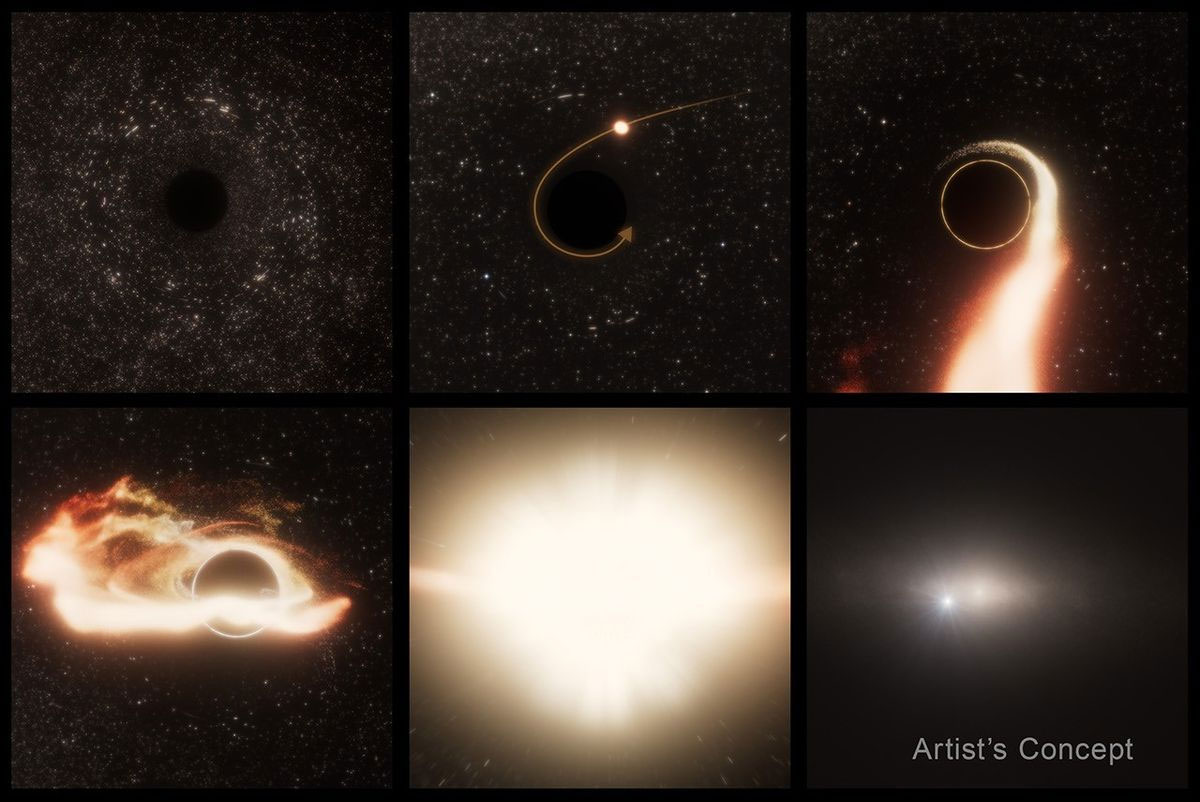
The galaxy that hosts this rogue black hole also has another supermassive black hole at its center. Scientists believe this happened when two small galaxies collided and merged into a larger galaxy.
' Supermassive black holes are always at the center of galaxies, but galaxies merge to grow. When two galaxies merge, you get multiple black holes ,' said Dr. Ryan Chornock (co-author, UC Berkeley). ' Theoretical models predict that there should be rogue black holes in the galaxy. '
The team predicts that these two black holes could merge in the future, creating gravitational waves strong enough to be detected from Earth – a dramatic cosmic event!
FAQ
What is the main takeaway about The Moment a Wandering Black Hole 'swallows' a Star?
The key is to understand the core idea, compare the available options, and apply the practical guidance that matches your situation.
What should beginners know about The Moment a Wandering Black Hole 'swallows' a Star?
Start with the essential steps and terminology. Avoid changing advanced settings until you understand how they affect performance, privacy, cost, or compatibility.
How can I use this information in practice?
Follow the relevant section in order, test one change at a time, and confirm the result before moving to the next step or recommendation.
Related Articles
 10 Interesting Facts About Black Holes in the Universe (part 2)5 minutes read
 10 Interesting Facts About Black Holes in the Universe (part 1)7 minutes read
 Scientist: Complete Guide6 minutes read
 Jetty McJetface: One of the Most Powerful Explosions in the Universe5 minutes read
 Discover the Most Bizarre Black Holes in the Mysterious Space6 minutes read
 The Streams of Plasma Sprayed from Black Holes Can Kill Anything3 minutes read
Reader Comments 0
Sign in with email or Google to join the discussion.