Table of Contents
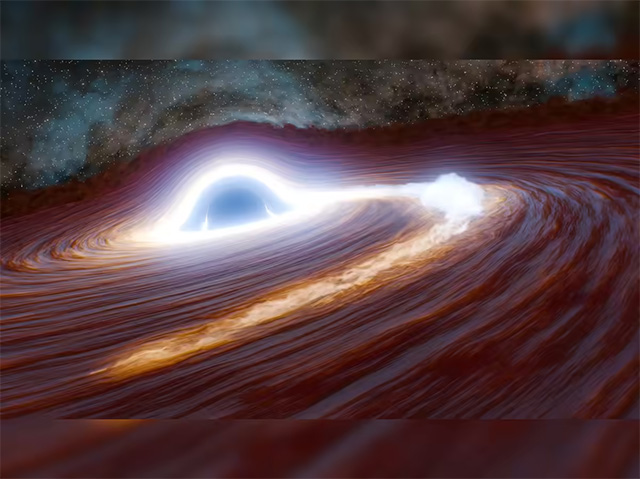
Astrophysicists have used the Frontier and Aurora exascale supercomputers to build an unusually detailed model of matter falling into a black hole. The simulations combine full general relativity with radiation transport, allowing the team to examine accretion flows without several of the simplifying assumptions used in earlier models.
The work, published in The Astrophysical Journal, was led by researchers from the Institute for Advanced Study and the Flatiron Institute. Lead author Lizhong Zhang said the model brings the main physical processes that govern black hole accretion into a single computational framework.
What the simulations model
The researchers studied radiation-dominated accretion under several conditions. They varied the rate at which matter entered the black hole, tested two rates of black hole spin and changed the configuration of the surrounding magnetic field.
A new algorithm directly solves the radiation-transport equation in curved spacetime. That calculation is extremely demanding because radiation, magnetic fields, moving matter and gravity influence one another. Even a seemingly small approximation can change the simulated structure of the system.
The resulting models reproduced several features seen in real astronomical observations, including radiation spectra associated with X-ray binaries and ultraluminous X-ray sources. Zhang described the process as observing these systems with computers rather than telescopes.
What happens above the Eddington limit
The Eddington limit describes the point at which outward radiation pressure can balance the inward pull of gravity on surrounding matter. It is often used as a reference for the maximum steady luminosity—and corresponding accretion rate—of a compact object.
In the simulations, accretion above that limit produced thick disks supported by radiation pressure. The flows also generated strong outflows, while a narrow funnel formed close to the center. Radiation escaped inefficiently from this state because much of the energy remained trapped in the inflowing material instead of emerging as light.
How magnetic fields change the flow
At accretion rates near or below the Eddington limit, the simulated structure depended strongly on magnetic flux. With a vertical magnetic flux, the disk formed a dense central layer surrounded by a magnetically dominated corona. Without that vertical flux, magnetic pressure played a larger role throughout the disk.
The models did not develop a fully magnetically arrested disk, a state in which a powerful magnetic field impedes the inflow of matter. Even so, simulations that combined magnetic flux with a rapidly spinning black hole produced strong relativistic jets.
Why stellar-mass black holes are useful test cases
The study focused mainly on stellar-mass black holes with masses roughly ten times that of the Sun. These objects are harder to image directly than the supermassive black holes at the centers of galaxies, so researchers often infer their structure from radiation spectra.
Stellar-mass systems also evolve quickly. Changes can occur over minutes or hours, giving scientists a practical way to compare simulations with observations over relatively short periods. The new models produced spectra resembling those observed from X-ray binaries and ultraluminous sources, including Cyg X-3 and SS433.
The team also proposed that super-Eddington models could help researchers investigate the compact “little red dots” detected in early-universe observations by the James Webb Space Telescope. That possible connection requires further study rather than serving as a firm identification.
Why Frontier and Aurora were essential
Frontier at Oak Ridge National Laboratory uses AMD processors, while Aurora at Argonne National Laboratory is built on Intel technology. Both are exascale systems, designed to perform more than a quintillion floating-point operations per second. Their scale made it possible to solve equations that were previously too computationally expensive for this type of model.
Christopher White developed the radiation-transport algorithm, and Patrick Mullen implemented it in AthenaK, simulation software optimized for exascale machines. The researchers plan to extend the method to supermassive black holes and improve the treatment of interactions between radiation and matter.
The next challenge is not simply to run larger simulations, but to identify which predictions can be tested against observations. That comparison will determine how much the models can reveal about black hole growth, disks and jets.
Related Articles
 The 10 Fastest Supercomputers in the World In 20269 minutes read
 TOP 10 Supercomputers with Fastest Processing Speed in the7 minutes read
 The Fastest Supercomputers in the World10 minutes read
 10 Fastest Supercomputers in the World 2024: Recommended Choices11 minutes read
 Learn the Basics of Supercomputers, Complex and Powerful Machines22 minutes read
 Used Since the 1990s, Nearly 30-year-old 'Supercomputers' Are Still Running 'Ferry Ferries' and Play10 minutes read
Reader Comments 0
Sign in with email or Google to join the discussion.