Table of Contents
Explore are we living in a black hole, including the key concepts, practical examples, important considerations, and useful guidance.
First, the best current scientific models suggest that both space and time have a beginning – a subatomic point called a singularity. From that state of extremely high density and temperature, the universe expanded violently in the Big Bang.
Secondly, our observable universe is surrounded by a boundary called the cosmic event horizon – beyond this threshold, nothing can be observed anymore, because the universe has expanded faster than the speed of light, making many regions too far away even for the most powerful telescopes.
Interestingly, these two elements – the singularity and the event horizon – are also the core characteristics of black holes. These 'gravitational monsters' exist throughout the universe, devouring gas, dust, and even light. Like the universe, black holes are also bounded by an event horizon – a boundary beyond which nothing can ever return, and within which is believed to be a singularity.
Perhaps it is because of this similarity that some recent scientific studies have suggested that our entire universe may be contained within a black hole.
Although this idea may be somewhat outside the realm of traditional cosmology, the possibility of 'living in a black hole' is not just wishful thinking.
" This is certainly a reasonable idea ," said Niayesh Afshordi, an astrophysicist at the Perimeter Institute for Theoretical Physics (Canada). " The problem is how to make the details actually work. "
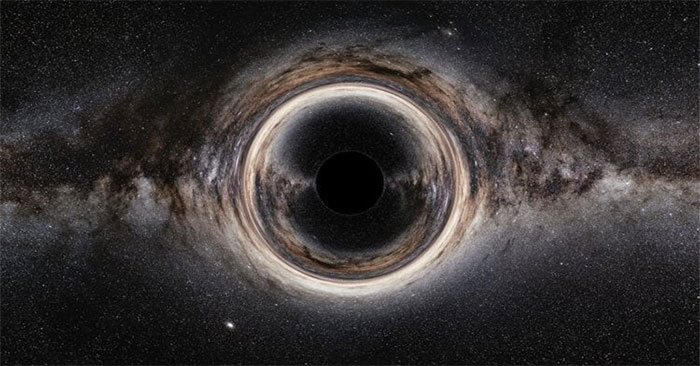
A brief history of the 'universe in a black hole' hypothesis
The fundamental mathematics that helps us understand the universe has many similarities to the mathematics that describes black holes. Both stem from Albert Einstein's theory of general relativity, according to which matter bends the structure of spacetime, thereby creating gravity.
A remarkable coincidence is that the radius of the observable universe is exactly equal to the radius of a black hole with a mass equivalent to the entire universe.
This is what led some scientists, decades ago, to hypothesize that the universe lies inside a black hole. The first two to seriously develop this idea were theoretical physicist Raj Kumar Pathria and mathematician IJ Good in the 1970s.
About 20 years later, physicist Lee Smolin went even further, proposing that each black hole that forms in our universe could create a new universe within it, with slightly different laws of physics than the 'parent' universe. In this way, universes 'bud' from each other, transforming and evolving as they give birth to daughter universes. Smolin called this idea cosmic natural selection.
Is our universe… the opposite of a black hole?
Although these ideas never became mainstream, many physicists still acknowledge the profound conceptual connection between black holes and the universe. "Mathematically, they are very closely related," says Ghazal Geshnizjani, a theoretical physicist at the Perimeter Institute. "They are like two opposite sides of each other."
The universe is thought to have begun from a singularity – a point where density was infinite before the Big Bang. Conversely, black holes end at a singularity, a tiny 'crushing point' where everything is compressed to the point where it no longer has physical meaning.
The event horizon of a black hole – the spherical surface surrounding the singularity – is the point of no return. Contrary to the popular image of a 'cosmic vacuum cleaner,' black holes are actually quite 'safe': a spacecraft can fly around and escape safely, as long as it doesn't cross the event horizon.
The constant expansion of the universe also creates a similar phenomenon. When observing the sky, we see that the farther away galaxies are, the faster they move away from us. At extremely great distances, the expansion rate exceeds the speed of light, causing celestial bodies to disappear beyond a boundary – the cosmic horizon. It feels as if stars are falling into the 'mouth' of a black hole turned inside out.
Sounds a bit… confusing, right? But the important thing is: these surface similarities don't mean the universe is a black hole. To draw such a conclusion, physicists need to determine the observable consequences of this hypothesis.
"We have theories, and theories must have consequences," said Alex Lupsasca, a physicist at Vanderbilt University. "If those consequences are disproven experimentally, then the original assumptions are no longer true."
How can we know if the universe is located inside a black hole?
If the universe truly lies inside a black hole, then that must leave observable traces. For example, the universe might have some kind of 'preferred orientation' – galaxies rotate in a certain direction, or there might exist a subtle axis in the background radiation left over from the Big Bang.
"You would expect to see some kind of gradient in the universe," Afshordi said. "One direction toward the center of the black hole, one direction outward."
However, the most accurate measurements currently available suggest that the universe on a large scale is very uniform, with no particular direction. This is the foundation of cosmological principles, which state that the universe looks almost the same everywhere. Explaining this uniformity from a chaotic event like the birth of a black hole is a major challenge. Black holes form from dying stars – a chaotic, violent, and irregular process.
There's also the problem of the black hole singularity. For anything that falls into it, that's the inevitable outcome – a stark contrast to a universe that's expanding at an ever-increasing rate.
To solve these problems, physicists need to find a way to combine the two most successful theories of the 20th century: general relativity (describing the very large) and quantum mechanics (describing the very small). The singularity – infinitely small but possessing enormous mass – cannot be fully described by either of these theories. This is why quantum gravity remains an unfulfilled goal of modern science.
Therefore, we still don't know exactly what happened inside a black hole or before the Big Bang.
Nevertheless, cosmologists agree that exploring these ideas is both intellectually stimulating and could lead to entirely new discoveries. Perhaps in the future, we will have to readjust our cosmological models – and discover that the universe actually lies within a black hole.
Final Thoughts
Understanding are we living in a black hole makes it easier to evaluate the information and apply the most relevant recommendations. Focus on the key points above and verify details that may change over time.
FAQ
What is are we living in a black hole?
Explore are we living in a black hole, including the key concepts, practical examples, important considerations, and useful guidance.
What key points does this article cover?
The article focuses on A brief history of the 'universe in a black hole' hypothesis, Is our universe… the opposite of a black hole?, How can we know if the universe is located inside a black hole?, with practical explanations and examples.
How can you use this information in practice?
Use the explanations to compare options, verify important details, and make a more informed decision. Apply the recommendations that best match your goals and situation.
Related Articles
 Discover the Most Bizarre Black Holes in the Mysterious Space6 minutes read
 Black Hole, White Hole, Deep Hole: Black Hole Is What Is White Hole14 minutes read
 10 Interesting Facts About Black Holes in the Universe (part 2)5 minutes read
 10 Interesting Facts About Black Holes in the Universe (part 1)7 minutes read
 Discover a Monster Black Hole 100,000 Times Bigger Than the Sun3 minutes read
 Black Force - a New Force in the Universe, Becomes Even More Strange6 minutes read
Reader Comments 0
Sign in with email or Google to join the discussion.