Table of Contents
Protein serves as an essential nutrient for the body. However, if you consume too much, you may experience the following symptoms.
Protein Is an essential nutrient for the body. However, if you consume too much, you may experience the following symptoms.
How much protein is too much?
Your ideal protein Intake Depends on a number of factors, including age, gender, body size, activity level, and overall health, so it can vary greatly from person to person. Experts say you also need to consider your specific fitness goals when calculating. For example, if you're a bodybuilder, you'll need more protein than someone who doesn't work out much to build muscle.
According to the U.S. National Library of Medicine, protein should make up 10 to 35 percent of your total daily calorie needs, and should come from a variety of sources. The recommended daily allowance (RDA) for protein requires a minimum of 0.36 grams per pound of body weight. By that standard, a 140-pound (63-kg) person would need about 50 grams per day, while a 200-pound (90-kg) person would need about 70 grams.
That said, the recommended intake is higher for people who exercise regularly and those over 60. Since protein is key to muscle recovery after intense physical activity, people with a workout routine should consume between 70 and 100 grams per day. Meanwhile, older people lose muscle mass at a much higher rate than younger people, so they may need as much as 80 to 140 grams.
So, with all these different factors in mind, is there really a limit to how much protein you should eat? Yes. According to experts, most people are advised to consume no more than 2 grams per kilogram per day" (or about 0.9 grams per pound)—the threshold for chronically high protein intake, according to the University of Missouri.
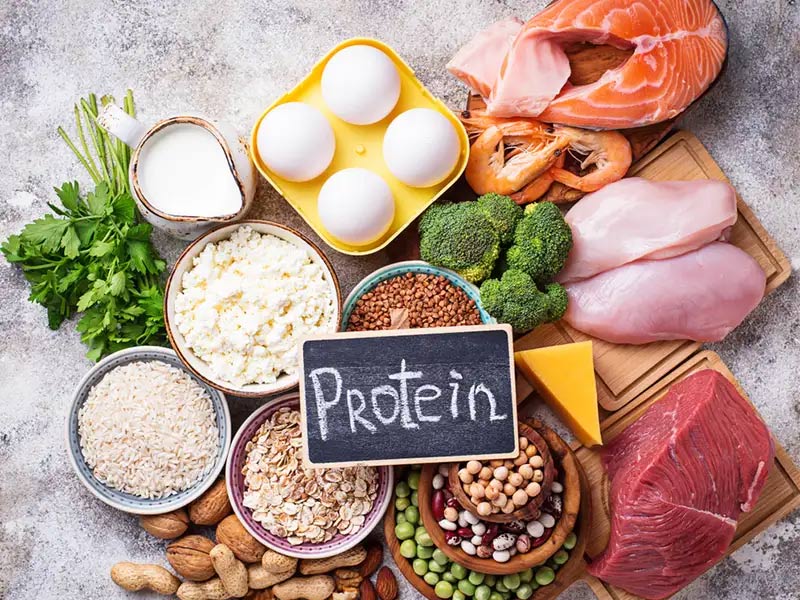
Signs you're getting too much protein
Bad breath
Eating too much protein can make your breath smell bad, especially if you're also cutting out carbs. This is due to ketosis, a metabolic state that occurs when your body starts burning fat for energy due to a lack of glucose (a sugar derived from carbohydrates). In fact, ketosis-induced bad breath is so common that it even has a nickname: "keto breath."
Digestive problems
Protein " Can be difficult to digest in large amounts ," so you may feel some discomfort in your lower abdomen. Diarrhea or constipation are possible.

Dehydration
When protein enters the body, it is sent to the liver to be broken down – a process that produces various waste products, including a substance called urea. From there, urea is transported to the kidneys (the body's waste removal organs), where it is filtered out of the blood and excreted from the body in urine. The more protein you eat, the harder your kidneys have to work to remove urea (and therefore the more you pee), so large amounts of protein can actually dehydrate you.
Weight gain
While protein is closely linked to physical strength among fitness enthusiasts, it doesn't naturally convert into muscle once it enters your body. After all, excess calories will be converted to fat regardless of the source, and since one gram of protein is actually equivalent to four calories, you may find yourself gaining weight if you eat more than you burn.
In addition to all of the above, both carbohydrate deficiency and dehydration can cause problems like headaches, fatigue, confusion, which can be secondary symptoms.
FAQ
What should you know about signs you're getting too much protein?
In practical terms, protein is an essential nutrient for the body. However, if you consume too much, you may experience the following symptoms.
Why does signs you're getting too much protein matter?
The article highlights that so, with all these different factors in mind, is there really a limit to how much protein you should eat.
What is the main takeaway?
The main takeaway is that signs you're getting too much protein Bad breath Eating too much protein can make your breath smell bad, especially if you're also cutting out carbs.
Related Articles
 Warning Signs That You Are Not Getting Enough Protein Every Day6 minutes read
 American Medicine Discovered: Increasing the Concentration of Protein Soluble Klotho in the Blood4 minutes read
 What Is A2 Protein Milk: Explained5 minutes read
 What Diseases Can You Get If You Eat Too Much Protein?7 minutes read
 The Best Protein - Rich Fish to Eat According to Nutritionists7 minutes read
 Should You Prioritize Fiber or Protein in Your Diet: Explained5 minutes read
Reader Comments 0
Sign in with email or Google to join the discussion.