Table of Contents
This practical guide explains how to subtract fractions. Follow the steps in order, review the requirements first, and use the troubleshooting notes when a setting or option does not work as expected.
How to subtract fractions with like denominators
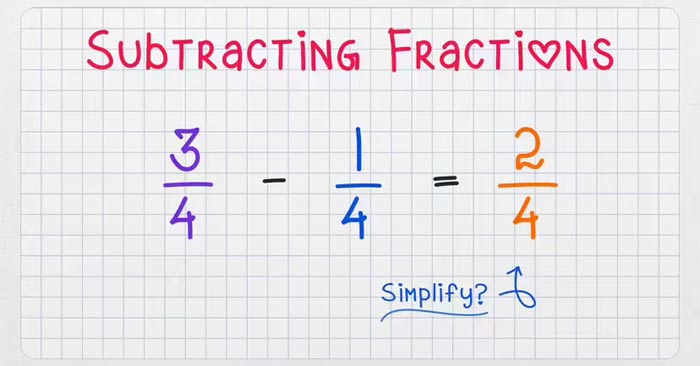
When subtracting numbers with the same denominator (that is, the same number at the bottom of both fractions), the calculation is easy. You just subtract the numerators or top numbers from each other and keep the two denominators the same. Here's an example:
3/4 – 1/4 = 2/4When the numerator and denominator share a common factor, simplify the fraction by finding the common factor and dividing both by that factor. In the case of 2/4, the common factor is 2, and the simplified version of 2/4 is 1/2.
Note that 2/4 and 1/2 represent exactly the same quantity.
How to subtract fractions with different denominators
Step 1: Find the lowest common denominator
When subtracting fractions with unlike denominators, the first task is to find the common denominator. Consider two unlike denominators and find a number that is a multiple of both, that is, a number that can be divided evenly into each denominator.
Suppose fraction A (3/4) minus fraction B (2/5):
3/4 – 2/5 = ?The denominator of fraction A is 4 and fraction B is 5, and we know the least common multiple of 4 and 5 is 20. During subtraction, you can use another common multiple such as 40, but it is usually better to use the least common denominator (LCD), which is the smallest number that fits into both denominators.
Note: Sometimes you will come across mixed fractions, which are a combination of a whole number and a proper fraction. When subtracting mixed fractions, such as 2 1/2 – 1 3/4, you will need to convert the values to fractions before finding the lowest common denominator. In this example, 2 1/2 would become 5/2 and 1 3/4 would become 7/4.
Step 2: Convert both fractions In an arithmetic expression, you can multiply any fraction by 1; that is always valid.
So for each fraction, you want to find the number that can be multiplied by the denominator to get the lowest common denominator when subtracting the fractions. This number will always have the same denominator as the other fraction.
Since fraction A has a denominator of 4, you'll need to multiply by 5 — but you can't just multiply the denominator by 5. Instead, you'll multiply the entire fraction by 5/5, which equals 1. You'll multiply fraction B by 4/4.
Here's how to convert two unlike fractions into fractions with a common denominator:
3/4 – 2/5 = [(5/5) x (3/4)] – [(4/4) x (2/5)] [(5/5) x (3/4)] – [(4/4) x (2/5)] = 15/20 – 8/20Step 3: Subtract the two numerators
Now you are ready to subtract the two numerators.
15/20 – 8/20 = 7/20There is no need to simplify this problem because there are no common factors of 7 and 20.
Common mistakes when subtracting fractions
Subtracting fractions may seem simple, but even small mistakes can lead to incorrect results. Here are some common mistakes to watch out for.
Ignore the common denominator
One of the most common mistakes is subtracting fractions with unlike denominators without first finding a common denominator. Always remember that fractions must have the same denominator to be subtracted. For example, 2/3 − 4/5 requires a common denominator of 15.
Confusing the numerator with the denominator
After aligning the denominators, keep track of which number is the numerator (top) and which number is the denominator (bottom). Mixing them up can lead to incorrect subtraction and incorrect results.
Improper handling of mixed fractions
Subtracting mixed fractions without converting them to fractions is a serious mistake. For example, 2 1/2 − 1 3/4 must be converted to 5/2 − 7/4, then the common denominator is found.
Reduce the fraction first
Avoid the temptation to simplify any fractions before you subtract. Only simplify the final answer to ensure you don't leave out any common factors.
FAQ
How to subtract fractions with like denominators?
When subtracting numbers with the same denominator (that is, the same number at the bottom of both fractions), the calculation is easy. You just subtract the numerators or top numbers from each other and keep the two denominators the same. Here's an example:
How to subtract fractions with different denominators?
Step 1: Find the lowest common denominator
What should you know about common mistakes when subtracting fractions?
Subtracting fractions may seem simple, but even small mistakes can lead to incorrect results. Here are some common mistakes to watch out for.
Related Articles
 How to Write Fractions in Word Simply and Quickly4 minutes read
 How to Write Fractions in Word Is Very Simple5 minutes read
 How to Write Fractions in Word 2010, 2013, 2016, 2019, 20206 minutes read
 How to Write Fractions in Word: Step-by-Step Guide4 minutes read
 How to Write Fractions in Word - Instructions on How to Write Fractions in4 minutes read
 How to Type Fractions in Word: Step-by-Step Guide3 minutes read
Reader Comments 0
Sign in with email or Google to join the discussion.