Table of Contents
Google is bringing advertising into AI Mode, its conversational search experience. Sponsored results can appear alongside AI-generated information, so readers need to distinguish paid placements from ordinary source links. The feature belongs to Google Search; it should not be described as a blanket change to all replies in the standalone Gemini app.
What Google has confirmed
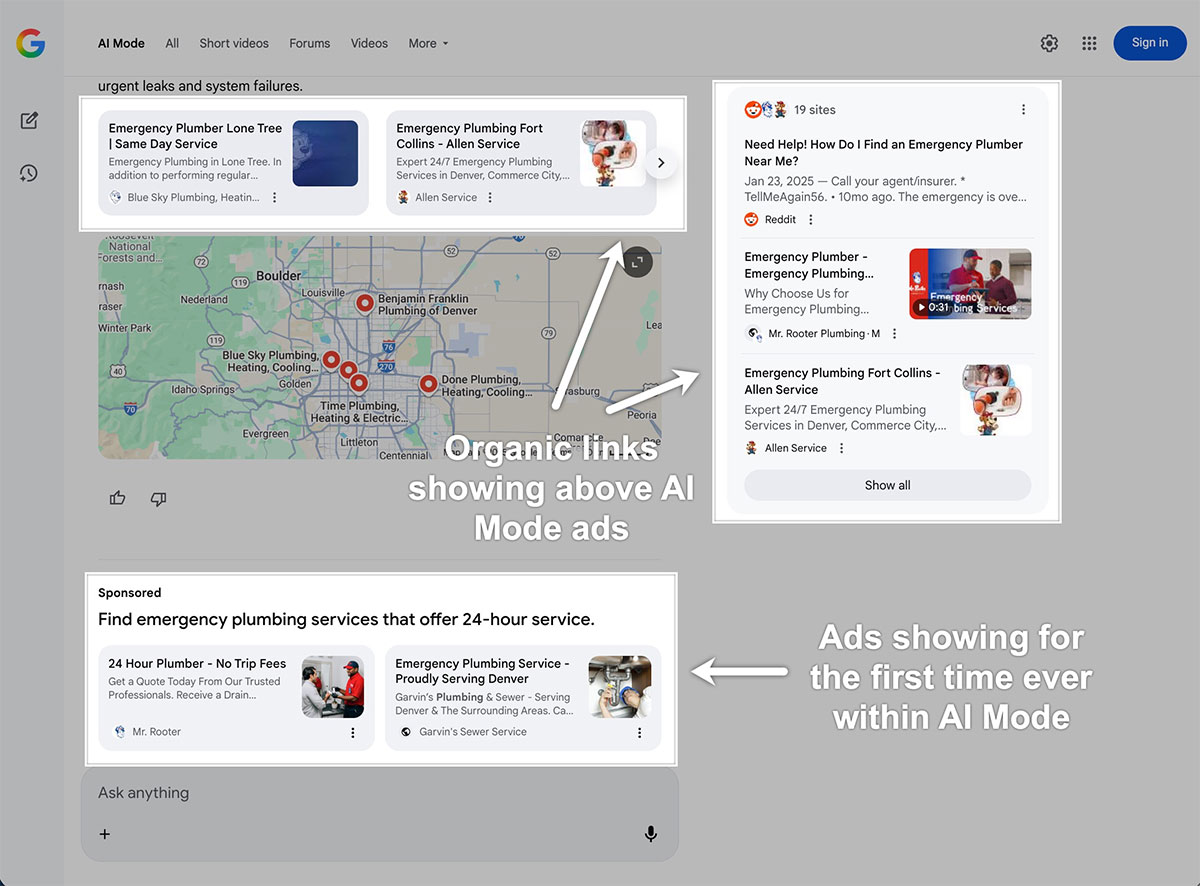
Google's 2025 advertising announcement said it was beginning to test ads below and within AI Mode responses. Later announcements described further experiments, so a screenshot of an ad does not establish that every format has left testing or reached every account.
In its 2026 Search ads update, Google described two additional formats:
- Conversational Discovery ads: ads tailored to the question, with product or service information.
- Highlighted Answers: sponsored entries eligible to appear when AI Mode provides recommendations.
Google said these formats would remain labeled Sponsored. It also described an AI-generated explainer alongside the advertiser's creative. These are advertising formats under testing, rather than a promise that the same layout appears for every search.
Why placement and availability vary
An example showing ads beneath source cards illustrates that particular result. It does not prove that organic cards always appear first. Google has described ads integrated into responses as well as below them; placement can vary with the experiment and search.
Likewise, a report of an ad on a repair or pet-care query does not establish that those categories are the platform's highest-revenue priority. No universal rollout date or ranking rule can be inferred from a few examples.
AI Mode is also distinct from the AI Overview that can appear in ordinary Search results. See how Google AI Mode works for the basic distinction.
How to assess a sponsored recommendation
Look for the Sponsored label before treating an entry as an independent recommendation. Open the destination and check the company, offer conditions, total cost, and suitability for your task. An AI-written explanation does not make a paid placement unbiased or guarantee that its claims are correct.
For comparisons, examine more than one provider and verify important details on the provider's own site. Useful source links can still help you investigate an answer; they should be read alongside the advertising labels.
What ad settings can change
Google's My Ad Center controls personalization and ad preferences. Turning off personalized ads changes the use of saved account information for ad targeting; it does not make Google Search or AI Mode ad-free.
TipsMake's ad-personalization guide provides background, although current menus may use different wording. If you prefer ordinary web links, you can also use Google's Web results filter where offered. Neither choice guarantees the removal of every advertisement.
Related Articles
 Google stops inserting 'obscene' banner ads
 Google improves Search to provide more in-depth results for questions
 How to enable AI mode in Google search
 The fast Google search tips you should know
 Japan requires Google to delete 122 search results
 Google stops displaying content authors in search results
Reader Comments 0
Sign in with email or Google to join the discussion.