 Home
Home
 Wifi Tips
 Fix Computer
 Windows 10
 Windows 11
 Artificial Intelligence
 Space Science
 Strange story
Google launches TranslateGemma – a new open-source translation model with many advantages.
TranslateGemma is Google's new translation model suite, supporting 55 languages, offering high performance, and is an evolution of Gemma 3.
Google has just announced a new set of open-source translation models, developed based on Gemma 3 – the company's open-weight model. Google calls this a "major leap forward in open-source translation." The new model, called TranslateGemma, supports up to 55 languages, including popular languages such as Spanish, French, Chinese, and Hindi.
Notably, this announcement came just hours after OpenAI launched ChatGPT Translate. While ChatGPT Translate focuses on contextual and tone-based translation, rather than word-for-word translation, TranslateGemma is more geared towards performance, accuracy, and flexible deployment for developers.
TranslateGemma currently has three versions with different parameter scales: 4B, 12B, and 27B. According to Google, the 12B model even outperforms the original Gemma 3 27B when evaluated using the WMT24++ benchmark. For developers, achieving high performance from a model with less than half the number of parameters means better processing speed, lower latency, while maintaining accuracy.
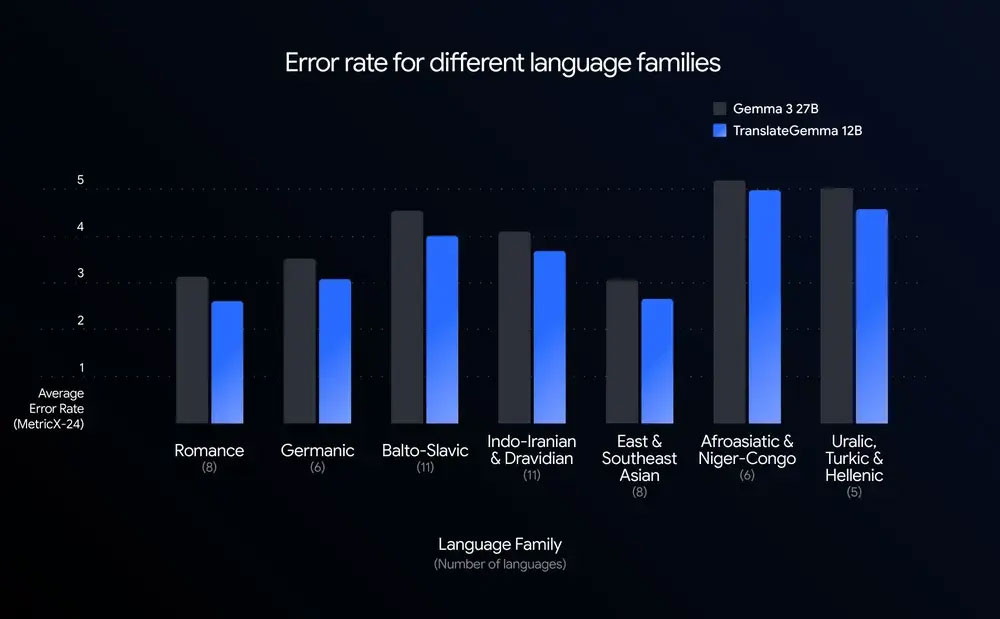
Google says the 4B version is optimized for mobile device inference, while the 12B version is suitable for mainstream laptops. The 27B model, however, requires more powerful hardware, such as a cloud-based NVIDIA H100 GPU.
In tests using the Vistra benchmark for image text translation, TranslateGemma delivered impressive results. Although not specifically optimized for image translation, the model demonstrated better text translation capabilities than many competitors.
Google also shared that this efficiency comes from a special two-stage training process. In the first stage, the company uses Supervised Fine-Tuning, training Gemma 3 models on human-generated translation data, combined with high-quality aggregated data generated by Gemini models.
Next comes the Reinforcement Learning phase, where Google uses various reward models, along with advanced metrics like MetricX-QE and AutoMQM, to guide the model toward more natural and contextually accurate translations.
Currently, the TranslateGemma models are publicly available on Kaggle and Hugging Face, allowing anyone to download, test, or develop translation applications based on these platforms.
 Micah Soto
- TOP AI tools for highly accurate translation
- Meta develops a non-open-source AI model called 'Avocado,' signaling a major turning point in its AI strategy.
- The translation of Google Translate also sometimes has to surrender before Vietnamese
- The role and advantages of Model Context Protocol (MCP) in modern AI models.
- Google Translation: People translate tools automatically
- Google Launches Gemini 2.5 Computer Use: AI Models That Superiorly Control Web and Mobile Interfaces
- How to Become an Open Source Enthusiast
- Google Translate launches real-time AI translation feature and foreign language learning tools
- Is Google secretly installing Gemini Nano on Chrome? How to check and remove it.
- Google Docs Live: Transform ideas into complete documents using AI.
- Top 7 most noteworthy small language models today.
- How to turn off Gemini AI on your Google account
- Google Search integrates AI photo editing feature – useful or redundant?
- How to Convert Photos to Videos Using Google Photos AI
- History Comes to Life in These Photos, Thanks to Google's AI
- Google AI can predict long-term climate and weather trends in just minutes
- Review of 2017 by Google
- Google's DeepMind can diagnose eye diseases exactly like doctors


-
 Experience the AI translation feature on Firefox.
-
TOP AI tools for highly accurate translation
-
How to set Google Translate as the default translation app on iPhone
-
DeepL - An advanced AI-based online translation tool.
-
Does translation earpiece technology make foreign language learning pointless?
-
How to enable video translation in Microsoft Edge
 Experience the AI translation feature on Firefox.
 TOP AI tools for highly accurate translation
 How to set Google Translate as the default translation app on iPhone
 DeepL - An advanced AI-based online translation tool.
 Does translation earpiece technology make foreign language learning pointless?
 How to enable video translation in Microsoft Edge
 Tech info
 Technology story
 Technology comments
 Quiz technology
 New technology
 British talent technology
 Attack the network
 System
 Mac OS X
 Hardware
 Game
Game Technology
 Science
 Life
Life Application
 Electric
 Program
 Mobile