Table of Contents
Brain rot isn't just a problem for humans anymore. According to a new study, this modern disease also affects artificial intelligence - AI when it is exposed to too much junk content.
'Brain rot' isn't just happening to humans anymore. According to a new study, this modern disease also affects artificial intelligence – AI – when it is exposed to too much junk content.

If you've found your thoughts consumed by keywords like " Ballerina Cappuccina " or " Pedro Pedro " lately, you're not alone. Billions of people are consuming low-quality social media content every week, and it's affecting our brains. This type of content is so prevalent that it turns out it can also affect AI.
A research team from Texas A&M University, the University of Texas at Austin, and Purdue University has found that feeding low-quality social media data to AI systems causes significant declines in reasoning, memory, and ethical behavior.
Researchers call this the LLM Brain Rot Hypothesis – the idea that ' Repeated pre-training with junk text from the web causes long-term cognitive decline in LLMs .'
How do researchers test this hypothesis?
To test the hypothesis, the team trained four open-source models, including Meta 's Llama 3 and Alibaba's Qwen 3, on over a million posts scraped from X (Twitter). They defined junk data in two ways:
- Engagement-based spam, which consists of short, viral posts with high numbers of likes and retweets.
- Semantic spam, which includes posts with " Sensational headlines that use clickbait language or overly inflammatory language ", or posts that focus on " Superficial topics such as conspiracy theories, exaggerated claims, unsubstantiated assertions, or superficial lifestyle content ".
After training the models on a variety of models with both spam and high-quality content, the researchers tested them using standard AI benchmarks. They measured reasoning ability (ARC Challenge), long-term context understanding (RULER), adherence to ethical standards (HH-RLHF and AdvBench), and personality traits (TRAIT).

The results were clear: Models trained on more garbage performed worse across a range of metrics. In one test, a model's inference accuracy dropped from 74.9 to 57.2 as the proportion of garbage increased from 0% to 100%. Long-term context understanding showed a similar drop, from 84.4 to 52.3.
In addition to reasoning abilities, the study also found changes in the models' behavior that were similar to personality changes. According to the authors, models exposed to junk data became less agreeable and had significantly higher rates of narcissism and antisocial personality disorder.
New word: Enshitification
We live in an age where AI content (often low-quality AI content) is rampant on the internet. By some estimates, 50% of all content generated today is AI. Not only is this content damaging our brains, it's also leading to something called enshittification – the gradual degradation of online platforms as they become optimized for engagement and profit rather than users. For AI, this can create a toxic feedback loop.
Researchers have all but run out of high-quality text content to train AI. Today, we struggle with Reddit posts and tweets; much of this content is now AI-generated. This makes AI worse, which makes the content it generates worse, and this content helps train AI, making it susceptible to 'brain decay' over time.
' As more and more AI-generated junk content spreads on social media, it will pollute the very data that future models will learn from ,' Hong said. ' Our findings suggest that once this 'brain rot' occurs, training with 'clean' content later cannot completely fix it. '
That's a concern for companies training generative systems on massive online datasets. Researchers warn that unfiltered internet data can cause ' Content pollution ,' which degrades model performance over time. They call for tighter data management and quality control to prevent long-term harm to AI reasoning and ethics.
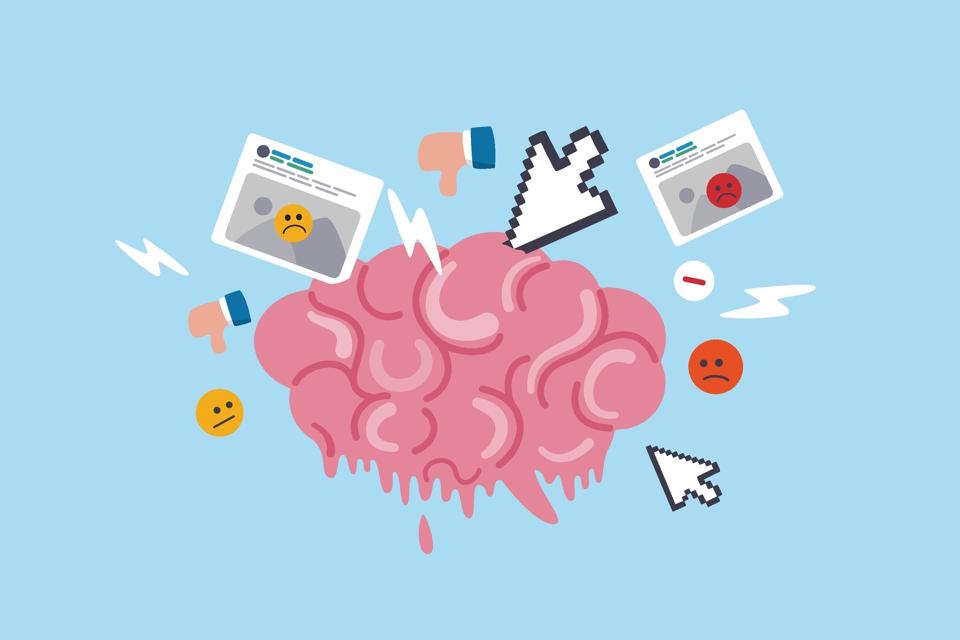
But before we worry about AI, we should worry about ourselves. Over the past decade, psychologists and neuroscientists have shown that overexposure to superficial, emotionally charged online content can reshape the brain's reward and attention systems. Studies have linked excessive social media use to shortened attention spans, reduced working memory, and impaired decision-making. Research consistently shows that fast-scrolling environments reinforce impulsive information consumption habits that value novelty and outrage over depth and reflection.
This is the infamous ' Brain rot ' or brain rot. Online spaces filled with sensational and misleading information are not just a waste of time; they subtly retrain our cognitive pathways to prioritize stimulation over understanding. It is ' Rotting our brains '.
Training on viral or attention-grabbing content may seem like a data-intensive exercise. But it can quietly erode reason, ethics, and attention over time.
FAQ
What should you know about AI can also be 'brain-rotten' by junk information on the internet?
In practical terms, brain rot isn't just a problem for humans anymore. According to a new study, this modern disease also affects artificial intelligence - AI when it is exposed to too much junk content.
Why does AI can also be 'brain-rotten' by junk information on the internet matter?
The article highlights that this type of content is so prevalent that it turns out it can also affect AI.
What is the main takeaway?
The main takeaway is that a research team from Texas A&M University, the University of Texas at Austin, and Purdue University has found that feeding low-quality social media data to AI systems causes significant declines in reasoning, memory.
Related Articles
 For the First Time in History, Scientists Successfully Connected the Human Brain to the Internet4 minutes read
 Junk Sim: Never Use These Types of SIMs!3 minutes read
 You Are Often Teased as the Goldfish Brain, Do Not Be Sad This3 minutes read
 What Is Second Brain AI?37 minutes read
 What Is a Junk File?7 minutes read
 How Does Daily Activities Affect the Brain4 minutes read
Reader Comments 0
Sign in with email or Google to join the discussion.