Table of Contents
This guide organizes the entries in "6 Prompts Make ChatGPT the Perfect Microlearning Tutor for Any Topic" and explains what each option, idea, or example offers. It also highlights practical details that matter when comparing the choices.
1. Set up your Microlearning course
ChatGPT can design a Microlearning roadmap for you. You should choose a narrow area within a topic instead of a broader topic to make your Microlearning sessions more specific.
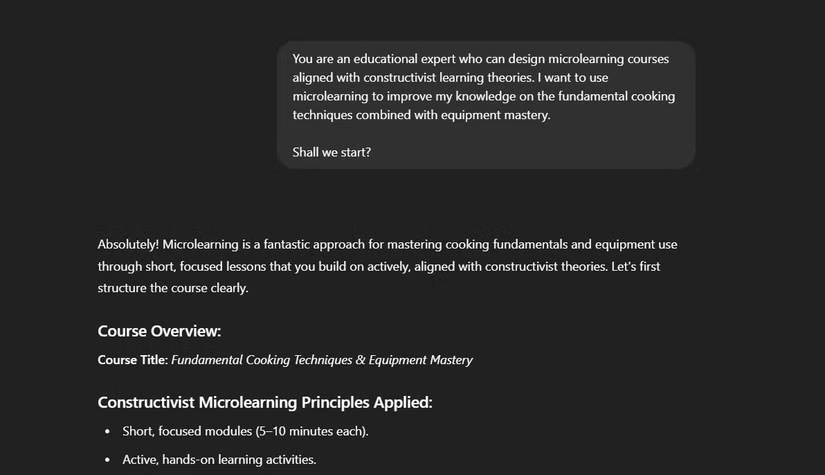
You are an educational expert who can design microlearning courses aligned with constructivist learning theories. I want to use microlearning to improve my knowledge on [Topic]. Shall we start?
You are an education professional who can design Microlearning courses that align with constructivist learning theories. I want to use Microlearning to enhance my knowledge of [Topic]. Let's get started !
Let's say you're trying to improve your cooking skills by understanding the fundamentals, especially food chemistry. Here's how to get started:
2. Interactive learning prompt
Interactive prompts engage you in the learning process. Back-and-forth conversations with LLM help you actively build your understanding.
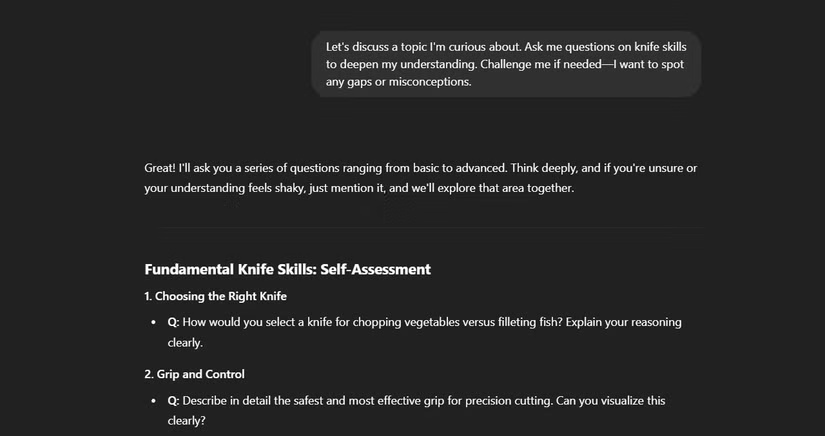
One suggested approach is prompting borrowed from the Feynman Technique (named after the famous physicist's study habit). You might say:
Let's discuss a topic I'm curious about. Ask me questions on [Topic] to deepen my understanding. Challenge me if needed—I want to spot any gaps or misconceptions.
Let 's discuss a topic I'm curious about. Ask me questions about [Topic] to deepen my understanding. Challenge me if necessary—I want to uncover any gaps or misconceptions.
Learning in this dialogic style helps you quickly discover what you don't know.
True/False Challenge Prompts are quick tests of your knowledge. Ask the AI to generate true/false questions about a topic. These quick tests highlight what you've learned and what needs more attention.
'Who's Who' Identification Prompts work like digital flashcards. They are especially useful when learning new terms, theories or important figures. This approach quickly builds your recall and confidence.
3. Prompt content analysis
Breaking information into small chunks makes learning less intimidating and more effective.
Micro-Lesson Structuring prompts help with this. Ask the AI to:
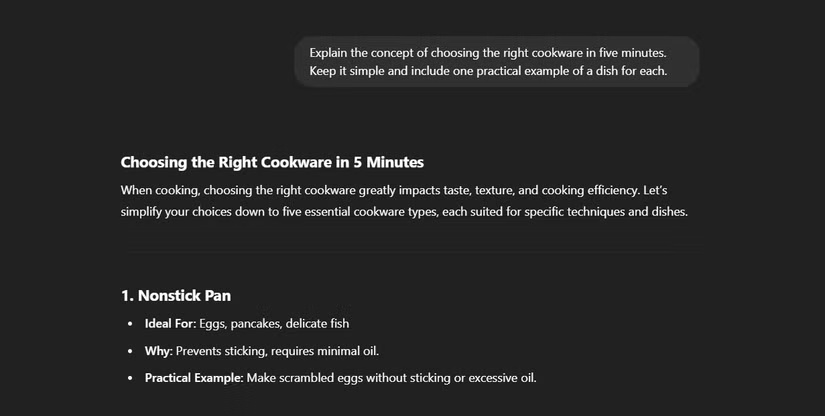
Explain this [concept] in five minutes. Keep it simple and include one practical example. Short lessons are easy to digest and improve your focus.
Explain this [concept] in 5 minutes. Keep it simple and include a real-life example. Short lessons are easy to understand and improve your ability to concentrate.
This is similar to the method used with Copilot to simplify complex information.
Learning Sequence Prompts help you build knowledge step by step. You can ask ChatGPT:
Break this topic into five lessons. Each should logically build on the previous but still make sense individually.
Divide this topic into five lessons. Each lesson should build logically on the previous one but still have its own meaning.
This method ensures you fully understand each section before moving on to the next.
Multimedia Help Prompts for visual learners. Ask for quick explanations, visual diagrams, and then multiple choice questions. Combining text and images greatly improves retention.
4. Prompt repetition and spaced review
Regular review is important for long-term retention. Spaced repetition prompts help ensure important concepts stay fresh in your memory. While not perfect, you can also design your own spaced repetition system using ChatGPT Tasks.
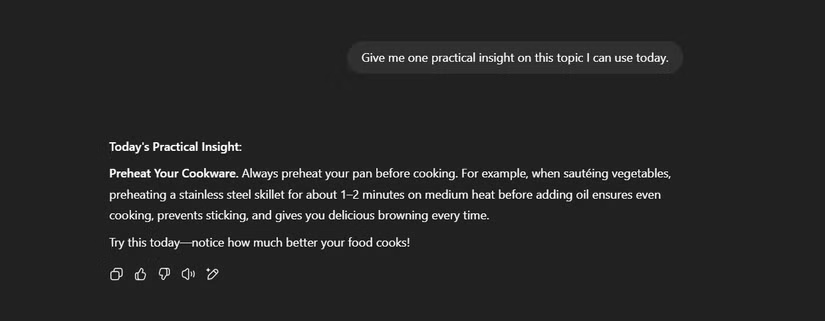
A few daily Practical Tip Prompts can help you stay focused. For example, ask:
Give me one practical insight on this topic I can use today.
Give me a practical understanding of this topic that I can use today.
Small, daily doses of information significantly increase your long-term memory.
Weekly Highlight Prompts summarize your learning progress each week. Ask AI:
What are the three most important things I should remember about this week's lessons?
What are the three most important things I should remember about this week's lessons?
Regular weekly reviews help reinforce your understanding.
Spaced Repetition Prompts are structured to reinforce memory over longer periods of time. You can schedule tasks in ChatGPT with a simple prompt:
Test me on this concept after three days, then again after a week, and once more after two weeks.
Test me on this concept after 3 days, then test me again after a week and again after two weeks.
Regular repetition will anchor the information securely in your mind. Anki is great for creating flashcards and studying on the go. You can also choose from several great free AI flashcard generators.
5. Prompt learning by situation
Situational learning puts knowledge into real-world contexts. It makes abstract concepts tangible and relevant. Case Study Highlights push you to apply concepts through real-world examples. Ask AI:
Give me a quick, three-minute case study showing this concept in action.
Give me a quick, 3 -minute case study that shows this concept in action.
Real-world examples help you see analogies and applications, while enhancing memory and recall.
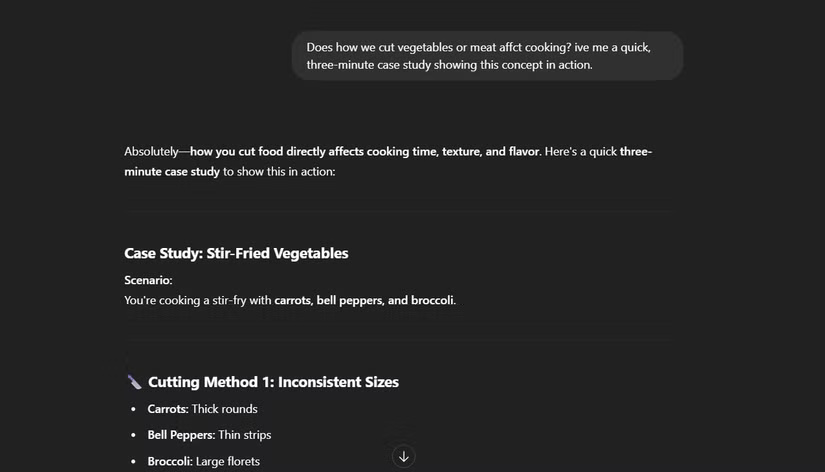
Scenario Prompts help you put theory into practice. You can try this prompt:
Give me a workplace scenario where I need to apply this concept. Walk me through the decision-making process step-by-step.
Give me a situation at work where I need to apply this concept. Walk me through the decision-making process step by step .
This helps you grasp how concepts work in a real-world context.
Problem-Solving Prompts actively engage your analytical skills. They ask for a short, specific problem related to your topic, followed by a detailed, step-by-step solution. Practice like this greatly enhances your ability to learn.
6. Prompt learning in game style
Games turn learning into a fun experience, increasing motivation and the desire to continue pursuing the subject.
Progressive Challenge Prompts sets learning up into a series of game-like levels. ChatGPT prompts start at the basics of Level 1, then gradually increase in difficulty at Level 2. Progressing through the levels helps maintain your score, motivating you to learn more.
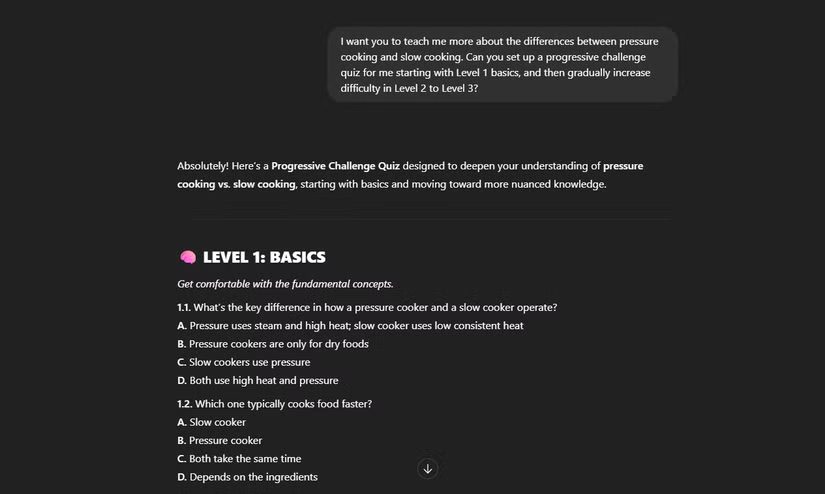
Interactive Quiz Prompts turn assessment into interactive fun. Enter the prompt:
Give me a five-question quiz on this topic, with instant feedback for each answer.
Give me a 5 question test on this topic, with immediate feedback for each answer.
Immediate feedback helps you quickly identify and correct misunderstandings.
Critical Thinking Prompts help you improve your critical thinking. Say something like:
Show me a common misconception about this topic and help me understand why it's wrong.
Point out a common misconception about this topic and help me understand why it is wrong.
Error analysis will fill in the gaps in your learning and build the fundamental concepts of your subject.
Note : These prompts are useful for learning basic topics. For more advanced (or even controversial) topics, ChatGPT, like all LLMs, can be a bit of a distraction. Additionally, ChatGPT tends to give politically correct answers and often avoids topics it deems inappropriate for its guidelines. So, supplement your learning with other methods as well.
Microlearning can help you learn a subject by spending time in short bursts. You enrich your knowledge by using Deep Research to get deeper answers. There are many different ways to use Deep Research to uncover more facts and figures, although it still does not replace the hard process of deep learning.
The above prompts are just samples used for Microlearning experiments. Some of them have been collected and edited from the web. You can create your own prompts while adjusting them to the topic you want to learn more about.
FAQ
What should you know about 1. Set up your Microlearning course?
ChatGPT can design a Microlearning roadmap for you. You should choose a narrow area within a topic instead of a broader topic to make your Microlearning sessions more specific.
What should you know about 2. Interactive learning prompt?
Interactive prompts engage you in the learning process. Back-and-forth conversations with LLM help you actively build your understanding.
What should you know about 3. Prompt content analysis?
Breaking information into small chunks makes learning less intimidating and more effective.
What should you know about 4. Prompt repetition and spaced review?
Regular review is important for long-term retention. Spaced repetition prompts help ensure important concepts stay fresh in your memory. While not perfect, you can also design your own spaced repetition system using ChatGPT Tasks.
Related Articles
 How to Always Get Perfect Replies from ChatGPT with These 7 Prompts10 minutes read
 How to Use ChatGPT as a Personal Tutor: 3 Prompts17 minutes read
 How to Come up with the Best Prompts to Learn with ChatGPT9 minutes read
 9 Great ChatGPT Prompts for a Productive Workday: Explained7 minutes read
 8 ChatGPT Prompts to Make Brainstorming More Effective: Explained10 minutes read
 minutes read
Reader Comments 0
Sign in with email or Google to join the discussion.