Table of Contents
Scientists have discovered an 'Infinity' galaxy with three active black holes, one of which may have just formed.
Infinity Galaxy Overview
Astronomers have discovered a rare galaxy system that may provide the strongest evidence yet of how supermassive black holes form under extreme conditions. The object, nicknamed The 'Infinity' galaxy , was discovered in archival data from the James Webb Space Telescope (JWST) by Pieter van Dokkum (Yale University) and Gabriel Brammer (University of Copenhagen).
This galaxy is located at A redshift of z = 1.14 , which is more than 8 billion light-years from Earth. Redshift is a phenomenon in which light is stretched to longer wavelengths, and is often used by astronomers to measure distance, velocity, and the expansion of the universe.
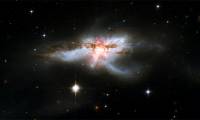
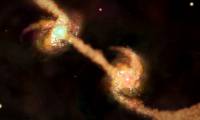
The JWST image shows two compact galactic nuclei, each with stellar masses of about 10¹¹ times the mass of the Sun, separated by about 10 kiloparsecs. Both are surrounded by stellar rings or shells, forming a figure 8 shape – like the infinity symbol. This configuration is reminiscent of the nearby II Hz 4 system, where two disk galaxies collided head-on, creating collision rings.
Follow-up observations with the Keck Observatory, the Very Large Array (VLA) and NASA's Chandra X-ray Observatory confirmed the presence of a supermassive black hole that was rapidly sucking in matter. Surprisingly, this black hole was not located in any galactic nucleus, but appeared somewhere in between, both in position and velocity. It emitted strong radiation in both radio waves and X-rays, similar to a quasar, suggesting a very rapid growth rate.

JWST's Near Infrared Camera (NIRCam) detected excess emission in the F150W filter, revealing that the black hole is surrounded by hydrogen gas glowing brightly in the Hα spectral line. The emission source, approximately 400–2000 Å across, reflects a turbulent and highly ionized environment. The gas is spread throughout the system and shows signs of shock and compression at the collision site, similar to what has been observed in bullet clusters.
Interestingly, both galactic nuclei also contain active supermassive black holes, bringing the total number in the system to three. However, the central black hole appears to have formed in situ within the shocked gas, rather than being brought over from one of the galaxies. The researchers suggest this could be an example of a direct collapse mechanism, where a giant gas cloud collapses under its own gravity and becomes a black hole without going through the process of star formation.
The discovery has important implications for the debate about the formation of primordial black holes. The 'light seeds' theory, which suggests that black holes begin as stellar remnants and grow through mergers, has difficulty explaining the rapid emergence of billion-solar-mass black holes observed by JWST in the early universe. In contrast, the 'heavy seeds' theory, in which black holes form directly from collapsing gas clouds, is faster but lacks observational evidence. The structure, gas distribution, and central black hole in the Infinity Galaxy provide compelling evidence for this scenario.
Scientists will need more simulations and spectroscopic observations from JWST to confirm whether the direct collapse process is indeed taking place. If so, the Infinity Galaxy would be the first direct evidence of this mechanism, opening up a solution to the mystery of how supermassive black holes emerged so quickly in the early universe.
'We believe we are witnessing the birth of a supermassive black hole – something never seen before,' Said Mr Van Dokkum.
Right now, the Infinity Galaxy is a rare and complex system: two massive galaxies colliding, three active black holes, and a black hole possibly being born – a unique moment in the history of the universe.
FAQ
What should you know about the 'infinity' galaxy reveals the mystery of the birth of supermassive black?
In practical terms, scientists have discovered an 'Infinity' galaxy with three active black holes, one of which may have just formed.
Why does the 'infinity' galaxy reveals the mystery of the birth of supermassive black matter?
The article highlights that if so, the Infinity Galaxy would be the first direct evidence of this mechanism, opening up a solution to the mystery of how supermassive black holes emerged so quickly in the early universe.
What is the main takeaway?
The main takeaway is that 'We believe we are witnessing the birth of a supermassive black hole – something never seen before,' said Mr Van Dokkum.
Related Articles
 10 Interesting Facts About Black Holes in the Universe (part 1)7 minutes read
 Universe: Complete Guide4 minutes read
 Shocking Discovery in Astronomy: 3 Supermassive Black Holes in4 minutes read
 10 Interesting Facts About Black Holes in the Universe (part 2)5 minutes read
 Detecting Monstrous Black Holes, 20 Billion Times Larger4 minutes read
 Discover the Terrible War Between Two Giant Black Holes3 minutes read
Reader Comments 0
Sign in with email or Google to join the discussion.