Table of Contents
Explore stephen hawking was right: black holes never shrink, including the key concepts, practical examples, important considerations, and useful guidance.
Thanks to major improvements in the sensitivity of the detection system, the research team observed the collision with nearly four times the clarity they had previously. The new data helped them confirm two important theoretical predictions:
- Black holes formed after mergers never shrink , just as Stephen Hawking's theory predicted.
- Black holes will vibrate after merging, just as Einstein's theory of general relativity predicted.
"The extremely clear signal from this GW250114 black hole merger allows us to test some of the most important hypotheses about black holes and gravitational waves," Isi shared.
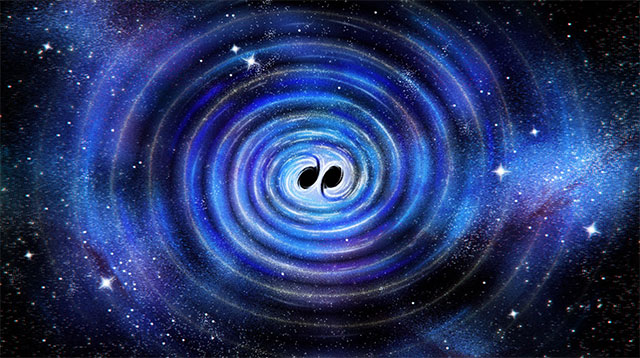
Verifying Hawking's 'Law of Area'
In 1971, Stephen Hawking proposed that the event horizon—the outer boundary from which nothing can escape— never diminishes in size.
In 2021, Isi and his colleagues used data from the LIGO observatory to analyze the ripples in spacetime generated by a black hole collision, providing the first observational evidence to confirm that prediction. At the time, The New York Times commented that if these results had been published before Hawking's death, he might have received the Nobel Prize.
The new results further reinforce that conclusion with much greater accuracy: the surface area of the merged black hole is always greater than or at least equal to the sum of the surfaces of the two original black holes . This significant improvement was achieved thanks to data collected simultaneously from the two LIGO facilities in Washington and Louisiana.
The research team also isolated and analyzed the gravitational waves emitted when the black hole merged. By measuring the pitch and duration of these ripples, they were able to better determine the structure and properties of the newly formed black hole. This mechanism is similar to listening to the sound emanating from a hollow musical instrument to determine its size, material, and the forces at work.
The results show that the merged black hole fits the description of the Kerr black hole — a mathematical model developed by mathematician Roy Kerr in the 1960s that accurately solves Einstein's space-time equations.
Physicists have long believed that all black holes obey Kerr's solution, but confirming this through observation has been extremely difficult. This particularly clear signal provides the most direct evidence to date that black holes do indeed behave as Kerr predicted.
"Over the next decade, gravitational wave observatories like LIGO will continue to be upgraded, allowing us to see even more clearly the mysteries of black holes ," Isi shared. " I'm very excited to see what we will discover. "
Final Thoughts
Understanding stephen hawking was right makes it easier to evaluate the information and apply the most relevant recommendations. Focus on the key points above and verify details that may change over time.
FAQ
What is stephen hawking was right?
Explore stephen hawking was right: black holes never shrink, including the key concepts, practical examples, important considerations, and useful guidance.
What key points does this article cover?
The article focuses on Verifying Hawking's 'Law of Area', with practical explanations and examples.
How can you use this information in practice?
Use the explanations to compare options, verify important details, and make a more informed decision. Apply the recommendations that best match your goals and situation.
Related Articles
 Successfully Creating Cosmic Black Holes, Demonstrating Hawking6 minutes read
 This Is the Technology That Helped Stephen Hawking Talk to the World When He Lost His Ability7 minutes read
 Stephen Hawking's Life Through Photos5 minutes read
 Download Stephen Hawking's Space Doctoral Thesis - Download Properties of Expanding Universes5 minutes read
 10 Interesting Facts About Black Holes in the Universe (part 1)7 minutes read
 Stephen Hawking Warned: 'humans Have Only 100 Years Left to Leave8 minutes read
Reader Comments 0
Sign in with email or Google to join the discussion.