Table of Contents
A new study shows that the enzyme HSL not only breaks down fat but also regulates fat cell activity in the cell nucleus, opening up new research directions for obesity and metabolic disease.
After more than 60 years of research on fat metabolism, international scientists have just discovered something that has caused the entire industry to reconsider: an enzyme that was thought to only have the task of breaking down stored fat actually plays a completely different role inside the nucleus of fat cells.
Fat cells (adipocytes) in the body are not simply places to 'store excess energy' as many people think. They play a central role in regulating the body's energy supply. Inside fat cells are small lipid droplets - storage areas of fat that the body can mobilize when it needs energy, such as during fasting or between meals.
To 'unlock' this reserve, the body relies on a protein called HSL (Hormone-Sensitive Lipase), which acts as an energy control switch. When energy levels drop, hormones like adrenaline activate HSL, causing it to break down stored fat to fuel the organs.
At first glance, if we lack HSL, we might think that the body will not be able to burn fat, leading to fat accumulation and obesity. But surprisingly, studies on mice and humans with HSL gene mutations have shown the opposite: HSL deficiency causes fat tissue to deteriorate, leading to lipodystrophy.
Although obesity and lipodystrophy may sound like opposites, they both stem from fat cell dysfunction. When fat cells don't function properly, metabolism goes haywire, increasing the risk of similar metabolic and cardiovascular diseases.
Unexpected discovery inside fat cells
To explain this strange phenomenon, a research team led by Professor Dominique Langin (University of Toulouse, France) discovered that HSL appears in an unexpected location: in the nucleus of fat cells.
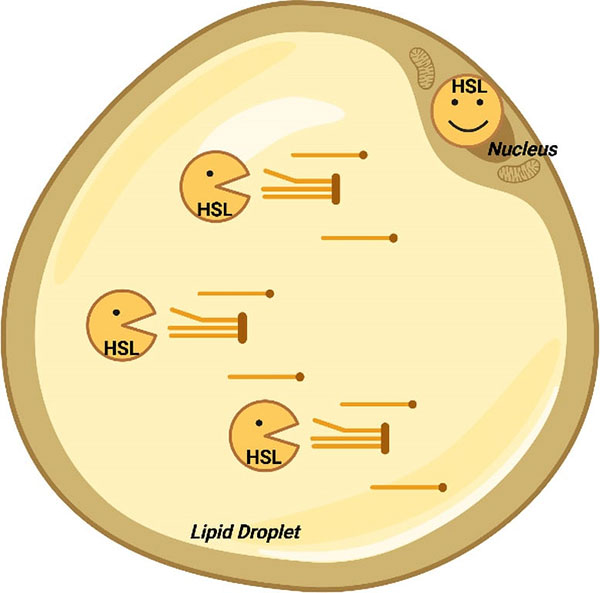
Previously, HSL was known to be an enzyme that resides on the surface of lipid droplets, where it directly breaks down fat. But new research shows that HSL is also present in the cell nucleus, where it binds to a variety of other proteins to keep fat cells 'healthy'.
'In the nucleus of fat cells, HSL participates in a regulatory program that helps maintain optimal fat tissue levels and ensures that fat cells function normally,' — Jérémy Dufau , co-author of the study, shared.
The sophisticated regulatory mechanism of HSL
The study also found that the amount of HSL in the cell nucleus is tightly controlled. When adrenaline is released to activate HSL on the surface of lipid droplets (during fasting), the enzyme also leaves the cell nucleus. Conversely, in obese mice, the amount of HSL in the nucleus is abnormally high — which may be related to dyslipidemia.
'HSL has been known since the 1960s as a fat-dissolving enzyme. But now we know it also plays an essential role in the nucleus of fat cells, helping to maintain the health of fat tissue,' — Professor Dominique Langin Concludes.
This discovery not only explains the lipodystrophy in HSL-deficient humans, but also opens up new research directions for metabolic diseases such as obesity and related complications.
The findings come at a remarkable time, with half of French adults now overweight or obese. Globally, that figure is 2.5 billion. Obesity increases the risk of diabetes, cardiovascular disease and reduces quality of life. Therefore, further research into the mechanisms of fat cell function is key to improving prevention and treatment in the future.
FAQ
What is new about shocking discovery about obesity?
In practical terms, a new study shows that the enzyme HSL not only breaks down fat but also regulates fat cell activity in the cell nucleus, opening up new research directions for obesity and metabolic disease.
Why does this update matter?
The article highlights that unexpected discovery inside fat cells To explain this strange phenomenon, a research team led by Professor Dominique Langin (University of Toulouse, France) discovered that HSL appears in an unexpected location: in the.
Is the change available to everyone?
Availability may depend on the product version, region, account, or rollout stage described in the article.
Related Articles
 How to Use G Shock Watch from a - Z7 minutes read
 Not Dieting, This Is the New Method of Preventing Obesity8 minutes read
 The Solar System Is Moving Three Times Faster Than Predicted5 minutes read
 This Drug May Reverse the Effects of Obesity in the Mother4 minutes read
 New Discoveries Could Make 2025 an Unexpectedly Happy Year5 minutes read
 75% of British People Are Not Aware of the Link Between Obesity3 minutes read
Reader Comments 0
Sign in with email or Google to join the discussion.