Table of Contents
Michael Faraday's journey from a poor, self-taught bookbinder to the " father of electromagnetism " has inspired generations of scientists. Faraday is one of the great names whose work has shaped the way we live today.
In 1812, young Michael Faraday sat in awe as he listened to a lecture by the renowned chemist Sir Humphry Davy. Faraday was working as a bookbinder's apprentice and spent his spare time poring over the books he bound.
Born into poverty and with little formal education, he had no idea that he would revolutionize science. Through sheer determination and a love of learning, he changed the course of history, becoming one of the greatest experimental physicists and chemists ever known. His work still drives modern science and technology today.
A difficult childhood but could not stop the love of learning
Born on 22 September 1791 in Newington, Surrey, Faraday's family was very poor. His father, a blacksmith, struggled with illness, and young Michael had to support the family by becoming an apprentice bookbinder.
But it was from this humble job that Faraday's real academic career began. He studied the books he was assigned to bind carefully, with a special passion for scientific works.
Faraday was largely self-taught. He was persistent, his innate curiosity not allowing him to stop until he had found the answer. He attended public lectures whenever possible, including those of Humphry Davy, the famous chemist and inventor.
Faraday's opportunity came when he presented Davy with a neat lecture note of what he had learned. Impressed by it, Davy offered him a job as a laboratory assistant at the Royal Institution. This was the turning point that led Michael Faraday to greatness.

Famous Christmas Sermons
Faraday eventually became a professor at the Royal Institution, where he left an indelible mark not only through his research but also through his public engagement.
He had an extraordinary talent for simplifying complex ideas. Faraday took over the famous Christmas Lectures, originally instituted by Davy in 1825, and turned them into one of the most celebrated scientific traditions.
These lectures, designed to educate the public, especially young people, are presented with clarity and enthusiasm, making complex ideas more accessible.
Faraday delivered a total of 19 Christmas Lectures, covering topics such as chemistry, electricity, and magnetism.
His ability to communicate science to large audiences brought him widespread fame, and these lectures continue to this day, inspiring future generations of scientists.
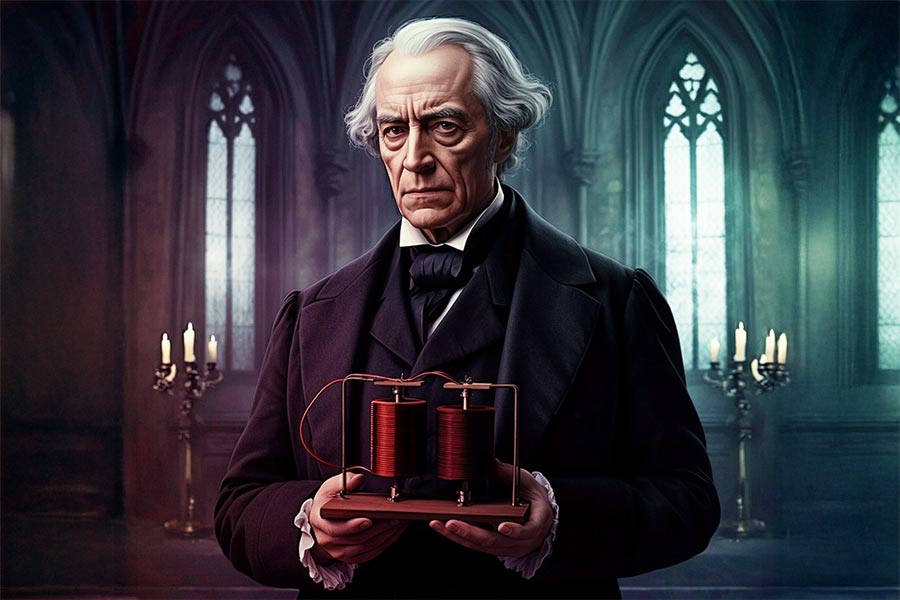
Discoveries that changed science
One of Faraday's most groundbreaking discoveries was electromagnetic induction. In 1831, Faraday discovered that by moving a magnet across a coil of wire, he could produce an electric current.
This seemingly simple observation became the basis of generators and transformers. Every time you turn on a light, charge your phone, or use an electric motor, you are benefiting from Faraday's discovery.
Faraday's work went beyond electricity. In chemistry, he discovered benzene, liquefied gas, and developed the laws of electrolysis, which describe how electric currents cause chemical reactions. His work paved the way for an understanding of chemical reactions and the behavior of ions in solution, becoming the foundation for modern electrochemistry.
Furthermore, Faraday introduced the concept of electric fields, which led to the development of Maxwell's equations. Without his discoveries, modern technologies such as electric motors, generators, and even communication systems might not exist as they do today.
Additionally, Faraday developed the first electric motor, and contributed to the discovery of diamagnetism - demonstrating that magnetic forces can act on all materials, not just metals.
Despite his many accomplishments, Faraday remained humble and refused any formal titles or honors. He focused on his work, driven by pure curiosity and a desire to understand the natural world. Faraday may have started his journey as a humble bookbinder, but his legacy as a pioneer in the fields of electromagnetism and electrochemistry will live on forever.
Final Thoughts
Overall, Michael Faraday's Journey from Poor Bookbinder is best understood by considering the main facts, practical context, and limitations together. Use the details above as a clear starting point and confirm time-sensitive information when necessary.
FAQ
What does this article explain about Michael Faraday's Journey from Poor Bookbinder?
Michael Faraday's journey from a poor, self-taught bookbinder to the " father of electromagnetism " has inspired generations of scientists. Faraday is one of the great names whose work has shaped the way we live today.
What should you know about A difficult childhood but could not stop the love of learning?
Born on 22 September 1791 in Newington, Surrey, Faraday's family was very poor. His father, a blacksmith, struggled with illness, and young Michael had to support the family by becoming an apprentice bookbinder.
Should time-sensitive details be verified?
Yes. Software features, game codes, product specifications, prices, and research findings can change. Confirm important details with an official or primary source when accuracy affects your decision.
Related Articles
 Fathers Day Fathers Day 2017: Origin and Meaning: Father's Day7 minutes read
 Father's Day 2025: Origin and Meaning7 minutes read
 How Much Electricity Does the Computer, Phone and Electrical4 minutes read
 15 Great Things Have Been Killed by Modern Technology10 minutes read
 Young Beggars, Stealing Money to Start a Career of the Father of5 minutes read
 How to Use Air Conditioner to Save Up to 50% Electricity with Just 1 Button11 minutes read
Reader Comments 0
Sign in with email or Google to join the discussion.