Table of Contents
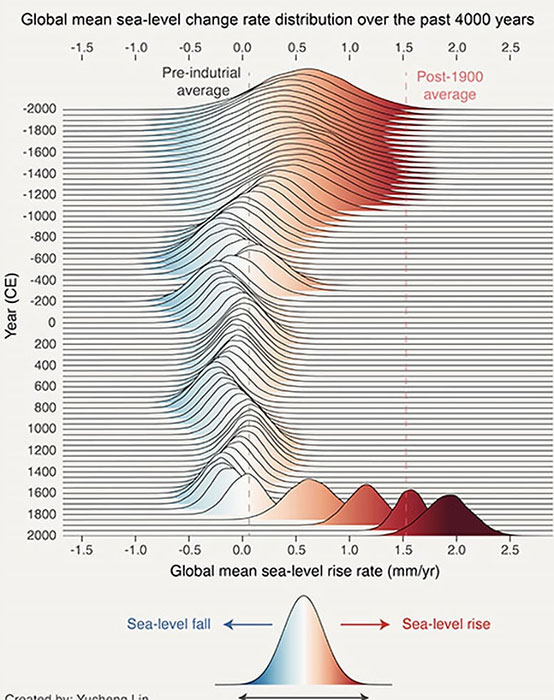
New research shows that global sea levels are rising faster than at any time in the past 4,000 years, posing serious risks to coastal cities such as Shanghai, Shenzhen and Hong Kong.
A new geological study shows that sea levels are now rising at their fastest rate in 4,000 years, underscoring the urgency of action at both global and local levels.
A team of scientists led by Rutgers University (USA) discovered that sea levels are rising faster today than at any time in the past 4,000 years, making China's coastal cities one of the most seriously threatened areas.
To determine the trend, the researchers analyzed thousands of geological records from ancient coral reefs, mangroves, and other sources – 'natural records' that preserve evidence of past sea levels. This allowed them to trace sea-level fluctuations back nearly 12,000 years, starting in the Holocene epoch – the period following the last ice age.
Since 1900, global average sea levels have risen about 1.5 mm per year – faster than any century-long period in the past four millennia, according to research published in the journal Nature.
' The average rate of global sea level rise since 1900 is the fastest in at least 4,000 years ,' said researcher Yucheng Lin – a former PhD student at Rutgers University and now a scientist at Australia's Commonwealth Scientific & Industrial Research organization (CSIRO).
Lin conducted the research with Professor Robert Kopp, of Earth and Planetary Sciences at Rutgers University. Mr. Kopp commented: ' Dr. Lin's work shows that geological data can help us better understand the risks facing coastal cities today .'
Main causes: Temperature and ice melting
According to Lin, there are two main factors causing sea levels to rise rapidly: thermal expansion and ice melting. As the planet warms due to climate change, the oceans absorb heat and expand. At the same time, ice sheets in Greenland and Antarctica melt, adding huge amounts of water to the oceans.
'As the Earth warms, the volume of seawater increases. Glaciers melt faster because they are smaller than the giant ice sheets, and now we are seeing a sharp increase in the rate of ice melt in Greenland,' said Lin.
While rising sea levels are a global problem, China is facing a 'double threat'. Many major cities and economic hubs such as Shanghai, Shenzhen and Hong Kong are located in deltas – areas that are already prone to natural subsidence due to weak geology.
That said, human activities make the situation worse.
' You can calculate the natural rate of sea level rise in this area, but over-extraction of groundwater is causing that process to happen much faster ,' the team said.
The role of land subsidence
Subsidence is the gradual lowering of the Earth's surface, which can occur due to natural geological processes or human activities – especially groundwater extraction.
To assess the impact of sea-level rise on China's deltas, the team combined geological data, information on land subsidence, and human-caused factors in several coastal areas – notably the Yangtze River Delta and the Pearl River Delta, home to many megacities.
In Shanghai, some areas of the city have sunk more than a meter in the 20th century due to over-extraction of groundwater – hundreds of times faster than the global average rate of sea level rise.
Deltas are flat, fertile and close to water – ideal for agriculture, transport and urbanisation – but are also vulnerable to flooding.
' Just a few centimeters of sea level rise would significantly increase the risk of flooding in the deltas, ' Lin warned. ' This is not only an important domestic area but also the world's manufacturing center. If coastal risks occur here, the global supply chain will be severely affected .'
Positive signals and adaptive direction
Despite the worrying findings, Lin believes there is still hope. Some cities, like Shanghai, have already begun taking action, including controlling groundwater extraction and pumping fresh water back into underground aquifers to slow the rate of subsidence.
The study also provides vulnerability assessment maps, helping authorities and urban planners identify subsidence hotspots and proactively prepare before sea levels rise further.
Although the focus is on China, Lin says the lesson is relevant globally. Many major cities such as New York, Jakarta and Manila are located in low-lying coastal areas and face similar risks.
' Deltas are great places for agriculture, fishing and urban development, and have always attracted people to live ,' Lin said. ' But because they are so flat and prone to subsidence, if sea levels continue to rise, they could be submerged very quickly. '
FAQ
What should you know about sea levels are rising at the fastest rate in 4?
In practical terms, new research shows that global sea levels are rising faster than at any time in the past 4,000 years, posing serious risks to coastal cities such as Shanghai, Shenzhen and Hong Kong.
Why does sea levels are rising at the fastest rate in 4 matter?
The article highlights that a team of scientists led by Rutgers University (USA) discovered that sea levels are rising faster today than at any time in the past 4,000 years, making China's coastal cities one of the most seriously threatened areas.
What is the main takeaway?
The main takeaway is that ' The average rate of global sea level rise since 1900 is the fastest in at least 4,000 years ,' said researcher Yucheng Lin – a former PhD student at Rutgers University and now a scientist at Australia's Commonwealth.
Related Articles
 Greenland's Largest Glaciers Are Melting at an Incredible Rate5 minutes read
 The 25-year Study Shows That Rising Sea Levels Are Rising4 minutes read
 10 Cities with the Fastest Internet Speeds in the World4 minutes read
 A Guide to Adding New Cities to Airvisual to See Air Pollution4 minutes read
 What Is Left of Asia If the Whole Ice on Earth Melts?3 minutes read
 Assess the Rising Lords, the Life of a Medieval Power Lord12 minutes read
Reader Comments 0
Sign in with email or Google to join the discussion.