Table of Contents
A completely new ion-caloric cooling technology has the potential to replace current cooling methods. This cooling technology is considered safer and more friendly to the Earth.
Refrigeration Technology Overview
A completely new ion-caloric cooling technology has the potential to replace current cooling methods. This cooling technology is considered safer and more friendly to the Earth.

Conventional refrigeration systems transport heat away from the space through a liquid that absorbs heat as it evaporates into a gas, then is transported through a closed tube and condenses back into a liquid.
While this process is effective, some of the materials we choose as refrigerants are not particularly environmentally friendly. However, there are many ways for a substance to absorb and release heat.
A method published in 2023, developed by researchers from Lawrence Berkeley National Laboratory and the University of California, Berkeley, takes advantage of the way energy is stored or released when materials change phase, such as when solid ice turns to liquid water.
Increasing the temperature of an ice cube will cause it to melt. What humans don't realize is that the melting process absorbs heat from its surroundings, effectively cooling it.
One way to melt ice without adding heat is to add a few electrically charged particles, or ions. Sprinkling salt on roads to prevent ice from forming is a common example of this. Thermal ion cycles also use salt to change the phase of a liquid and cool the surrounding environment.
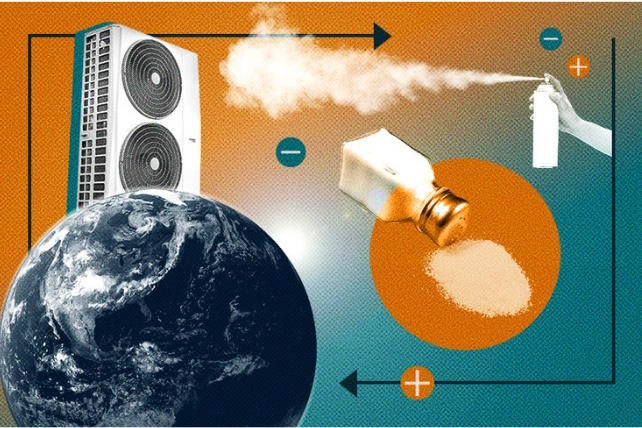
'The evolution of the refrigerant is an unsolved problem ,' says mechanical engineer Drew Lilley from Lawrence Berkeley National Laboratory in California.
" No one has yet successfully developed an alternative that can cool everything, work efficiently, be safe, and not harm the environment. We believe that the ion-heat-calorie cycle has the potential to meet all of those goals if implemented properly. "
The researchers have theoretically modeled the thermal ion cycle to demonstrate its ability to compete with, or even improve upon, the performance of currently used refrigerants. An electric current running through the system moves ions within, changing the melting point of the material and thus the temperature.
The team also conducted experiments using a salt made from iodine and sodium to melt ethylene carbonate. This common organic solvent is also used in lithium-ion batteries and is produced using carbon dioxide as an input. This could result in a system that has not only zero GWP, but also a negative GWP.
In the experiment, a temperature change of 25 degrees Celsius (45 degrees Fahrenheit) was measured using a charge of less than one volt, a result that far exceeds what other calorimetric technologies have achieved to date.

' You can find three things we are trying to balance: GWP of the refrigerant, energy efficiency, and equipment cost ,' says mechanical engineer Ravi Prasher from Lawrence Berkeley National Laboratory.
" From the very first trial, our data showed very positive results on all three of these aspects. "
Vapor compression systems currently used in process refrigeration are based on high GWP gases, such as hydrofluorocarbons (HFCs).
Countries that have signed the Kigali Amendment have committed to reducing HFC production and consumption by at least 80% over the next 25 years – and thermo-ion cooling could play a key role in this.
Now, researchers need to take this technology out of the lab and into real-world systems that can be used commercially and scaled up without any problems. Ultimately, these systems could be used for heating as well as cooling.
Research is underway, testing different salts to see which combination might be most effective at capturing heat from space. In 2025, an international team published their results on a high-performance version using a nitrate-based salt, recycled using an electric field and a membrane.
That's exactly what Prasher and his team predicted.
' We have this completely new thermodynamic cycle and framework that combines elements from many different fields, and we have demonstrated that it can work, ' Prasher said. ' Now it is time to experiment to test different combinations of materials and techniques to meet the engineering challenges. '
The research was published in the journal Science.
FAQ
What is new about scientists have invented a completely new way of cooling?
In practical terms, a completely new ion-caloric cooling technology has the potential to replace current cooling methods. This cooling technology is considered safer and more friendly to the Earth.
Why does this update matter?
The article highlights that this cooling technology is considered safer and more friendly to the Earth.
Is the change available to everyone?
Availability may depend on the product version, region, account, or rollout stage described in the article.
Related Articles
 5 Reasons to Use Cooling Fans Instead of Water Cooling6 minutes read
 How to Fix the Cooling Fan Phenomenon on the MacBook Is Loud6 minutes read
 Should I Buy a Laptop Cooling Pad? How to Use a Cooling Pad8 minutes read
 The Rise and Fall of Liquid Cooling: Is the Trend Coming to an End: Explained5 minutes read
 Are Cooling Pads Effective? How to Use a Laptop Cooling Pad7 minutes read
 Air Cooling or Liquid Cooling, Which Is Better?5 minutes read
Reader Comments 0
Sign in with email or Google to join the discussion.