Table of Contents
OpenAI has officially integrated GPT-5-Codex into Codex, providing 'dynamic thinking' capabilities that can handle processing from seconds to 7 hours.
OpenAI has announced that it will integrate an upgraded version of GPT-5 into its AI programming tool Codex. The new model, called GPT-5-Codex, is designed to manage 'thinking time' more flexibly, ranging from a few seconds to up to 7 hours for a programming task. As a result, Codex's performance on automated coding benchmarks has been significantly improved.
GPT-5-Codex is currently deployed in Codex products, accessible via the terminal, IDE, GitHub, or ChatGPT. ChatGPT Plus, Pro, Business, Edu, and Enterprise users will have early access. OpenAI also said it will soon make GPT-5-Codex available to API customers.
Competition in the programming AI tools market
The upgrade is part of a strategy to help Codex compete directly with rivals such as Claude Code, Cursor from Anysphere, or GitHub Copilot from Microsoft. The AI market for programming is getting hotter and hotter due to high demand from users. For example, Cursor reached more than $500 million in annual recurring revenue (ARR) by early 2025, while Windsurf – a similar tool – was caught in a chaotic acquisition that split its development team between Google and Cognition.
Outstanding Performance of GPT-5-Codex
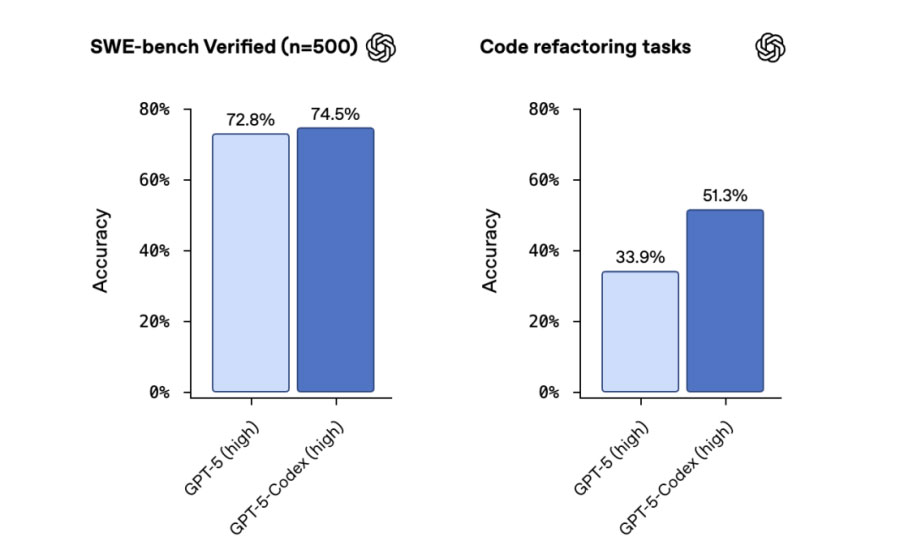
OpenAI claims that GPT-5-Codex outperforms GPT-5 on many tests, notably:
- SWE-bench Verified: evaluates the ability to program automated tasks.
- Code refactoring benchmarks: measuring the effectiveness of refactoring source code from large data repositories.
Also, GPT-5-Codex is also trained specifically for the code review task. When compared to experienced programmers, the model is found to produce fewer incorrect comments and add more 'high-impact' comments.
The 'secret' behind the new performance
In a press conference, Alexander Embiricos, Codex Product Lead at OpenAI, said the improvement mainly comes from GPT-5-Codex's 'dynamic thinking' capabilities.
This mechanism is similar to GPT-5's router on ChatGPT – which routes queries to appropriate models based on complexity – but GPT-5-Codex does not use a router. Instead, it can adjust its processing time in real time.
For example, instead of initially planning to work for 10 minutes, GPT-5-Codex might realize after five minutes that it needs another hour to completely solve a problem. In some cases, Embiricos says he has seen the model work for up to seven hours straight on a programming task.
FAQ
What is new about OpenAI launches GPT-5-Codex?
In practical terms, OpenAI has officially integrated GPT-5-Codex into Codex, providing 'dynamic thinking' capabilities that can handle processing from seconds to 7 hours.
Why does this update matter?
The article highlights that OpenAI also said it will soon make GPT-5-Codex available to API customers.
Is the change available to everyone?
Availability may depend on the product version, region, account, or rollout stage described in the article.
Related Articles
 OpenAI Codex Officially Launches Globally4 minutes read
 5 exciting projects to help you explore the power of7 minutes read
 OpenAI Codex User Guide with 3 Real-World Examples10 minutes read
 How to Enable and Use the GPT-5.5 Codex in Cursor (Detailed Instructions)7 minutes read
 5 Tips to Turn OpenAI Codex into a More Powerful AI Coding Agent9 minutes read
 How to Use OpenAI Codex Directly in Google Chrome5 minutes read
Reader Comments 0
Sign in with email or Google to join the discussion.