Table of Contents
The Black Sea lies between southeastern Europe and western Asia. Its most distinctive feature is the separation between a relatively fresh, oxygenated surface layer and denser deep water with little or no dissolved oxygen.
Where is the Black Sea?
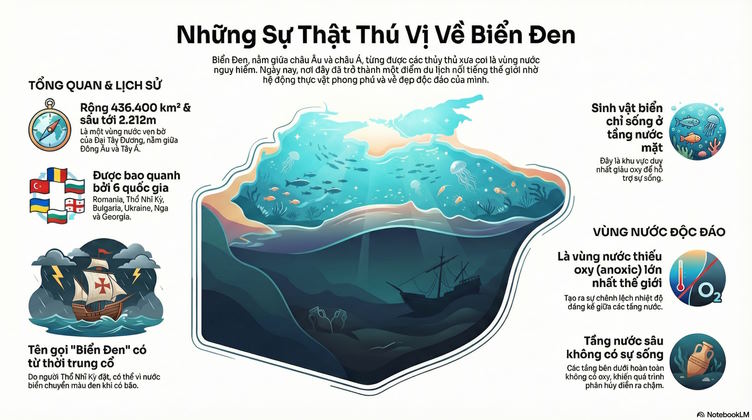
Six countries have Black Sea coastlines: Bulgaria, Georgia, Romania, Russia, Türkiye, and Ukraine. The Black Sea Commission’s geography summary lists a surface area of approximately 432,000 square kilometers and a maximum depth of 2,212 meters. Area estimates can vary with the boundaries used.
It is a sea connected to the wider ocean system, not an isolated lake. Water passes through the Bosporus Strait into the Sea of Marmara, then through the Dardanelles to the Aegean and Mediterranean seas. The Black Sea also connects to the Sea of Azov.
Rivers and straits shape its water balance
The Danube, Dnieper, Dniester, Southern Bug, and Rioni are among the rivers feeding the Black Sea. Their freshwater input helps make the upper water less salty than the deeper water arriving from the Mediterranean system.
Exchange through the Bosporus occurs in two main layers: relatively fresh Black Sea water flows outward near the surface, while saltier water flows inward below it. Describing this simply as water “emptying” into the Mediterranean misses the inward flow.
Why the deep water lacks oxygen
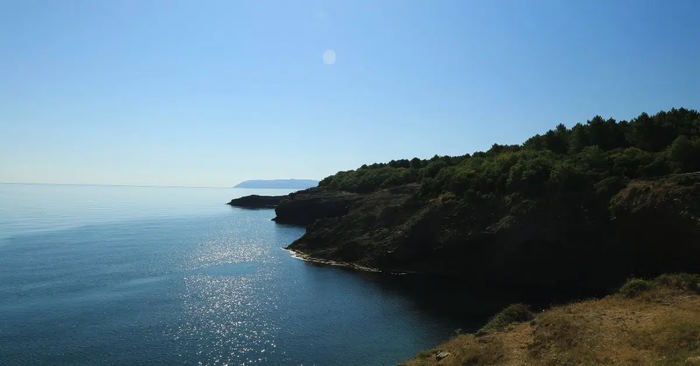
Saltier water is generally denser than fresher water. This density difference helps keep the Black Sea’s layers separated and limits the mixing that could supply oxygen to its depths. The Woods Hole Oceanographic Institution’s Black Sea research overview explains this stratification and the sulfide-rich deep water.
Anoxic means lacking dissolved oxygen. It does not mean chemically inactive or entirely lifeless. Microorganisms can inhabit environments that cannot support the fish and other animals normally associated with oxygenated seawater.
The boundary between water layers is not a single fixed depth everywhere. It varies with location and water conditions, so a universal cutoff is an oversimplification.
Does the Black Sea support marine life?
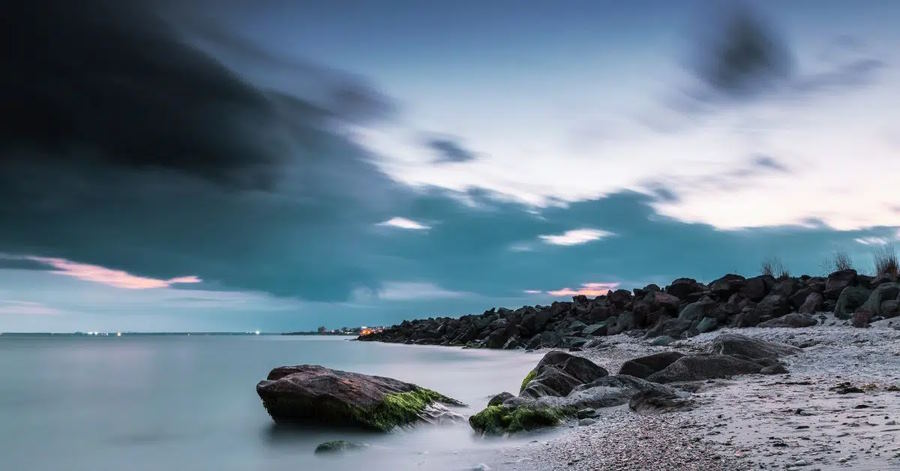
Yes. Its oxygenated upper waters and coastal habitats support fish, algae, and other marine organisms. The deep anoxic basin has a very different ecosystem. Saying that the whole sea is “dead” confuses those environments.
Changes in salinity and density also matter in other marine settings; TipsMake’s article on natural phenomena includes an explanation of brinicles, although these cold-water formations are a different process.
What does the name mean?
The name does not mean that the water is permanently black. Several explanations have been proposed, including associations with storm-darkened water or dark deposits on submerged objects. These explanations should be treated cautiously rather than presented as a settled origin.
The Black Sea is also different from the Dead Sea, an inland saline lake in the Middle East. For more geography and ecology articles, browse TipsMake’s Discover Nature section.
Related Articles
 Interesting facts about the Sun that you may not know
 40 interesting facts you didn't know about the Sun.
 10 interesting facts about black holes in the universe (Part 1)
 10 interesting facts about black holes in the universe (Part 2)
 15 interesting facts about DRAGON phenomenon you may not know
 11 interesting and quirky historical facts that make everyone think it's a joke
Reader Comments 0
Sign in with email or Google to join the discussion.