Table of Contents
A new, hyper-detailed 'map' of the Sculptor Galaxy has revealed the life cycles of stars and the hidden structures within, providing new insights into how tiny processes can affect even the most massive galaxies.
Astronomers have released unprecedented images of the Sculptor Galaxy, created by the European Southern Observatory's (ESO) Very Large Telescope (VLT). The instrument captured the galaxy in thousands of different wavelengths of color at once, allowing the team to build a complete picture of how stars are born, live, and die in Sculptor.
' Galaxies are incredibly complex systems that we are still trying to understand ,' said Enrico Congiu, an ESO researcher and lead author of the study published in the journal Astronomy & Astrophysics. ' The Sculptor Galaxy is a special case, as it is both close enough to see the details of its internal structure, and large enough to be considered as a complete system .'
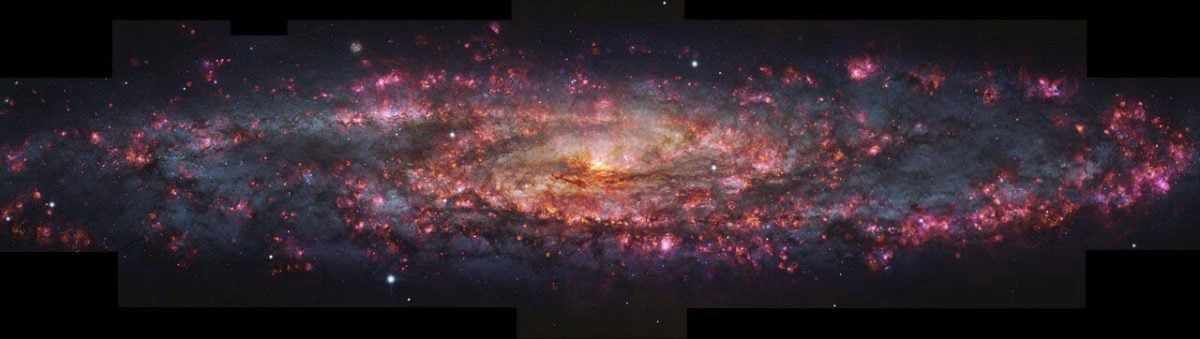
'Thousand-color' photo reveals the life cycle of stars
The basic components of a galaxy — stars, gas, and dust — all glow in different colors. The more colors scientists can capture, the better they can understand the age, chemical composition, and motions within a galaxy. While conventional astronomical images show just a few colors, Sculptor's new map shows thousands of colors, allowing for unprecedented detail.
To create the map, the team observed the Sculptor Galaxy – also known as NGC 253, which is about 11 million light-years away from Earth – for 50 hours straight using the MUSE instrument on the VLT. They had to stitch together more than 100 shots to cover a 65,000-light-year area of the galaxy.
According to Dr Kathryn Kreckel (University of Heidelberg, Germany), co-author of the study: ' We can zoom in to study individual star-forming regions so close that we can almost see individual stars, or zoom out to observe the entire galaxy .'
In their initial analysis, the team found about 500 planetary nebulae — the dust and gas that sun-like stars eject when they die — in Sculptor. That's a far cry from the usual number, as astronomers typically find fewer than 100 of these nebulae in any given galaxy outside the immediate vicinity of the Milky Way.
Because of their unique properties, planetary nebulae can also be used as 'distance gauges' to their host galaxies. ' Identifying them allows us to accurately calculate the distance to Sculptor - a fundamental factor for all other studies of this galaxy, ' said co-author Adam Leroy (Ohio State University, USA).
In the future, this map will be used to study how gas flows, changes chemical composition, and creates new stars across Sculptor. 'How these tiny processes can affect a massive galaxy remains a mystery.'
Final Thoughts
The development covered in this article is worth following, but specifications, dates, and feature details may change until the relevant company or organization publishes an official confirmation.
FAQ
What is the main development covered in this article?
A new, hyper-detailed 'map' of the Sculptor Galaxy has revealed the life cycles of stars and the hidden structures within, providing new insights into how tiny processes can affect even the most massive galaxies.
What should you know about 'Thousand-color' photo reveals the life cycle of stars?
The basic components of a galaxy — stars, gas, and dust — all glow in different colors. The more colors scientists can capture, the better they can understand the age, chemical composition, and motions within a galaxy.
Is every reported detail officially confirmed?
Not necessarily. Product leaks, preview builds, research reports, and early announcements can change. Confirm important specifications, dates, and availability through an official source before making a decision.
Related Articles
 9 Amazing Facts About the Universe Amaze You7 minutes read
 The Most Distant Galaxy Ever Discovered Holds Amazing Secrets4 minutes read
 9 Secrets That Movie Theater Staff Never Reveal to You7 minutes read
 Reveal the Real Photos of Galaxy Note 10: No 3.5mm Jack and Bixby3 minutes read
 Smallest Galaxy Ever Discovered: Like a Human but Only the Size of a Grain of Rice8 minutes read
 Galaxy: Complete Guide: The Moment Two Galaxies Collide in a Super Rare3 minutes read
Reader Comments 0
Sign in with email or Google to join the discussion.