Table of Contents
The Galaxy S26 Ultra is now an announced product, so its official specifications are more useful than the earlier case-maker images and rumors. Samsung confirms a thinner, more rounded design and faster wired charging, but the battery remains rated at 5,000 mAh typical. The old prediction of a larger battery did not become the published specification.
What the earlier image could—and could not—show
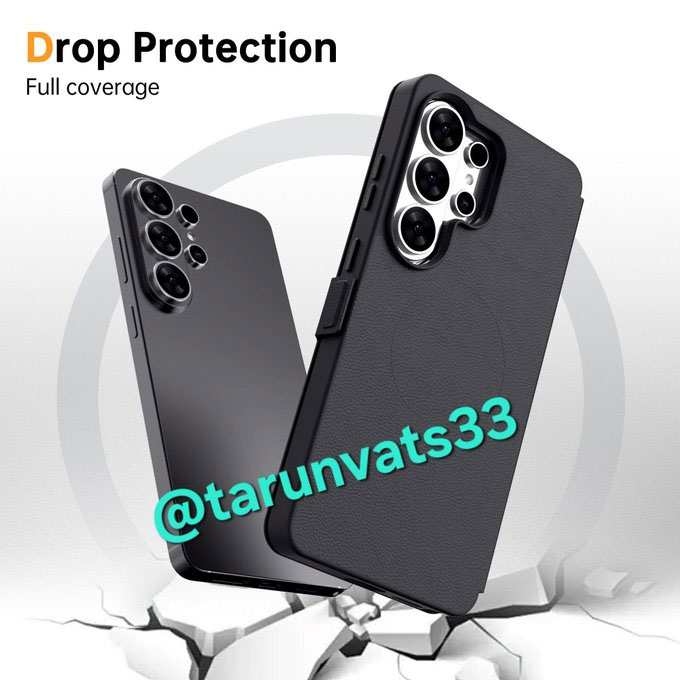
The image below appeared in prelaunch coverage as an alleged Galaxy S26 Ultra design. Keep it in that context: a leaked case or mockup is not an authenticated photograph of a retail phone, and it cannot establish battery capacity or camera specifications.
Confirmed design changes
Samsung describes a shared rounded design across the S26 lineup. Its official first-look article lists the Ultra at 7.9 mm thick and 214 g. Those measurements provide a firmer basis for comparison than speculation about why a camera bump looks different.
The Samsung design account explains the effort to align corner curvature across the models. That confirms the design direction without needing to infer engineering changes from a case.
Battery and charging: separate the two
Samsung's published specifications give the Ultra a 5,000 mAh typical battery and wired charging up to 60 W. Faster charging is not the same as increased battery capacity or guaranteed longer runtime.
Actual charge speed depends on the charger, cable, temperature, battery state, and other conditions. A maximum power figure does not mean the phone draws that power throughout a complete charge.
Do not carry camera rumors forward as facts
The earlier article speculated about variable aperture and a larger sensor based on the camera housing. A housing shape cannot establish either feature. Use Samsung's current camera specifications and sample images for the exact model instead of treating an unconfirmed rumor as an upgrade.
Different apertures on different cameras are also not the same thing as a single lens with a variable aperture.
What to check before upgrading
- Compare the official battery specification with your current phone rather than assuming a larger number.
- Check compatible charging accessories and what is included in your region.
- Inspect the phone's size, grip, and camera protrusion in person if those matter to you.
- Evaluate actual camera results for the focal lengths and lighting you use.
- Compare local storage options, price, and support details on the regional product listing.
Earlier leaks are useful as a record of prelaunch expectations. They should no longer be the basis for describing what the released phone contains.
Related Articles
 How to take a screenshot on Samsung Galaxy S21, S21+, and S21 Ultra phones
 Galaxy S20 and S20 +: Snapdragon 865 / Exynos 990, 8 / 12GB RAM, 100X zoom camera, 8K video recording
 Galaxy M11 revealed: Perforated screen, 3 rear cameras, Snapdragon 450, 5000mAh battery
 Samsung will launch the Galaxy Watch7 Ultra under the name Galaxy Watch X, with an emphasis on battery life
 The super product of 6 million screens 'eats up' the Galaxy S23 Ultra revealed, the flawless design overshadows the iPhone 14
 The display panel on the Galaxy S20 Ultra is the 'best ever made' panel, this is why
Reader Comments 0
Sign in with email or Google to join the discussion.