Table of Contents
Explore co2 concentrations in earth's atmosphere will reach a 'once-in-a-million'.
Scientists studied the chemical composition of tiny fossils, about the size of a battery head, collected from deep-sea sediments in the Caribbean. They then used this data to reconstruct the concentration of CO2 in Earth's atmosphere during the Pliocene epoch, approximately 3 million years ago, when our planet reached its warmest temperature ever recorded—more than 3°C warmer than today—and global sea levels were also higher during that period.
"Statistical data on CO2 concentrations throughout geological history is crucial because it tells us how past climate systems, ice sheets, and sea levels have responded to rising CO2 levels across the planet. This is especially relevant to the climate change and rapidly increasing CO2 concentrations that humanity is facing today," said Dr. Elwyn de la Vega, the lead researcher.
To determine atmospheric CO2 concentrations, the research team used the isotopic composition of the element boron, which is naturally present as an impurity in the shells of plankton called foraminifera or 'forams'. These organisms, about half a millimeter in size, gradually accumulate in large numbers on the seabed, forming a vast and detailed repository of information about Earth's past climate. The isotopic composition of boron in the shells of foraminifera depends on the acidity (pH) of the seawater where they live. From the close relationship between atmospheric CO2 and seawater pH, it is possible to calculate past CO2 concentrations through a more detailed analysis of the properties of boron in the shells of ancient foraminifera.
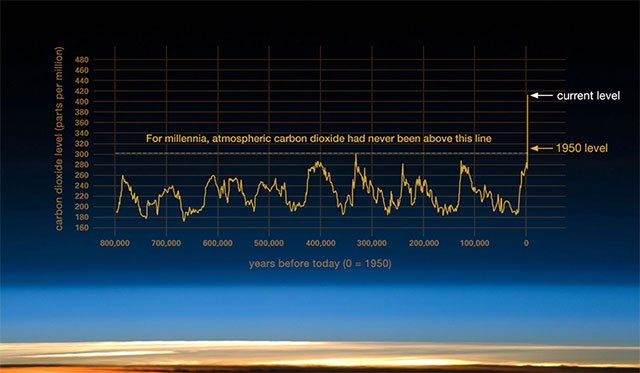
Dr. Thomas Chalk, co-author of the study, added:
"Focusing on warmer periods in the past, like today, gives us a good way to study how Earth reacted to the excessive amount of CO2 released into the atmosphere. We found that the warmest period of the Pliocene epoch had between 380 and 420 parts per million of CO2 in the atmosphere. This is similar to today's value of around 415 parts per million, indicating that we were already at a high level. Currently, atmospheric CO2 levels on Earth are increasing at a rate of about 2.5 ppm per year, meaning that by 2025, CO2 levels on the planet will surpass the record high of the last 3.3 million years."
It can be said that the Earth's climate is becoming increasingly extreme at a 'terrifying' rate due to the rapidly increasing concentration of CO2 in the atmosphere. Humanity will have to quickly learn to adapt to this unprecedented challenge.
- What is the greenhouse effect? What types of greenhouse gases cause the greenhouse effect?
Final Thoughts
Understanding co2 concentrations in earth's atmosphere will reach a 'once-in-a-million' level in 2025 makes it easier to evaluate the information and apply the most relevant recommendations. Focus on the key points above and verify details that may change over time.
FAQ
What is co2 concentrations in earth's atmosphere will reach a 'once-in-a-million' level in 2025?
Explore co2 concentrations in earth's atmosphere will reach a 'once-in-a-million'.
What key points does this article cover?
The article explains the core concept, important considerations, and practical details readers should understand.
How can you use this information in practice?
Use the explanations to compare options, verify important details, and make a more informed decision. Apply the recommendations that best match your goals and situation.
Related Articles
 When Will Bitcoin Reach 100,000 USD?3 minutes read
 35 Million Netbooks Sold This Year3 minutes read
 Tips for Playing EvoWars.io for New Players to Reach Level 356 minutes read
 6 Million People in the US Are Using Water That Contains Toxic Chemicals6 minutes read
 Tips to Increase the Amount of Reach Naturally for Fanpage2 minutes read
 How Can Extreme Temperatures Affect Spacecraft?4 minutes read
Reader Comments 0
Sign in with email or Google to join the discussion.