Table of Contents
This updated guide explores breakthrough new material increases solar panel efficiency and longevity with practical details, clear explanations, and useful takeaways. A new composite material can passively cool solar panels, increasing their power output by 12.9% and extending their lifespan by more than 200%. This is the achievement recently announced by an international research team led by King Abdullah University of Science and Technology.
Scientists have developed an acrylate-based composite material that improves solar cell performance. When applied to panels installed in a country with high temperatures like Saudi Arabia for several weeks, the material significantly increased power output and lifespan, while reducing the power consumption of the panels themselves.
Solar energy is at the heart of global green economies, accounting for more than three-quarters of total installed renewable energy capacity. Still, providing a stable and long-term supply of solar power poses a major challenge.
Current commercial solar cells can only convert about 20% of light into electricity, the rest is absorbed as heat or reflected. This heat reduces efficiency and shortens the life of the cell, leading to premature replacement. Therefore, cooling solutions are necessary, but traditional systems such as fans or pumps consume electricity. Passive cooling is an alternative that consumes no energy.
Speaking about this issue, Professor Qiaoqiang Gan, head of the research team, said:
We specialize in developing passive cooling materials that are thin and light, and can be applied to a variety of cooling systems such as greenhouses or solar panels without compromising performance.
The team created a desiccant composite sheet from lithium chloride (LiCl) and sodium polyacrylate. The material absorbs moisture from the air at night and releases it during the day. Unlike other cooling desiccant materials, polyacrylate is a cheap polymer, and the manufacturing process does not require toxic chemicals or specialized reagents, which significantly reduces costs.
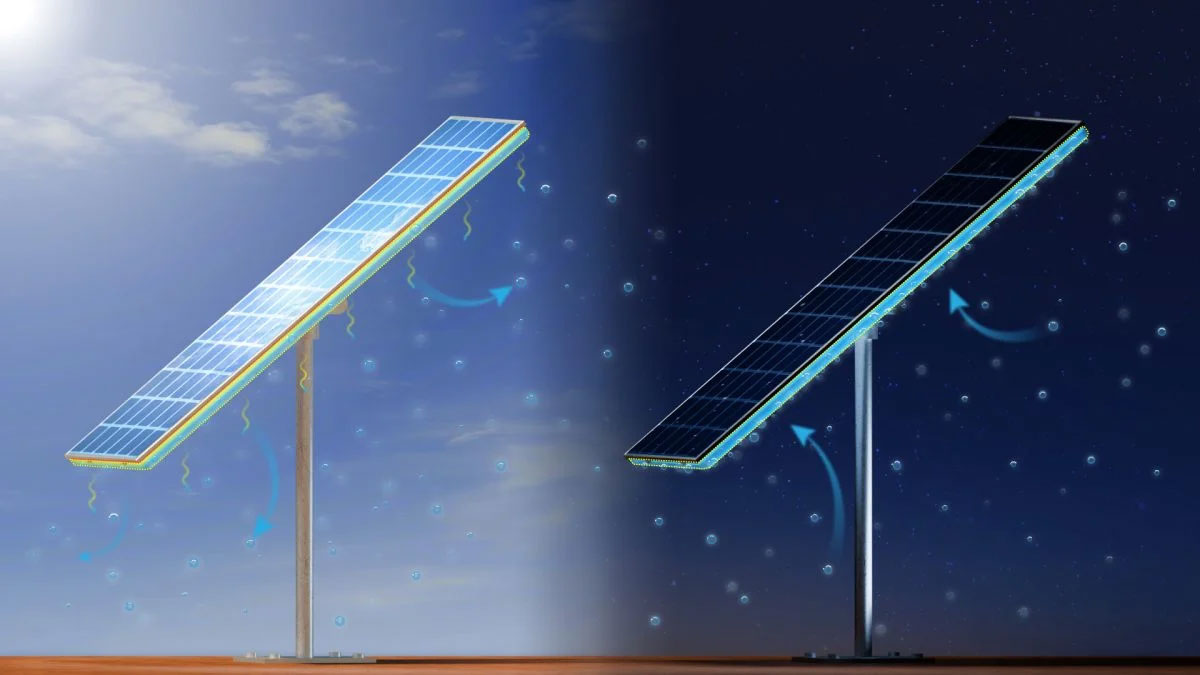
When operated for weeks in the Saudi Arabian desert, solar cells coated with the new material offered these advantages:
- Temperature reduction: 9.4°C lower than conventional batteries
- Increased power output: >12.9%
- Extended life: >200%
- Reduce electricity production costs: ~20%
Testing was also conducted in the coldest regions of the United States in rainy conditions, proving its effectiveness in all environments.
It is still too early to talk about commercialization, but the new material promises to pave the way for the prospect of increasing solar cell efficiency in harsh climates, while helping to reduce maintenance and replacement costs, as well as promoting a highly economical renewable energy transition.
FAQ
What is the main takeaway about Breakthrough New Material Increases Solar Panel Efficiency and Longevity?
The key is to understand the core idea, compare the available options, and apply the practical guidance that matches your situation.
What should beginners know about Breakthrough New Material Increases Solar Panel Efficiency and Longevity?
Start with the essential steps and terminology. Avoid changing advanced settings until you understand how they affect performance, privacy, cost, or compatibility.
How can I use this information in practice?
Follow the relevant section in order, test one change at a time, and confirm the result before moving to the next step or recommendation.
Related Articles
 Breakthrough Solar Panels That Can Withstand Even the Biggest Storms3 minutes read
 Laptops Use Super Solar Power3 minutes read
 Successfully Developed 'indoor Solar Cells' with Conversion3 minutes read
 What Is Solar Storm? How Solar Storm Affects the Earth4 minutes read
 The Difference Between Lcd Panel Technologies16 minutes read
 The Moon Has a Life Expectancy of About 4.51 Billion Years - Bigger8 minutes read
Reader Comments 0
Sign in with email or Google to join the discussion.