Basic Chinese Chess Play - How to Identify and Move Each Piece
To play Chinese chess, you need to understand the most basic rules, the chess board, the chess pieces as well as how they move in Chinese chess. Let's refer to the guide to playing Chinese chess for beginners below.
Table of Contents
Along with chess, Chinese chess is one of the two most popular types of chess in Vietnam, played by many people from old to young, male to female. However, if you have never played before, you will have some difficulty in recognizing the chess pieces as well as the rules of the game. To play Chinese chess, you need to grasp the most basic rules, the chess board, the chess pieces as well as how they move in Chinese chess. Let's refer to the guide to playing Chinese chess for beginners below.
1. Introduction to the chess board and chess pieces
The Chinese Chess board is a rectangle formed by 9 vertical lines and 10 horizontal lines intersecting at 90 points. A space called a river (or river) lies horizontally in the middle of the board, dividing the board into two equal symmetrical parts. Each side has a square General Palace (Cửu cung) formed by 4 squares at the 4th, 5th, 6th vertical lines from the last horizontal line of each side, in these 4 squares there are two diagonal lines drawn through.
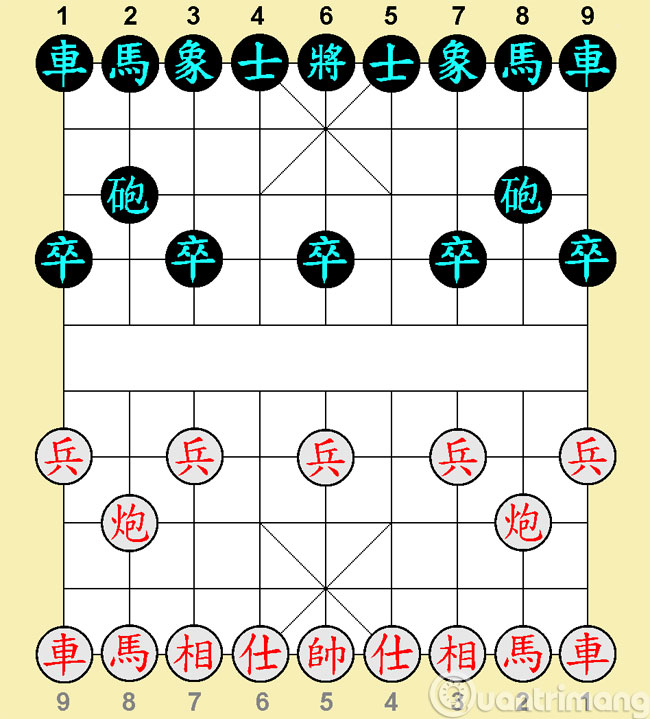
By convention, when the board is viewed from the front, the White (or Red ) pieces are at the bottom and the Black pieces are at the top . The vertical lines on the White (Red) side are numbered from 1 to 9 from right to left. The vertical lines on the Black side are numbered from 9 to 1 from right to left.
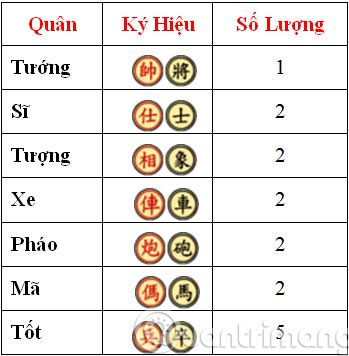
Each chess game must have 32 pieces at the beginning , divided equally between each side, including 16 White (Red) pieces and 16 Black pieces, including 7 types of pieces, with symbols and numbers for each side as follows:
2. Movement principles of each chess piece
- Pawn : (or Soldier) moves one square per move. If the pawn has not crossed the river, it can only move forward. Once it has crossed the river, the pawn can move sideways one move or forward one step per move.
- Cannon : Moves horizontally and vertically like a chariot. The difference is that if the cannon wants to capture a piece, it must jump over exactly one piece. When not capturing a piece, all points from the starting point to the destination must be clear of blocking pieces.
- Knight : Moves 2 squares horizontally and 1 square vertically ( or 2 squares vertically and 1 square horizontally ) for each move. If there is a piece right next to the knight and blocks the 2 horizontal path (or 2 vertical path), the blocked knight cannot move that path.
- Rook : Moves horizontally or vertically on the board as long as it is not blocked by other pieces from its starting point to its destination.
- Bishop : Moves 2 squares diagonally ( 2 horizontally and 2 vertically ) for each move. The bishop is only allowed to stay on one side of the board, and cannot move to the opponent's half of the board. The bishop's move will be invalid if there is a piece blocking its path.
- Mandarin : Moves one square diagonally each turn. Mandarins must always stay in their palaces like the General.
- General : Moves one square at a time, horizontally or vertically. The general must always stay within the palace and cannot leave it. The "palace" is the 3×3 square marked by an X-shaped diagonal line.
3. Basic rules of the game
Chess has many rules and can be said to be quite "difficult" for those who do not know how to play. But you only need to grasp the following basic concepts.
Capture pieces
- When a piece reaches another intersection occupied by an opponent's piece, it has the right to capture that piece and occupy the captured piece's position.
- You cannot capture your own pieces.
- Allowed to let the opponent start your army or actively give your army to the opponent, except generals
- Captured pieces must be discarded and removed from the board.
Checkmate
- When a side's piece makes a move that threatens to capture the opponent's general on the next move, it is called checkmate.
- The side being checkmated must find a way to defend and avoid the checkmate. Otherwise, they will lose the game.
- When making a checkmate move, the mover can call "checkmate" or not.
- The general is under fire from all four directions (including from behind)
- The side in check must move its general to another position to avoid check and capture the piece in check.
- And the side being checked must use another piece to block the checking piece, and move a piece to protect the general.
Anti-general
- Two generals on the board cannot be on the same vertical column without a piece blocking between them.
- A move that leaves two generals in anti-general position is illegal.
Chasing the Army
- A piece moves to a position where it can capture any opponent's piece (except the king) on the next move.
- Or a move that makes the Cannon checkmate the opponent.
Exceptions include:
- When a general or pawn moves to checkmate an opponent's piece. This move is not called a chase.
- A move that threatens a pawn that has not yet crossed the river is not considered a chase.
- A sacrificial move is not called a chasing move.
Win the game
- Checkmate the opponent's general.
- Checkmate your opponent without them being able to defend their general.
- The opponent did not make enough moves in the allotted time.
- The opponent arrived later than the allotted time to start the game.
- If the opponent uses one piece to checkmate continuously or uses many pieces to checkmate continuously, the player must change his move or else lose.
- The other side commits a violation, while this side does not commit a violation, and the violating side refuses to change its move.
- When the seal is opened to continue the postponed game, if the sealed player writes a wrong move without explanation, he loses. If the player whose turn it is to write a wrong move in the seal but the opponent retires, both players lose.
- The opponent declared defeat.
Lose the game
- Do not record 3 times the minutes each time including 4 consecutive moves.
- The opponent made 3 technical errors and 3 behavioral errors.
- The opponent violates specific cases of losing on the chess positions.
Draw
- The referee finds the game unwinnable, meaning that neither side has any pieces left that can attack the other to checkmate the opponent's king.
- When the total number of moves since the last time the game progressed is 30. The game progresses when a piece is captured or when a pawn has crossed the river and advanced one step.
- Neither side committed any fouls and neither side changed their moves.
- Both parties simultaneously violate the same prohibition.
- When the total number of moves in the game is 300.
- If one side proposes a draw and the other side agrees, the game is automatically declared a draw.
- One side proposed a draw, after the referee checked that each side had made 60 moves without capturing any mandarins, the game was declared a draw.
- When one side is in checkmate, surrounded and has no more moves, it is not allowed to propose a draw.
Have fun!
Was this article helpful?
Your feedback helps us improve.
Related Articles
 Guide to playing Chinese chess for beginners9 minutes read
 Basic knowledge in chess3 minutes read
 How to play chess from basic to advanced, good tactics8 minutes read
 Instructions for playing Auto Chess Mobile for newbies5 minutes read
 Simple way to play chess on Facebook Messenger3 minutes read
 Chess occurrence rate Mobile Union Chess2 minutes read
Reader Comments 0
Sign in with email or Google to join the discussion.