Table of Contents
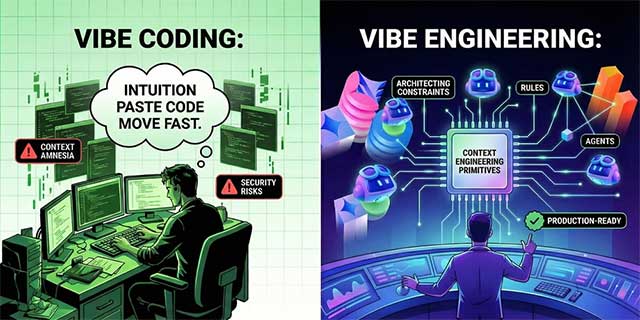
Vibe engineering is an AI-assisted development approach in which people define the product, architecture, constraints, and quality bar while coding agents help implement the software. The engineer may write fewer lines manually, but remains responsible for understanding the system, reviewing changes, testing behavior, and operating the result safely.
The term is informal, not a recognized engineering standard. It is useful mainly as a contrast with “vibe coding,” where someone repeatedly prompts an AI until an application appears to work, often without fully inspecting the code. Vibe engineering keeps the speed of AI generation but restores the discipline required for maintainable software.
Vibe engineering vs. vibe coding
| Area | Vibe coding | Vibe engineering |
|---|---|---|
| Goal | Produce a working result quickly | Build a system that can be understood, tested, changed, and operated |
| Planning | Minimal; prompts evolve by trial and error | Requirements, interfaces, constraints, and risks are defined first |
| Code review | May focus only on visible behavior | Changes are inspected for logic, security, maintainability, and fit |
| Verification | Manual spot checks | Automated tests, static checks, security review, and acceptance criteria |
| Ownership | The AI's output is treated as the product | The human team owns every shipped change |
| Best fit | Prototypes and low-risk experiments | Real products and long-lived codebases |
Both approaches use conversational coding tools. The difference is not the amount of generated code; it is the level of human control and evidence required before a change is accepted.
Why this approach is emerging
Modern coding agents can inspect repositories, edit multiple files, run commands, execute tests, and iterate on failures. This moves the developer's attention from typing syntax toward specifying intent, choosing tradeoffs, and evaluating results.
Tool choice still affects the workflow. Browser-based builders, AI-enabled editors, and terminal agents offer different levels of environment access and automation. TipsMake's Replit and Cursor comparison explains two common approaches, while the guide to AI agent frameworks covers systems designed for multi-step tool use.
What the engineer still owns
AI can accelerate implementation, but it does not remove responsibility. A vibe-engineering workflow keeps humans accountable for:
- Requirements: What problem is being solved, for whom, and how success will be measured.
- Architecture: Service boundaries, data flow, interfaces, dependencies, and deployment strategy.
- Constraints: Security, privacy, latency, cost, accessibility, compliance, and compatibility.
- Verification: Tests, review criteria, threat modeling, observability, and rollback plans.
- Operations: Monitoring, incident response, upgrades, documentation, and long-term maintenance.
An agent can propose answers in each area, but the team must decide which assumptions are acceptable. Plausible-looking code is not evidence that a design is correct.
A practical vibe-engineering workflow
1. Define the outcome and acceptance criteria
Describe the user-visible behavior, inputs, outputs, constraints, and failure cases. Replace vague instructions such as “add authentication” with testable requirements: supported sign-in methods, session lifetime, authorization rules, audit events, error behavior, and migration needs.
2. Ask the agent to explore before editing
Have the agent identify relevant files, existing patterns, dependencies, tests, and likely risks. Exploration reduces the chance of creating a second architecture beside the one already in the repository.
Anthropic's Claude Code best-practices guide recommends an “explore, plan, then code” sequence and emphasizes giving the agent a way to verify its own work. The principle applies to any coding agent.
3. Review the plan
Before implementation, check the proposed files, interfaces, data changes, test strategy, and rollout path. Ask what alternatives were rejected and why. For risky work, request a threat model or failure-mode analysis before code is generated.
4. Implement in small, reviewable units
Break the plan into changes that can be tested and reviewed independently. Small diffs make it easier to detect invented APIs, accidental duplication, excessive dependencies, and unrelated edits. Commit or checkpoint known-good states so the team can recover when an iteration goes wrong.
5. Make verification part of the prompt
Tell the agent which commands, tests, linters, type checks, or sample inputs prove success. A useful task ends with evidence: passing tests, expected output, a focused diff, and a note about anything that could not be verified.
6. Add an independent review
Review the final change yourself or use a separate review pass that did not create the implementation. Check authorization, input validation, error handling, concurrency, data migration, dependency changes, and logging—not only the happy path.
7. Observe the software after release
AI-generated code needs the same production discipline as human-written code. Deploy gradually when possible, monitor errors and performance, and keep a tested rollback path. Update documentation and tests whenever the behavior changes.
Where AI coding agents help most
- Explaining an unfamiliar codebase and locating relevant components.
- Generating repetitive scaffolding that follows an existing pattern.
- Writing or expanding tests from clear acceptance criteria.
- Refactoring a bounded area while preserving public behavior.
- Drafting documentation, migration notes, and review checklists.
- Comparing implementation options with explicit tradeoffs.
- Investigating failures when logs and reproduction steps are available.
The best tasks have clear boundaries and fast feedback. Agents struggle more when the desired behavior is ambiguous, the environment cannot be reproduced, or success depends on undocumented business knowledge.
Common failure modes
- Invented interfaces: The agent calls an endpoint, library method, or configuration option that does not exist.
- Local success, system failure: A unit test passes while integration, permissions, or deployment behavior remains broken.
- Context loss: Long sessions dilute earlier constraints and encourage inconsistent decisions.
- Unnecessary rewrites: The agent changes more files than the task requires, increasing review and regression risk.
- Security shortcuts: Credentials, authorization checks, validation, or dependency risks are overlooked.
- False confidence: Fluent explanations make unverified assumptions sound settled.
Guardrails for production work
- Use least-privilege permissions and keep production credentials out of the agent environment.
- Require confirmation before destructive commands, deployments, database changes, or external messages.
- Protect secrets and sensitive customer data from prompts, logs, and generated fixtures.
- Pin and review new dependencies rather than accepting them automatically.
- Keep automated tests and static analysis independent of the model's explanation.
- Reject changes the team cannot understand well enough to maintain.
- Measure outcomes such as defect rate, review time, rollback frequency, and delivery lead time—not lines of generated code.
Does vibe engineering reduce the need for programming knowledge?
It can lower the effort required to create a prototype, but production work still benefits from deep technical judgment. Engineers need to recognize fragile abstractions, misleading tests, unsafe permissions, poor data models, and operational gaps. Those skills become more important when code is produced faster.
New developers can learn with AI, but should regularly read the generated code, predict what it will do, run experiments, and debug without immediately asking the agent for the answer. Otherwise, speed may come at the cost of understanding.
The bottom line
Vibe engineering is software engineering with a new implementation partner, not a replacement for engineering. AI can explore, propose, write, test, and revise at high speed. Humans still set the direction, choose the architecture, evaluate evidence, control risk, and own the result. The teams that benefit most will combine agent speed with small changes, explicit constraints, strong verification, and accountable review.
Related Articles
 Lenovo Sent an Invitation to Launch Vibe X2, an Invitation to4 minutes read
 What Is Social Engineering? How to Prevent Social Engineering?16 minutes read
 What Is Vibe Coding? Benefits, Risks, and Developer Roles8 minutes read
 Best Laptops for Mechanical Engineering Students13 minutes read
 What Is Decomposition and Why Does AI Need You to Do It?21 minutes read
 What Is Prompt Engineering? a Comprehensive Guide to Prompt Engineering in7 minutes read
Reader Comments 0
Sign in with email or Google to join the discussion.