Table of Contents
When AI becomes a regular part of a team, the biggest change is not that every task disappears. Work moves upstream and downstream: people spend less time producing a first pass and more time defining the problem, supplying context, reviewing evidence, handling exceptions, and deciding what happens next.
That shift can improve speed, but only when the workflow makes responsibility clear. An AI system can prepare an analysis or draft; it cannot own the business consequences, explain an unsupported claim, or decide which risk an organization should accept.
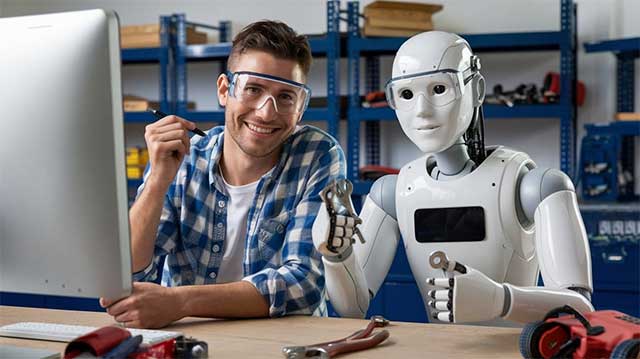
From producing to directing and reviewing
In a traditional workflow, one person may research, draft, calculate, format, and summarize a deliverable. With AI, some of those steps can start from a generated first pass. The human role becomes a combination of editor, subject-matter expert, and decision owner.
For a data analyst, that might mean asking AI to propose code or an exploratory plan, then checking the data types, logic, assumptions, edge cases, and output against a known sample. For a writer, it might mean using AI to organize notes, then verifying every claim and rewriting the material in the publication’s voice.
This is not merely “checking for typos.” Effective review often requires more expertise than the first draft because the reviewer must recognize a plausible-looking error and understand its effect.
What AI can reasonably handle
AI is most useful when the task is bounded, the input is available, and the result can be checked. Common examples include:
- summarizing approved documents with references to the source passages;
- drafting routine code, formulas, tests, or documentation;
- classifying or extracting fields from repeated records;
- turning an approved outline into alternative drafts;
- reformatting the same information for several channels;
- creating checklists and identifying missing information;
- preparing a first analysis for a qualified person to reproduce.
These tasks have visible inputs and outputs. A team can compare the result with the source, run a test, or apply a defined rubric.
What should remain human-led
People should lead when the work depends on accountability, sensitive context, contested values, or relationships. That includes:
- defining the real problem and deciding whether it should be automated;
- obtaining consent and protecting confidential information;
- judging whether the available data represents the situation fairly;
- handling personnel, legal, medical, financial, or safety decisions;
- negotiating priorities between stakeholders;
- approving communications that create commitments;
- taking responsibility for the final action.
AI can offer options, but an option is not a decision. Someone still needs to understand the affected people, the organization’s obligations, and the cost of being wrong.
A reliable human-AI workflow
| Stage | Human responsibility | AI contribution |
|---|---|---|
| Frame | Define the goal, audience, constraints, and success criteria | Surface questions or ambiguities |
| Prepare | Select approved, relevant inputs | Organize or summarize supplied material |
| Produce | Set the method and boundaries | Create a draft, analysis, or alternatives |
| Verify | Check sources, calculations, tests, and edge cases | Help generate a checklist or test cases |
| Decide | Assess consequences and approve the action | Compare options without making the accountable choice |
| Record | Document important decisions and ownership | Prepare an audit-friendly summary |
Example: AI as a first-pass analyst
Suppose a team wants to understand why customer cancellations increased. “Analyze churn” is too vague. A useful brief specifies the period, population, definition of cancellation, available fields, comparison groups, and decisions the analysis should inform.
- Preserve the original data and create a working copy.
- Ask AI to inspect the schema and propose checks before calculating anything.
- Verify missing values, duplicate records, dates, joins, and category definitions.
- Request code or formulas that can be rerun, rather than accepting only a prose conclusion.
- Compare key totals with the source system and test a small known sample.
- Ask for alternative explanations and evidence that would disprove each one.
- Have the analyst interpret the findings with product, pricing, and customer context.
- Record which conclusions are supported, uncertain, or out of scope.
The AI accelerates exploration, but the analyst protects the chain from source data to business recommendation.
New skills that become more valuable
Problem framing
A model cannot repair a task whose goal is unclear. People who can turn a broad request into a specific decision, measurable outcome, and workable set of constraints will get more reliable results.
Verification
Teams need workers who can check calculations, trace statements to sources, design tests, and distinguish a confident answer from supported evidence. Verification should be part of the production process, not an optional final glance.
Domain judgment
AI may know common patterns but not the unwritten constraints of a particular customer, system, market, or organization. Domain experts recognize when a technically valid suggestion is impractical, inappropriate, or based on the wrong assumption.
Workflow design
Useful automation depends on choosing the right handoffs. A strong workflow identifies which inputs the AI can see, which actions it can take, where a person must approve, and how to recover from a mistake.
Communication and accountability
Someone must explain the recommendation, disclose uncertainty, listen to objections, and own the outcome. These responsibilities become more visible as drafting and calculation become easier.
Risks of treating AI like an unquestioned colleague
- Automation bias: reviewers may accept a polished output because it looks complete.
- Skill erosion: people may lose the ability to perform or audit a task they always delegate.
- Data leakage: confidential material may be entered into an unapproved service.
- Uneven performance: a workflow may work on familiar cases and fail on rare or underrepresented ones.
- Unclear ownership: errors may persist because everyone assumes someone else checked them.
- Hidden labor changes: faster production can increase review volume and pressure rather than reduce workload.
How teams can adapt
- Choose one bounded workflow. Start where inputs and quality criteria are clear.
- Measure the baseline. Record current time, error rate, rework, and user outcome before adding AI.
- Define prohibited data and actions. Limit access before connecting tools or accounts.
- Assign a named reviewer. “Human in the loop” is meaningless unless someone has time, authority, and expertise to check the work.
- Test failures deliberately. Include missing data, misleading instructions, unusual cases, and conflicting sources.
- Preserve manual competence. Train people to reproduce critical work and run periodic no-AI checks.
- Review the impact on roles. Update expectations, training, career paths, and workload—not just software settings.
AI becomes a useful coworker when it has a narrow job, appropriate access, and an accountable human partner. The durable advantage is not simply generating more output. It is asking better questions, proving what is correct, understanding the real-world context, and making decisions that others can trust.
Related Articles
 30+ Images Proving Anything in Life Can Happen: Funny Pictures4 minutes read
 35 Funny Pictures Make You Believe That Anything in This World Can5 minutes read
 10 Strange Things Happen to the Body When You Fly7 minutes read
 What Terrible Will Happen if the Earth Suddenly Stops Spinning6 minutes read
 10 Serious Harms Will Happen if You Sit for 8 Hours a Day12 minutes read
 What Will Happen to the Body if You Don't Eat Meat7 minutes read
Reader Comments 0
Sign in with email or Google to join the discussion.