Table of Contents
This article will provide some tips for observing double stars with the naked eye, with binoculars, and, if you prefer, with a small telescope.
Binary stars are two stars that appear close together in the sky. They may be physically related or simply appear together because they are next to each other along our line of sight. Binary stars that are not gravitationally bound – but are only close together along our line of sight – are optical binaries. Binary stars that are gravitationally bound and orbit a common center of mass are true binaries. Scientists believe that most stars in the Milky Way galaxy orbit the center of the galaxy in pairs. NASA believes that more than 50% of the stars in the sky are in binary systems.

Like snowflakes, no two binary star systems are exactly alike. This makes them fascinating to look at. You will see a wide range of bright stars and a range of distances between the stars. Sometimes you will notice a contrast in color between the two stars.
This article will provide some tips for observing double stars with the naked eye, with binoculars, and, if you prefer, with a small telescope.
Tips for observing double stars
To see a binary star, Earth's atmosphere must be stationary. Movements in different layers of the atmosphere cause a star to wobble. On poor-visibility nights, it can be difficult for a telescope observer to "separate" a binary star into its two components. You may end up seeing just one star.
A few other observing factors that determine whether you can see both components of a binary star are: how dark the sky is. How bright the two stars you are trying to see are, i.e. their magnitudes. Bright stars of magnitude 5 or 6 are difficult to see, but they are still visible. And finally, how far apart are the stars? For distances closer than 5 arc minutes, you will probably need binoculars.
How to see famous binary star systems
Mizar and Alcor in the Big Dipper constellation
For those new to double stars and sky observation, it's best to start with something simple. The optical binary stars Mizar and Alcor in the Big Dipper are easy to find. The Big Dipper cluster is a striking pattern due to its large size and bright stars. It can be seen year-round from Northern Hemisphere latitudes such as the northern United States and Canada.
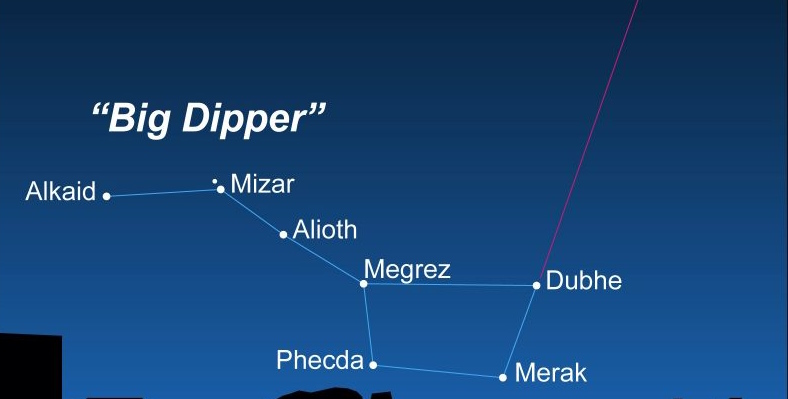
Seven stars make up the constellation Ursa Major: four in the handle and three in the shaft. The star in the middle of the three shafts is the Mizar/Alcor pair. These two stars appear about 12 arc minutes apart. So anyone with good eyesight can see them as two separate stars. Mizar is the brighter of the two, and Alcor is the dimmer. Mizar shines at magnitude 2.2 from a distance of about 82 light-years. Alcor shines at magnitude 4 from a distance of about 81 light-years. The two stars are bound together in space.
Mizar and Alcor
If you can't tell Mizar and Alcor apart with the naked eye, try using binoculars. Telling Mizar and Alcor apart used to be an eye test. If you can't see either without the aid of an optical device, maybe it's time to get your eyes checked?
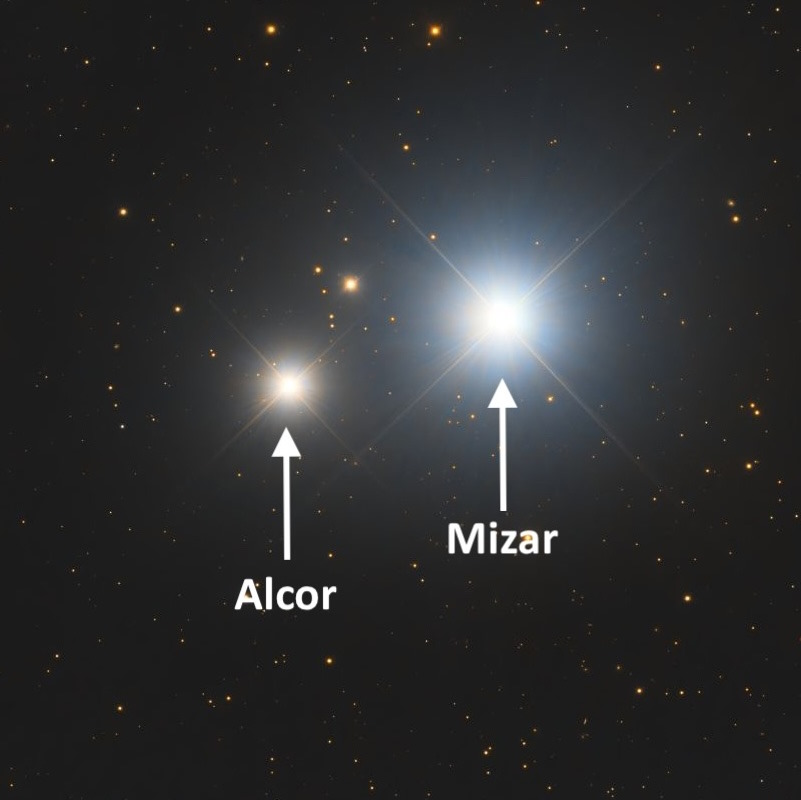
To learn more about these stars, look through a telescope and you will see that Mizar is a binary star system. The two parts of Mizar are 14 arc seconds apart. Interestingly, each part of Mizar is also a binary star system, making it a four-star system, not counting Alcor. Alcor is also a binary star system, so that makes it a six-star system in total.
The constellation Scorpio has two double stars.
Scorpio, a constellation best viewed in the Northern Hemisphere summer, has two pairs of double stars that you can distinguish with the naked eye. The easier target is Mu Scorpii. Its two components are a double star pair, one magnitude 2.9 and the other magnitude 3.5. Use the chart here to find Mu, then let your eyes adjust to the darkness to see if you can spot both Mu stars. The pair is less than 6 arc minutes apart.

If you can see both without optical aids, try looking directly below them for the two Zeta stars. These stars are an optical binary pair. Zeta 1 is nearly 40 times farther away than Zeta 2. Zeta 2 is magnitude 3.6. Zeta 1 is the hardest to spot at magnitude 4.7. If you need binoculars, try it, then try again without them. The two points are about 6 1/2 arc minutes apart.
Alpha Capricorni
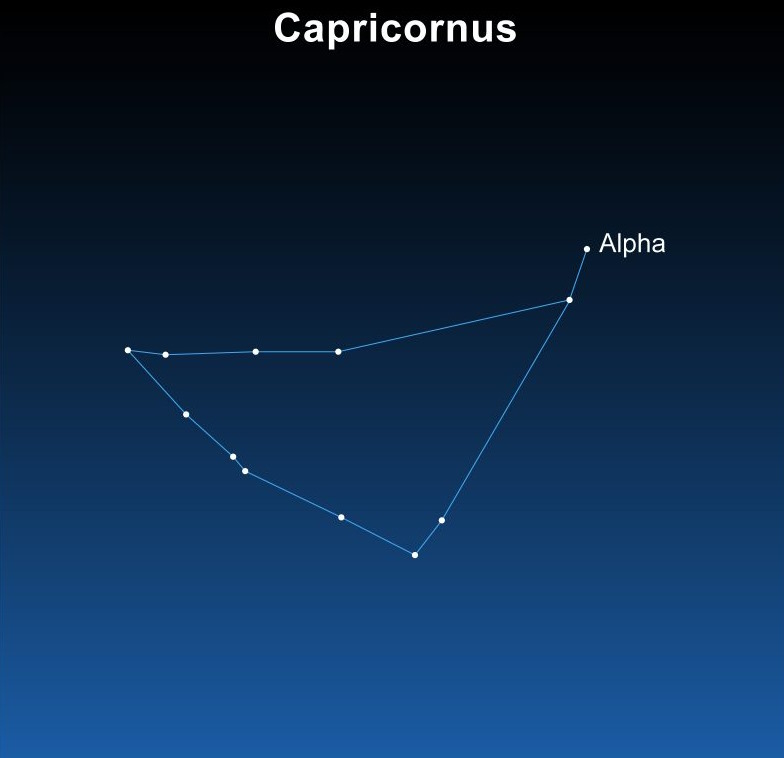
Like the pair of stars in the constellation Scorpio, some You can see Alpha Capricorn without any optical equipment, while others will need binoculars. Alpha Capricorni is an optical binary, meaning it only appears close to each other from our perspective. Alpha 1 shines at magnitude 4.2 and is 633 light-years away. Its companion, Alpha 2, also named Algedi, shines at magnitude 3.5 and is 107 light-years away. The pair is about 6.5 arc minutes apart.
FAQ
What Are Binary Stars? How to Find and Observe Binary Stars: Complete Guide?
In practical terms, this article will provide some tips for observing double stars with the naked eye, with binoculars, and, if you prefer, with a small telescope.
Why does what are binary stars matter?
The article highlights that binary stars that are not gravitationally bound – but are only close together along our line of sight – are optical binaries.
What is the main takeaway?
The main takeaway is that binary stars that are gravitationally bound and orbit a common center of mass are true binaries.
Related Articles
 Binary Numbers: Basic Steps of Binary Code Decoding5 minutes read
 For the First Time in History, People Witnessed Two Merged Neutron6 minutes read
 Number: How to Convert from Binary to Decimal8 minutes read
 Binary Search Algorithm (Binary Search)4 minutes read
 How Many Stars Can Be Seen in the Sky on a Moonless Night: Explained5 minutes read
 Why Does a 5-Pointed Star Twinkle in the Sky?3 minutes read
Reader Comments 0
Sign in with email or Google to join the discussion.