Table of Contents
Explore witness the rare phenomenon of young stars creating giant bubbles.
This cloud is located about 160,000 light-years from Earth, in the constellation Dorado, far outside our galaxy.
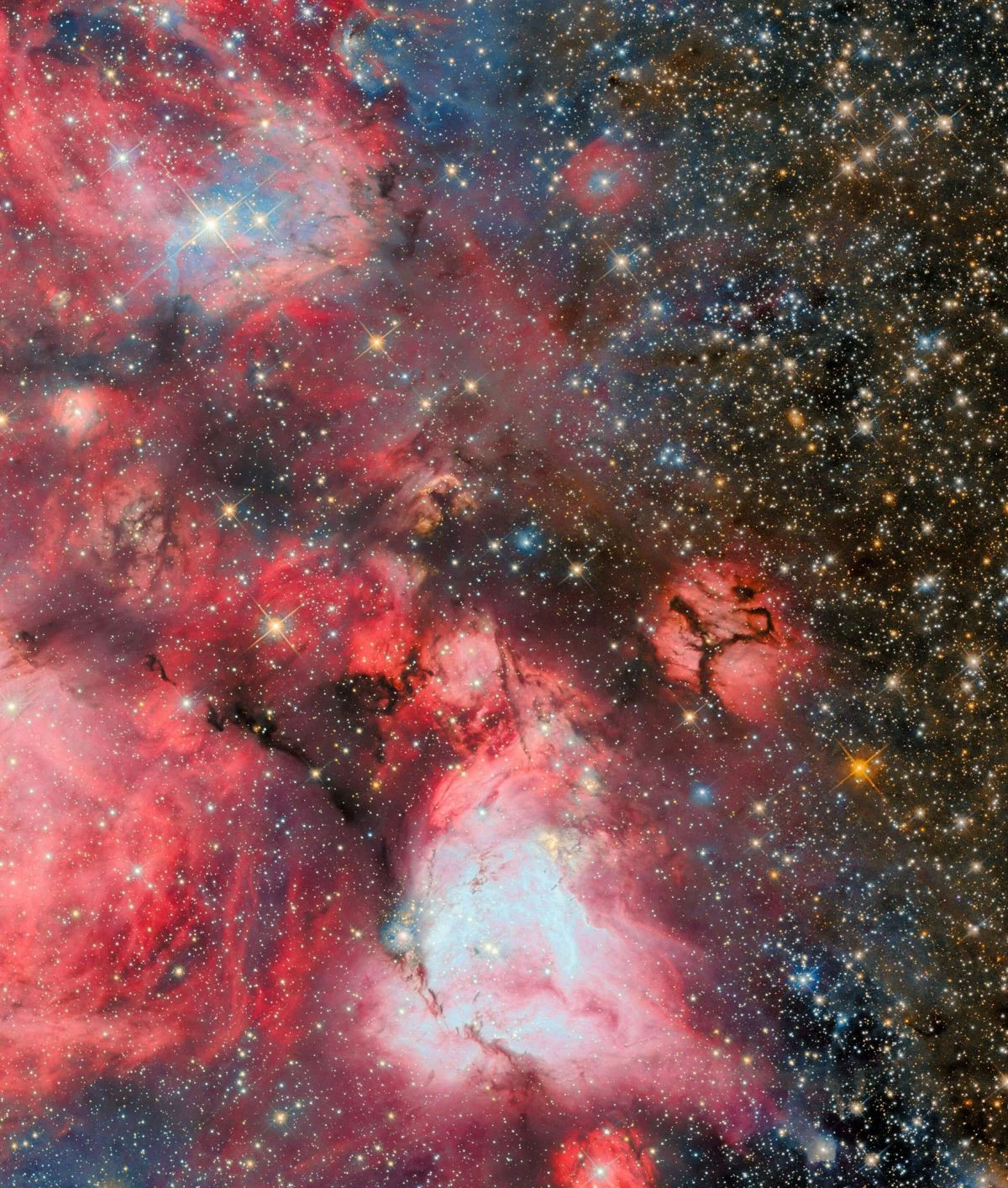
N159 – A giant 'star incubator' in the Large Magellanic Cloud
N159 belongs to the Large Magellanic Cloud, a dwarf galaxy and also the largest satellite galaxy orbiting the Milky Way. Thanks to its relatively close distance (on the cosmic scale), astronomers can observe star formation there with astonishing detail.
Within the Large Magellanic Cloud, N159 stands out as one of the regions with the highest mass and most intense star-forming activity.
The enormous scale of cloud N159
The Hubble image only captures a portion of the entire N159 complex. If viewed in its entirety, this structure spans over 150 light-years. To put this into perspective, a light-year is the distance light travels in one year, and this entire cloud is nearly 10 million times larger than the distance from Earth to the Sun.
This enormous scale explains why regions like N159 can produce such a large number of stars over millions of years.
How are stars formed in cold gas clouds?
Deep inside N159, temperatures drop to extremely low levels, and gravity gradually pulls the gas cloud to contract. As the cloud collapses under its own weight, dense regions form and eventually trigger nuclear reactions, marking the birth of new stars.
These young stars begin to glow while still within the gas and dust that gave birth to them. The youngest, hottest, and most massive stars emit intense energy, causing the surrounding hydrogen gas to glow with its characteristic red color. This phenomenon occurs when hydrogen atoms are excited by stellar light.
The Hubble telescope is particularly sensitive to this type of light, allowing scientists to pinpoint the regions where star formation is most intense.
Not all young stars are hidden within dense clouds. Some appear within the surrounding red gas, while others are located at the center of large voids, resembling bubbles carved deep into the cloud. These structures form through a process called stellar feedback.
As young stars become brighter, they release intense radiation and streams of charged particles moving at high speeds, known as stellar winds. These forces heat and push the surrounding gas away, creating voids and reshaping the original cloud itself.
Over time, stellar feedback can slow or even stop star formation in some regions, while stimulating the birth of new stars in other areas.
Hubble previously released a panoramic image of the N159 region in 2016. This new version adds observational data at a different wavelength, helping to highlight more clearly the hot gas region surrounding the young star.
This allows astronomers to gain a more detailed understanding of how young stars interact with their surroundings and gradually transform their own 'birthplace' in the universe.
Final Thoughts
Understanding witness the rare phenomenon of young stars creating giant bubbles in the universe makes it easier to evaluate the information and apply the most relevant recommendations. Focus on the key points above and verify details that may change over time.
FAQ
What is witness the rare phenomenon of young stars creating giant bubbles in the universe?
Explore witness the rare phenomenon of young stars creating giant bubbles.
What key points does this article cover?
The article focuses on N159 – A giant 'star incubator' in the Large Magellanic Cloud, The enormous scale of cloud N159, How are stars formed in cold gas clouds?, with practical explanations and examples.
How can you use this information in practice?
Use the explanations to compare options, verify important details, and make a more informed decision. Apply the recommendations that best match your goals and situation.
Related Articles
 Which Star Lives the Longest, Brightest, Biggest,. in the Universe6 minutes read
 Discover How Young Children Are Asking and Staring Their Parents2 minutes read
 Admire the Rare Moment Venus and Jupiter 'Meet' Each Other in the Sky4 minutes read
 How Big Can the Stars in the Universe Be1 minutes read
 Tarantula Nebula Captured by the Hubble Telescope4 minutes read
 Admire the Giant Stars Forming in the Corner of the3 minutes read
Reader Comments 0
Sign in with email or Google to join the discussion.