Table of Contents
This guide answers "What If a Baby Was Born Outside of Earth?" with a clear explanation, practical context, and the details that matter most.
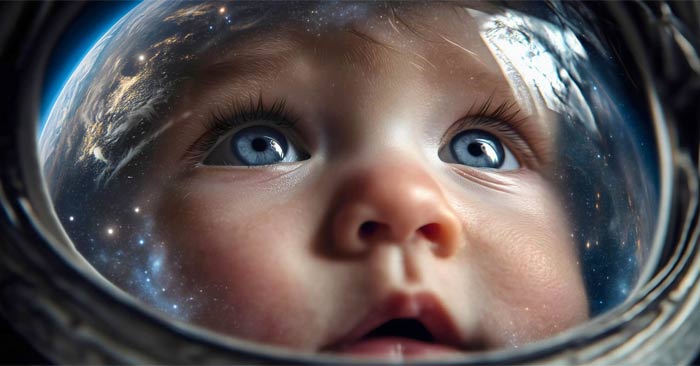
But can conception and pregnancy be safely performed in space? And what would happen to a child born outside Earth?
Most of us rarely think about the risks we face before birth. For example, about two-thirds of human embryos do not survive long enough to be born, with most miscarriages occurring in the first few weeks after conception; often before a person even knows they are pregnant.
These undetected early losses often occur when the embryo develops abnormally or fails to implant successfully in the uterine wall.
Pregnancy can be thought of as a series of biological milestones. Each milestone must occur in the correct order and has a certain chance of success. On Earth, these odds can be estimated using clinical studies and biological models. The study below explores how these same stages may be affected by the harsh conditions of interplanetary space.
Microgravity, the near-weightlessness humans experience during spaceflight, would make conception more physically difficult but would probably have little effect on maintaining a pregnancy once the embryo has implanted.
But giving birth and caring for a newborn would be much more difficult in zero gravity. After all, in space, nothing stands still. Fluids float. So do people. That makes giving birth and caring for a baby a much more complicated and messy process than it is on Earth, where gravity helps with everything from positioning to breastfeeding.
At the same time, the developing fetus is already developing in conditions similar to microgravity. It floats in neutral amniotic fluid inside the uterus, cushioned and suspended. In fact, astronauts practice spacewalks in water tanks designed to simulate weightlessness. In that sense, the uterus is already a microgravity simulator.
But gravity is only part of the equation when it comes to having a baby off Earth.
Radiation
Outside the Earth's protective shell, there is a more dangerous threat: cosmic rays. These are high-energy particles—'stripped' or 'naked' atomic nuclei—that travel through space at nearly the speed of light. They are atoms that have lost all their electrons, leaving behind only a dense core of protons and neutrons. When these naked nuclei collide with the human body, they can cause serious cellular damage.
On Earth, we are protected from most cosmic radiation by the planet's thick atmosphere, and depending on the time of day, from Earth's magnetic field for ranges ranging from tens of thousands to millions of miles. In space, that protection disappears.
When a cosmic ray passes through the human body, it can collide with an atom, stripping away its electrons, then smash into the nucleus, destroying protons and neutrons, leaving behind a different element or isotope.
This can cause extremely localised damage – meaning that individual cells, or parts of cells, are destroyed while the rest of the body may be unaffected. Sometimes the beam passes through without hitting anything. But if it hits DNA, it can cause mutations that increase the risk of cancer.
Even if cells survive, radiation can still trigger an inflammatory response. That means the immune system overreacts, releasing chemicals that can damage healthy tissue and disrupt the function of individual organs.
During the first few weeks of pregnancy, each embryonic cell is rapidly dividing, moving, and forming its initial tissues and structures. To continue developing, the embryo must remain viable throughout this delicate process. The first month after fertilization is the most vulnerable time.
Even a single high-energy cosmic ray at this stage could be fatal to the embryo. However, the embryo is very small – and cosmic rays, while dangerous, are relatively rare. So direct exposure is unlikely. If it does happen, it could lead to an undetected miscarriage.
Risks of pregnancy
As pregnancy progresses, the risks change. Once the placental circulation—the blood circulation system that connects mother and baby—is fully formed by the end of the first trimester, the baby and uterus will grow rapidly.
That development poses a bigger challenge. Cosmic rays are now more likely to hit the uterine muscle, which can cause contractions and potentially premature labor. While neonatal intensive care has improved dramatically, the earlier a baby is born, the higher the risk of complications, especially in space.
On Earth, pregnancy and childbirth are inherently risky. In space, those risks are amplified.
But development doesn't stop with birth. A baby born in space will continue to develop in microgravity, which can affect postural reflexes and coordination. These are the instincts that help a baby learn to hold its head up, sit up, crawl, and eventually walk: all movements that depend on gravity. Without the sense of 'up' and 'down,' these abilities may develop in very different ways.
And the radiation risks don't go away. A baby's brain continues to develop after birth, and long-term exposure to cosmic rays can cause permanent damage—potentially affecting cognition, memory, behavior, and long-term health.
So, can babies be born in space?
In theory, yes . But until we can protect embryos from radiation, prevent premature births, and ensure that babies can develop safely in microgravity, pregnancy in space remains a high-risk experiment—one we're not ready to undertake.
FAQ
What should you know about radiation?
Outside the Earth's protective shell, there is a more dangerous threat: cosmic rays. These are high-energy particles—'stripped' or 'naked' atomic nuclei—that travel through space at nearly the speed of light. They are atoms that have lost all their electrons, leaving behind only a dense core of protons and neutrons. When these.
What should you know about risks of pregnancy?
As pregnancy progresses, the risks change. Once the placental circulation—the blood circulation system that connects mother and baby—is fully formed by the end of the first trimester, the baby and uterus will grow rapidly.
So, can babies be born in space?
In theory, yes. But until we can protect embryos from radiation, prevent premature births, and ensure that babies can develop safely in microgravity, pregnancy in space remains a high-risk experiment—one we're not ready to undertake.
Related Articles
 Signs That Help You Understand Babies Better5 minutes read
 The First Baby Born Through AI - assisted Conception4 minutes read
 Explaining the Strange Phenomenon the Baby Just Born Has Walked3 minutes read
 Baby Three Wallpaper, Baby Three Wallpaper6 minutes read
 The First Baby in the World Was Born from Three Parents, of Which 23 minutes read
 Origin of Earth's Name and Other Interesting Facts: Complete Overview7 minutes read
Reader Comments 0
Sign in with email or Google to join the discussion.