Table of Contents
A giant container ship is about to use Seabound's technology to turn CO₂ emissions into green cement, reducing emissions by up to 95% and paving the way for a more sustainable shipping industry.
A giant cargo ship is to be fitted with a system to capture carbon from its engine exhaust, then turn it into cement for use in construction works on shore.
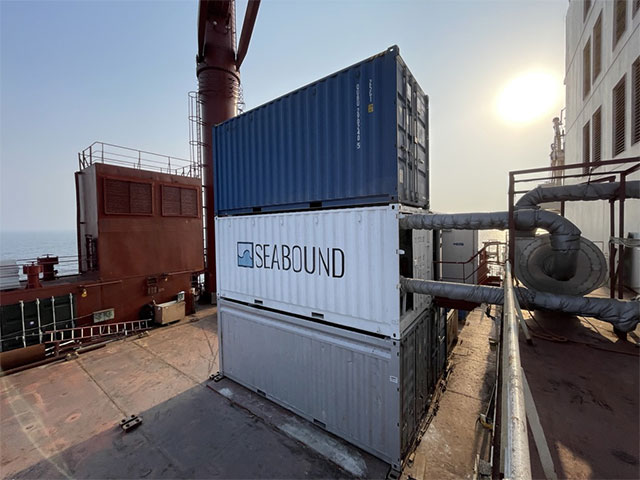
Developed by UK startup Seabound, the technology is being touted as the first commercial carbon capture system for ships. The device will be deployed on the UBC Cork, a cement carrier owned by German conglomerate Hartmann.
' This is a technology we want to scale to hundreds, even thousands of ships. We're excited to get it out into the world, collect real-world data, optimize future versions, and most importantly, prove that carbon capture on ships is more than just an idea, ' said Alisha Frediksson, CEO and co-founder of Seabound.
Turning waste gas into limestone for cement production
Seabound's carbon capture device works by piping exhaust from the ship's massive diesel engines into a large pressure chamber filled with calcium hydroxide gravel.
Here, the CO₂ in the exhaust gas reacts with the gravel and turns into calcium carbonate – also known as limestone, the main ingredient in cement. This limestone will be stored on board the ship and then unloaded in Norway, shipped to Heidelberg Materials' Brevik cement plant to be used to produce green concrete on an industrial scale.
According to Seabound, their system can capture up to 95% of CO₂ and 98% of sulfur emissions from a ship's exhaust. Its modular design means it can be attached to existing vessels without extensive modifications, giving the shipping industry an immediate way to cut emissions. However, the technology cannot replace the long-term need for cleaner fuels instead of diesel.
A step forward on the journey to 'green' the shipping industry
The shipping industry accounts for nearly 3% of global emissions, but decarbonization is difficult. Current battery technology cannot yet power the vast bulk carriers that sail long distances. Nuclear power has also been considered, but it is risky and controversial.
Experts say the most sustainable approach is zero-emission fuels like hydrogen or ammonia. However, these solutions are still in the early stages of development and would require the construction of entirely new ships.
In that context, Seabound's technology is seen as a temporary solution to curb emissions, while waiting for longer-term solutions.
' Alternative fuels for ships are still at least 10 to 20 years away from becoming widespread. But we need to start decarbonizing today ,' Ms Frediksson stressed.
Seabound has been testing the technology with Hapag-Lloyd and Lomar Shipping, and aims to capture 100 million tonnes of CO₂ per year by 2040 – equivalent to 10% of the entire shipping industry's emissions.
This first commercial project is co-funded by the EU's Eurostars program and has support from the Cyprus Maritime & Sea Institute.
FAQ
What should you know about this cargo ship could turn CO₂ emissions into cement?
In practical terms, a giant container ship is about to use Seabound's technology to turn CO₂ emissions into green cement, reducing emissions by up to 95% and paving the way for a more sustainable shipping industry.
Why does this cargo ship could turn CO₂ emissions into cement matter?
The article highlights that this limestone will be stored on board the ship and then unloaded in Norway, shipped to Heidelberg Materials' Brevik cement plant to be used to produce green concrete on an industrial scale.
What is the main takeaway?
The main takeaway is that according to Seabound, their system can capture up to 95% of CO₂ and 98% of sulfur emissions from a ship's exhaust.
Related Articles
 The Journey to Net-zero Emissions in the Global Automotive Industry Explained10 minutes read
 How to Use and Maintain Cement Tiles5 minutes read
 This AI System Can Better Control Ship Collision at Sea Than4 minutes read
 CO2 Emissions Will Be Used as Fuel for Cars in the Future3 minutes read
 How to Build a Bicycle Cargo Trailer: Step-by-Step Guide13 minutes read
 NASA Finds Aircraft Biofuels Reducing Pollution Emissions by up to 70%4 minutes read
Reader Comments 0
Sign in with email or Google to join the discussion.