Table of Contents
On August 5, 2025, Earth completed its rotation 1.33 milliseconds earlier, making it one of the shortest days of the year.
On Tuesday, August 5, 2025, Earth completed its rotation 1.33 milliseconds earlier than the standard 24-hour day, making that day only 86,399.99867 seconds long – one of the shortest days of the year. The difference is too small for humans to notice, but modern instruments can measure it accurately.
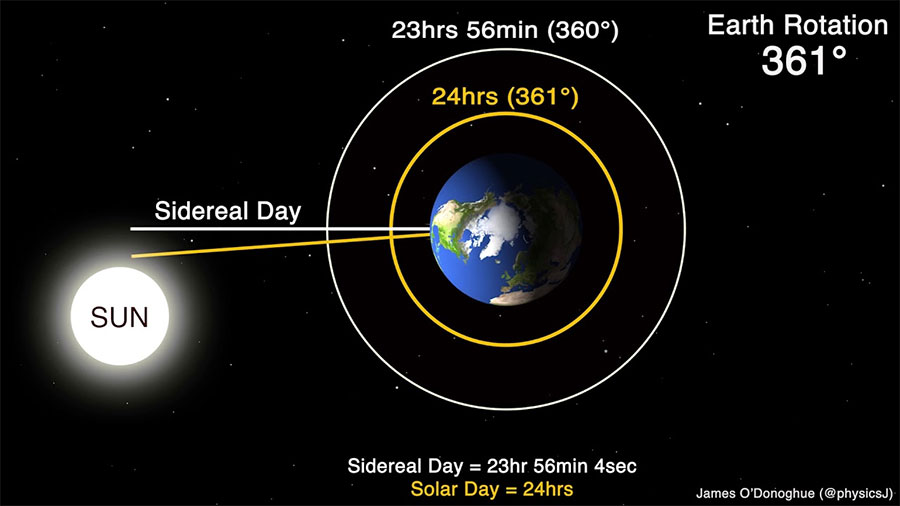
How are stellar days and solar days different?
In theory, a sidereal day: The time it takes for the Earth to complete one rotation relative to distant stars – lasting 23 hours, 56 minutes, 4 seconds, and 90.5 milliseconds. A solar day: About 4 minutes longer than a sidereal day because the Earth has to rotate a little more for the Sun to appear in the correct position in the sky again.
On August 5, both the stellar and solar days were shorter than average. Scientists attribute this to a number of factors: atmospheric winds, ocean currents, movements within the Earth's molten core, and the Moon's gravitational pull.
Since the 1970s, the discrepancy in Earth's rotation has been measured using atomic clocks and astronomical observations. In 1973, the cumulative yearly discrepancy was +1.106 milliseconds, forcing scientists to add a leap second to synchronize atomic time with Earth's rotation.
It may sound small, but a difference of just 1.33 milliseconds can cause a positioning error of about 62 centimeters at the equator. Left uncorrected, the 1973 drift could result in GPS errors of up to half a kilometer.
Measuring the Earth's rotation
To achieve precision down to the thousandth of a millisecond, they looked at quasars – extremely bright objects billions of light-years away that are almost stationary in the sky. By using radio telescopes to track the position of Earth relative to these 'cosmic lighthouses', scientists achieved extreme precision.
The data is then fed into computer models that take into account the influence of the atmosphere, the ocean, and astronomical factors to predict the length of the day. Wind is the most important short-term factor: strong winds in winter slow the Earth's rotation, while weak winds in summer shorten the days.
Long-term factors include:
- Melting ice at the poles: As ice mass moves toward the equator, it slows down the Earth's rotation,
- Earthquakes and geological disturbances: Can change the distribution of mass, thereby affecting rotation.
- The Moon's tidal force: Over billions of years, the Moon has gradually slowed the Earth's rotation, while also 'drifting' away from us about 3.8 cm each year.
From 1973 to 2020, Earth's rotation slowed down, forcing scientists to add a total of 27 leap seconds. But since 2020, our planet has been spinning a little faster, possibly due to interactions between the core and the mantle.
Researchers had predicted that August 5 would be one of the fastest rotation days, along with July 5 and July 22. A combination of internal dynamics, summer winds, and weaker tidal pull caused the rotation to shorten.
Although humans cannot perceive this difference, as scientists emphasize:
With ultra-precise atomic clocks and quasar reference astronomical measurements, the change is completely obvious.
FAQ
What should you know about our days are actually getting shorter?
In practical terms, on August 5, 2025, Earth completed its rotation 1.33 milliseconds earlier, making it one of the shortest days of the year.
Why does our days are actually getting shorter matter?
The article highlights that how are stellar days and solar days different.
What is the main takeaway?
The main takeaway is that on August 5, both the stellar and solar days were shorter than average.
Related Articles
 Why Do You Always Feel the Way Back Is Shorter Than the Road5 minutes read
 India Found Anti-cancer Properties in 3 Rice Varieties3 minutes read
 All 23 Classes in 100 Days at Sea: Costs and Perks7 minutes read
 Scientists Found the 555 Million-year-old Fossil of Human5 minutes read
 Building the Hair of the Mysterious Death of Nine Soviet Scientists6 minutes read
 How to Use the DAYS360 Function in Excel3 minutes read
Reader Comments 0
Sign in with email or Google to join the discussion.