Table of Contents
Only a Genius Can Solve This Equation That Is Causing a 'Storm' Online, How is easier to approach with a clear overview and reliable steps. This guide organizes the essential information, highlights practical details, and explains what to check along the way.
Key Takeaways
- Understand what is the mathematical equation that went "viral" on social networks.
- Follow the steps to solve math equation 4×4-4÷4+4.
- Understand why do so many people get math wrong.
What Is the Mathematical Equation That Went "Viral" on Social Networks?
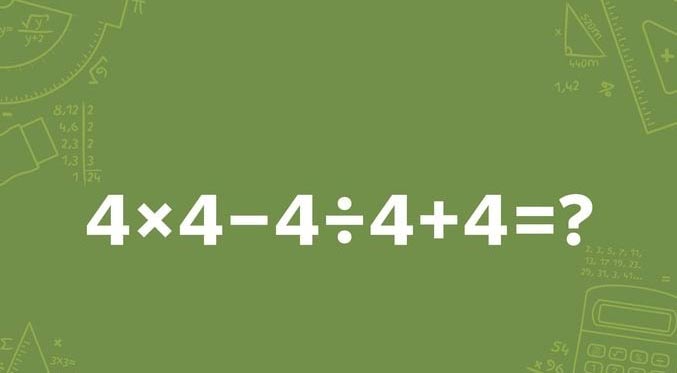
You've probably seen this problem (or a similar one) circulating on Facebook: 4×4-4÷4+4. The equation seems so simple. But math puzzles like this go viral because they're designed to fool people—and that's exactly why they're so appealing.
How to Solve Math Equation 4×4-4÷4+4
You need to follow the correct order of operations, a set of rules that dictate the sequence in which mathematical operations need to be performed. This helps you solve the equation 4×4-4÷4+4 (or any other equation). The acronym PEMDAS is a good way to remember the order: parentheses, exponents, multiplication, division, addition, subtraction. And a good mnemonic to remember it exactly is 'Please Excuse My Dear Aunt Sally.' Some people even say 'Please Excuse My Dear Aunt Sally and Let her Rest,' as a reminder to do those operations from left to right. (Fun fact: In the UK and some other countries, they use a different acronym, BODMAS—parentheses, order, division, multiplication, addition, subtraction—but it's the same concept.).
The solution below is courtesy of Alvaro Lozano-Robledo, PhD, a mathematics professor at the University of Connecticut, who is known for posting math tutorials on YouTube & TikTok. Here are the steps to solve the "hot" equation 4×4-4÷4+4:
- Since this expression doesn't have parentheses or exponents, let's start with multiplication and division, working from left to right. So, we do the multiplication first: 4×4=16.
- Next, we solve the division part of the equation: 4÷4=1.
- Then we move on to addition and subtraction, also working from left to right: 16-1=15.
- Finally, we add the last 4 numbers: 15+4=19.
Why Do So Many People Get Math Wrong?
' The maths is very clear,' says Lozano-Robledo. ' But I can imagine people who have been away from maths for a long time might not remember the rules for doing the calculations.'.
A common mistake is that people solve problems from left to right, ignoring PEMDAS.
Another common mistake is when people treat multiplication and division as if they must be done strictly from left to right, instead of realizing that they have the same precedence. The same goes for addition and subtraction—these operations should also be processed from left to right, regardless of which comes first.
But the main reason people get this and other viral maths puzzles wrong on social media is because these puzzles are deliberately confusing. ' If you write the maths properly, it's all clear, ' he said.
For instance, in this equation, if 4×4 were in parentheses, it would be obvious that we need to solve that part first. But without those group symbols, people would misunderstand the structure. 'Writing parentheses means "free,"' Lozano-Robledo jokes. ' This is not a telegram we send out to charge per character.'.
And it's not just the structure that adds to the confusion. Lozano-Robledo points to the use of symbols. ÷ In equations as opposed to a slash (. / ) for the division term. " We don't even use that symbol unless you're trying to be confusing,. " he says.
What Do Mathematicians Think About Controversial Equations?
" It's incredibly frustrating to see those equations presented like that," Lozano-Robledo shared, " because students or people will think, If I'm confused about a problem about multiplying and adding 4, how am I going to be able to solve any math problem, especially at a higher level? "
The bottom line, says Lozano-Robledo, if you're having trouble solving a math equation that's gone viral online, don't blame yourself! "The people who are wrong aren't the ones who come up with different and wrong answers," he adds. "The people who are wrong are the ones who propose and write the problem in a confusing way, when you can always communicate the math in a direct way.".
So next time you come across one of these viral math equations, remember to carefully follow the order of operations. But also remember that these puzzles aren't meant to teach math lessons; they're designed to grab attention and spark conversation.
Final Thoughts
The most reliable way to handle only a genius can solve this equation that is causing a 'storm' online, how is to follow the process in order, verify each important setting, and test the result before moving on. Use the guidance above as a practical reference, then adjust the details for your device, software version, or specific goal.
FAQ
What should I know first about Only a Genius Can Solve This Equation That Is Causing a 'Storm' Online, How?
This math equation is not as difficult as it looks.
How do I get the best results with Only a Genius Can Solve This Equation That Is Causing a 'Storm' Online, How?
Use current software or equipment, follow the steps in order, review the recommended settings, and test one change at a time so you can identify what improves the result.
What should I do if Only a Genius Can Solve This Equation That Is Causing a 'Storm' Online, How doesn't work as expected?
Check compatibility, permissions, connectivity, and version-specific settings. Restart the relevant device or app, then repeat the process carefully before trying a more advanced fix.
Related Articles
 5 Applications to Help You Track the Activity of the Storm Easily13 minutes read
 Fix Word Equation Error Not Displaying Correct Form: How-To Guide4 minutes read
 Solar Storms Could Bring Down the Global Internet System7 minutes read
 Solve a Quadratic Equation with One Variable Using Python4 minutes read
 How to Name Storms in the Pacific4 minutes read
 Why Is the Strongest Super Typhoon of 2025 Named Ragasa: Explained7 minutes read
Reader Comments 0
Sign in with email or Google to join the discussion.