Table of Contents
One of the most important things that the development of intelligent artificial intelligence can bring is access. Not just for a few, but for everyone – access to goods, services and information.
Victoria Slivkoff, Chief Ecosystem Officer at Walden Catalyst and CEO of Extreme Tech Challenge — a nonprofit that connects startups and venture capital to accelerate progress toward the United Nations Sustainable Development Goals (SDGs) — is excited about what lies ahead. As AI moves beyond the digital world and into the physical world, she says, we can move closer to realizing these ambitious goals.
' We are entering a phase where AI can reason. It is not just about synthesizing or organizing information, but also predicting and drawing conclusions. So what happens when we put it in the real world, where robots can sense, learn and interact with the environment around them? ' – Ms. Slivkoff shared.
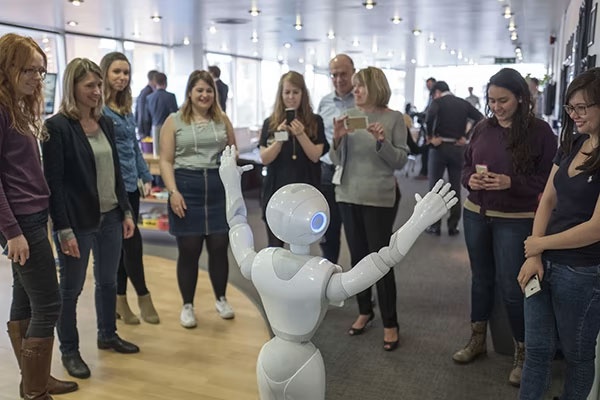
In the not-too-distant future, robots may become a familiar sight on the streets, in offices and in classrooms. But when that day comes, will robots have to adapt to humans, or will we be the ones who need to change to live together?
When robots… cut in line
Imagine this: you're waiting for the elevator, and a robot has just arrived. Who gets in first? If there's only room for one, do you expect the robot to give way, or do you expect the 'first come, first served' rule to apply as it does with humans?
Previous studies have shown that most people expect service robots to behave 'condescendingly', so they often prioritize themselves in conflict situations, even when the robot's task is more urgent.
But what if the robot is in the middle of an urgent task, like delivering a hot pizza or transporting life-saving medical supplies? If it has to wait until the queue clears, the task could be delayed. So how should a robot handle these social situations without being ignored or even bullied?
That was the subject of last year's study, 'Robots cutting in line: Expectations of politeness and priority in everyday human-robot conflicts.'
The results showed that when people expected robots to act confidently and at the same time the robots politely asked for priority, the interactions were more effective. However, the researchers also emphasized that it is not only the robots that need to learn to integrate, but also the people themselves who need to change their attitudes.
' Should we start thinking that service robots should also be given certain privileges, if they are taking on jobs and responsibilities for humans? This could help address the problem of 'robot bullying'. '
Classroom robot
Social robots — designed to communicate and interact with humans — are increasingly being used in care, education, and mental health support. They not only fill labor gaps, but also provide new experiences, help reduce loneliness, and support learning and emotional skills.
Utrecht University of Applied Sciences (Netherlands) is researching how robots can not only replace but also complement and enhance human-centered fields.
- In medicine: robots can help children reduce anxiety before procedures, or support pediatric patients in learning emotional control skills.
- At the Lowlands science festival, the school introduced WOKEbot , a project that investigates how appearance and tone of voice (whether people use 'I' or 'he/she') affect how open they are to discussing controversial topics.
' Controversies are a thing of the past. Sometimes people can resolve them, but sometimes they can't. The COVID-19 pandemic is a prime example: for or against vaccination? As polarization grows, a neutral moderator is needed. Here, robots have an advantage: they are more objective than humans, and can make it easier for you to open up and accept other perspectives ,' – Dr. Mirjam de Haas shared.
As part of her PhD, she also conducted successful experiments using robots to teach Dutch as a second language to immigrant students. With increasingly large and diverse classrooms, she believes that adding a 'robotic teaching assistant' could support the learning process of all students, including those with language difficulties or learning disabilities.
Is the world safe for robots?
Perhaps the most popular robot image in popular culture is 'The Terminator'. In the first film, a half-human, half-machine is sent back in time to assassinate the mother of a future savior. But in the sequel, the character becomes the protector of humanity.
The Sustainable Development Goals (SDGs) were adopted by all United Nations member states in 2015. Now, a decade later, the world is still struggling to meet its 17 commitments for people and planet. Could robots – deployed in the right direction and for the common good – be the key to our 'return to humanity'?
Final Thoughts
The key takeaway is that Are Humans Ready to Live with Robots and AI is easier to evaluate when its benefits, limitations, and real-world use are considered together. Review the details above before applying the information to a specific situation.
FAQ
What is the main point of Are Humans Ready to Live with Robots and AI?
One of the most important things that the development of intelligent artificial intelligence can bring is access. Not just for a few, but for everyone – access to goods, services and information.
What should you know about When robots… cut in line?
Imagine this: you're waiting for the elevator, and a robot has just arrived. Who gets in first? If there's only room for one, do you expect the robot to give way, or do you expect the 'first come, first served' rule to apply as it does with humans?
What limitations should readers keep in mind?
The answer can depend on the product version, source, use case, and date of publication. Review the article's context and confirm time-sensitive details before applying the information.
Related Articles
 Robots Are Identical to Humans That Are Almost Indistinguishable, Causing Confusion and Fear4 minutes read
 Can People and Robots Give Birth Together in 100 Years3 minutes read
 Amazon Uses Robots That Are 5 Times More Productive Than Humans in Warehouses11 minutes read
 OpenAI: the First AI Agent Could Enter the Workforce by 20254 minutes read
 Attack of Security Robots, a Man Is 'Wanted'6 minutes read
 Robot Chat in Strange Language, Threat to Humans5 minutes read
Reader Comments 0
Sign in with email or Google to join the discussion.