Table of Contents
This guide provides a clear, practical overview of "Microrobots Controlled by Metal Patches Can Deliver Drugs and Clean". It organizes the most useful details, explains important considerations, and highlights the steps or choices that matter most.
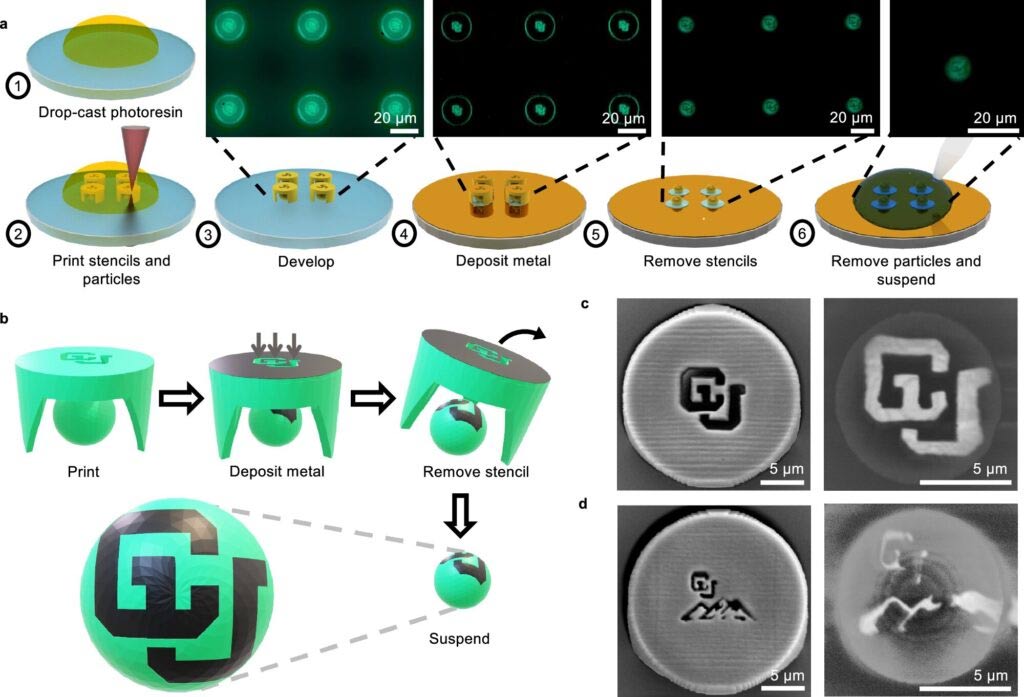
This innovative research, presented in the journal Nature Communications, introduces a new fabrication method that combines a high-precision 3D printing technology —called two-photon lithography—with a micro-printing technique. This process allows for simultaneous printing of both the particles and their corresponding stencils. After printing, a thin layer of metal such as gold, platinum, or cobalt is deposited through the pores of the stencil. Once the stencil is removed, each metal patch adheres to the particles, creating a highly functional microstructure.
These particles, invisible to the naked eye, can be manufactured in almost any design and can have surface patterns as small as 0.2 microns, making them 500 times thinner than a human hair. The metal patches play a key role in controlling the movement of individual particles when they are subjected to electromagnetic fields or when they encounter chemical gradients.
' The shape of the surface patch gives the particles information about where they need to go ,' explains Assistant Professor Wyatt Shields, lead author of the study. ' Until now, we haven't had a good way to precisely control the shape of those patches .'
With this newfound ability, the potential applications of the microparticles are vast. For example, they could enhance the delivery of drugs in the human body, thereby improving the effectiveness of treatment, or they could aid in the remediation of pollutants in the environment.
The research team included Kendra Kreienbrink, first author and a doctoral student in materials science and engineering in the Shields Laboratory, along with undergraduate students Zoe Cruse, who studies chemical engineering, biology & computer science, and Alisha Kumari, who majors in biomedical engineering.
' This research not only highlights the exciting advances possible in the field of active particles and microrobotics through non-traditional microfabrication ,' Shields added, ' but also underscores the value of mentoring undergraduates early in their research careers, which can lead to groundbreaking results .'
The significance of the study is significant, marking a step forward in the design and use of microparticles in practical applications, especially in the fields of medicine and environmental science.
FAQ
What does this guide cover?
This guide explains microrobots controlled by metal patches can deliver drugs and clean, including the main steps, important details, and practical considerations.
Who is this guide for?
It is designed for readers who want a clear, practical overview and a reliable process they can follow without unnecessary complexity.
What should you check before getting started?
Review the requirements, confirm that your software or device is up to date, and save any important data before changing settings.
Related Articles
 Cancer Drugs 'Smart'? Why Not!9 minutes read
 See the Air Pollution Index Using Breezometer Application4 minutes read
 Unusual Story: Air Pollution Can Adversely Affect Your Kidneys3 minutes read
 Air Pollution Can Kill 60,000 People by 20304 minutes read
 Few Doubts of Concrete Can Help Limit Air Pollution4 minutes read
 Successfully Formulated, Programmable, Liquid Metal Fabrication3 minutes read
Reader Comments 0
Sign in with email or Google to join the discussion.