Table of Contents
Eve Energy officially mass-produced solid-state batteries in China, paving the way for drones, humanoid robots and AI devices.
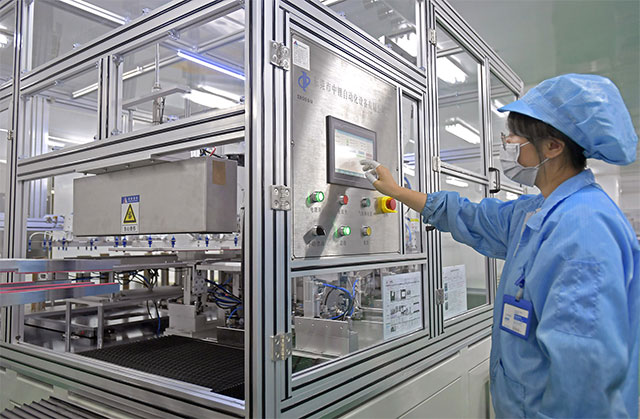
Eve Energy – one of China's leading battery manufacturers – has officially entered the mass production phase of solid-state batteries. This is considered an important milestone, paving the way for the practical application of new battery technology.
The first product expected to benefit from this generation of batteries is Drones . The new battery cells are not only more efficient and have greater energy density, but are also more stable, an extremely important factor when every gram of weight directly affects flight ability.
Eve Energy's new Chengdu factory is currently producing 10Ah cells Using a solid-state sulfide electrolyte. These cells can be assembled into 60Ah battery packs, enough to power drones, humanoid robots (like the Tesla Optimus), or AI-powered IoT devices.
According to Eve Energy, the battery's energy density is around 300 Wh/kg , which is significantly higher than the average 200 Wh/kg Of current lithium-ion batteries. To put that in perspective, batteries typically make up 40–50% of a drone's total weight, so any improvement in energy density translates into a significant increase in flight time.
Not only that, the solid-state battery structure also solves many of the limitations of liquid electrolyte batteries, such as heat resistance and safety when operating in harsh conditions. This is also the reason why they are considered the ideal choice for aviation applications or industrial robots.
Solving the cost problem
Currently, big names like CATL or Panasonic still believe that solid-state batteries are unlikely to be commercialized in electric vehicles before the end of this decade because of the high cost. Eve Energy has chosen a different direction: attacking the niche market first, where the scale is small but the performance requirements are high.
According to the plan, the factory in Chengdu will reach a capacity of 100 MWh/year By 2026, and aim to develop a battery line with an energy density of up to 400 Wh/kg .
One thing to note is that Eve's energy density figures are based on Weight (Wh/kg) , which is different from the numbers typically found on silicon-carbon batteries in smartphones (Wh/L – based on volume). Therefore, the two batteries cannot be directly compared.
Eve Energy isn't the only one eyeing the solid-state battery race. Earlier this year, Canada's Avidrone unveiled a cargo drone powered by Factorial batteries. But with the advantage of Being the first to mass produce , Eve Energy is likely to get the technology out of the lab and into real-world applications faster than any of its competitors.
FAQ
What is new about china starts mass production of solid-state batteries?
In practical terms, eve Energy officially mass-produced solid-state batteries in China, paving the way for drones, humanoid robots and AI devices.
Why does this update matter?
The article highlights that not only that, the solid-state battery structure also solves many of the limitations of liquid electrolyte batteries, such as heat resistance and safety when operating in harsh conditions.
Is the change available to everyone?
Availability may depend on the product version, region, account, or rollout stage described in the article.
Related Articles
 China's Memory Chip Production Will Go from Zero to 5% of the6 minutes read
 Solid-state Batteries with 100 Times More Energy Density Can Be3 minutes read
 Samsung's New Battery Technology Can Allow Electric Cars to Run3 minutes read
 China Begins Mass Production of Humanoid Robots4 minutes read
 What Are Solid-State Drives (SSDs)?9 minutes read
 Samsung Plans to Mass-produce 5nm Chipsets in Q2 20204 minutes read
Reader Comments 0
Sign in with email or Google to join the discussion.