Table of Contents
Explore james webb discovered the most distant supernova ever observed in the universe.
The explosion, designated SN in GRB 250314A, occurred when the universe was only about 730 million years old. This places the event in the reionization epoch – a crucial formative period when the first generations of stars and galaxies began to appear. Observing a supernova at such an early stage offers a rare opportunity to understand how massive stars ended their lifecycles in the early days of the universe.
This event was initially detected as an extremely powerful, high-energy flash, known as a sustained gamma-ray burst (GRB), recorded by the SVOM multi-band astronomical observatory in space on March 14, 2025.
Subsequent observations using the European Southern Observatory's Very Large Telescope (VLT) confirmed that this light source was located at an extremely distant cosmic distance.
The crucial turning point came from focused observations using JWST's NIRCam near-infrared camera, taken approximately 110 days after the initial outburst. This allowed scientists to separate the fading light of the supernova from the faint light of its host galaxy, thus confirming the existence of the stellar explosion at such an early stage in the universe's history.
Dr. Antonio Martin-Carrillo, co-author of the study and astrophysicist at the UCD School of Physics, said:
The key evidence – or 'smoking gun' – linking the death of massive stars to gamma-ray bursts was the discovery of a supernova appearing at the same location in the sky. Most supernovae studied so far have been relatively close to us, with very few exceptions. Once we determined the age of this event, we realized it was a unique opportunity to explore the universe at that time and understand how stars came into being and died.
He added:
Based on models of supernovae associated with GRBs in the nearby universe, we predicted an observable emission pattern and proposed a new observation using James Webb. Surprisingly, our model performed very well, and the observed supernova had characteristics very similar to the stellar explosions we commonly see. We even got an initial glimpse of the galaxy that 'contained' this dying star.
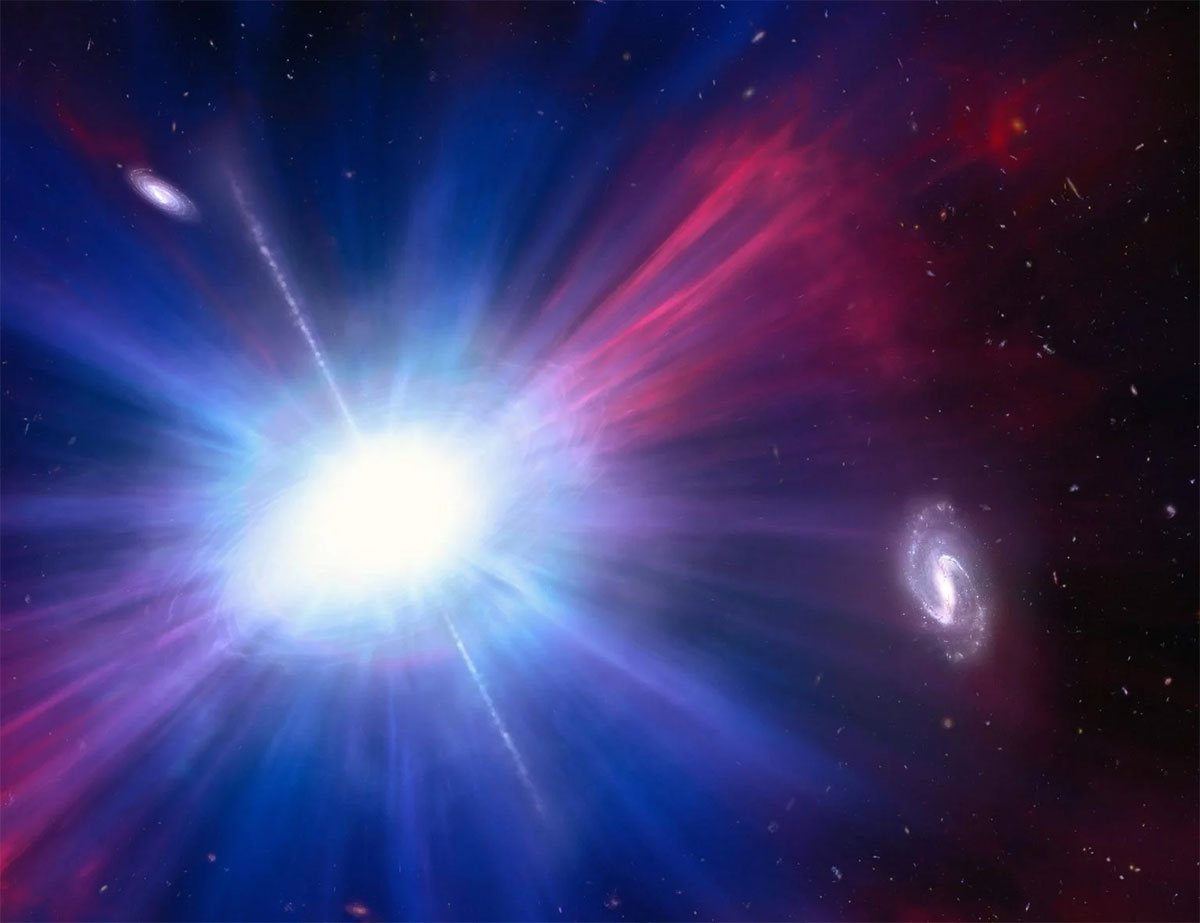
Data suggests that this ultra-distant supernova has a brightness and spectral characteristics very similar to SN 1998bw – the 'prototype' supernova associated with GRB, previously observed in the near universe.
This similarity suggests that the collapsing giant star that created GRB 250314A is not too different from GRB 'precursors' in the universe today, even though the physical conditions in the early universe were very different, such as much lower metal content.
The observations also ruled out the possibility that this was an extremely bright event, such as a superluminal supernova (SLSN).
This discovery challenges the long-held assumption that stars in the early universe – formed in metal-poor environments – would produce entirely different explosions, perhaps even brighter or 'bluer' than today's supernovae.
While this discovery serves as a crucial anchor for a better understanding of stellar evolution in the early universe, it also raises new questions about the surprising uniformity of stellar explosions across billions of years of cosmic history.
The research team plans to conduct a second round of observations using JWST within the next 1–2 years. At that time, the supernova's light is predicted to dim by more than two magnitudes, allowing scientists to fully analyze the characteristics of the host galaxy and accurately confirm the supernova's contribution to the overall observed signal.
Final Thoughts
Understanding james webb discovered the most distant supernova ever observed in the universe makes it easier to evaluate the information and apply the most relevant recommendations. Focus on the key points above and verify details that may change over time.
FAQ
What is james webb discovered the most distant supernova ever observed in the universe?
Explore james webb discovered the most distant supernova ever observed in the universe.
What key points does this article cover?
The article explains the core concept, important considerations, and practical details readers should understand.
How can you use this information in practice?
Use the explanations to compare options, verify important details, and make a more informed decision. Apply the recommendations that best match your goals and situation.
Related Articles
 Astronomer James Webb Finds the Most Distant Galaxy Ever4 minutes read
 The Most Distant Galaxy Ever Discovered Holds Amazing Secrets4 minutes read
 Astronomy: Complete Guide: The ''white Whale'' Planet Was Observed for4 minutes read
 Webb Telescope Discovers Oldest Black Hole, Breaking Cosmic Record5 minutes read
 Admire Incredibly Detailed Images of the Orion Nebula Through the Eyes of the5 minutes read
 The Supernova Exploded Twice in the Universe, Surprising Astronomers3 minutes read
Reader Comments 0
Sign in with email or Google to join the discussion.