Table of Contents
A Spanish physics professor has proven the Nernst theorem more than 120 years after it was first proposed by Albert Einstein.
A physics professor at the University of Seville (Universidad de Sevilla, Spain) has just solved a problem in the field of thermodynamics that has existed for more than a century, and at the same time presented a new proof that challenges the view once put forward by Albert Einstein.
Professor José María Martín Olalla's research, published in The European Physical Journal Plus , focuses on Nernst's heat theorem . This theorem, first stated in 1905, states that as the temperature approaches Absolute zero , the exchange entropy (degree of disorder) also approaches zero. In the paper, Martín Olalla shows that this theorem can be proven solely based on The second law of thermodynamics – which states that the entropy of the universe always increases.
What is special is that he defines the state T=0 by a concept called The Carnot thermometer . This definition does not depend on whether the heat capacity is zero or not, nor does it depend on the human ability to reach absolute zero. According to the study, this method helps to expand the scope of application of the second law, at the same time narrowing the third law of thermodynamics into a single statement: the entropy of a chemically homogeneous object with a finite density can never be negative.
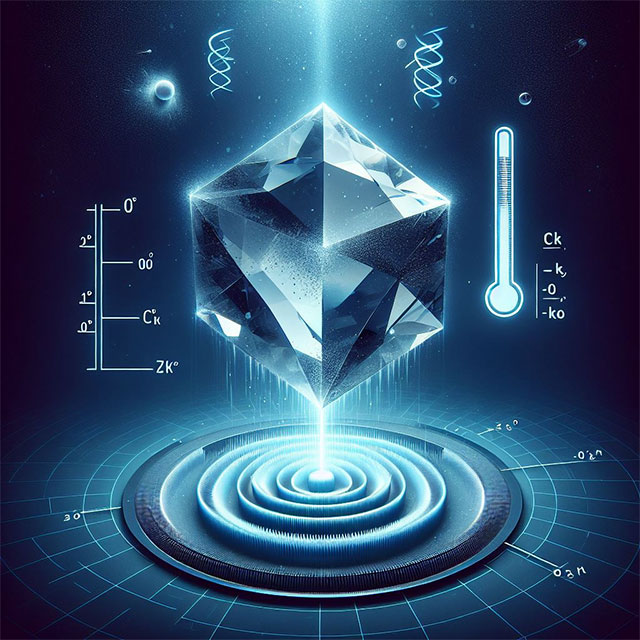
The debate stretches back to the time of Nernst and Einstein.
In the early 1900s, scientists began to study how matter behaved near absolute zero (–273°C). Chemist Walther Nernst, who won the Nobel Prize in 1920, claimed in 1912 that Absolute zero was unattainable . He reasoned that if it were, humans could build a machine that used absolute zero as a coolant to convert all the heat into work, breaking the law of increasing entropy.
Einstein disagreed. He argued that such a machine would never be practical and therefore would not threaten the second law. Einstein separated Nernst's theorem from the second law and treated it as a separate principle – the Third law .
Martín Olalla's proof brought the hypothetical machine back into the discussion, but with a 'plot twist': according to him, the second law requires that this machine must exist in a 'virtual' form – that is, it consumes no heat, does no work, and violates no laws of thermodynamics. Combined with the definition of the Carnot thermometer, the conclusion is: as temperature approaches absolute zero, entropy exchange approaches zero, and absolute zero is unattainable.
The meaning of the new proof
Professor Martín Olalla explains:
'A fundamental problem of thermodynamics is to distinguish between the sensations of hot and cold that we experience, and the abstract notion of temperature as a physical quantity. In fact, the second law gives a clearer notion of the natural zero point of temperature. This idea does not involve sensation, but involves the machine imagined by Nernst, but in imaginary form. This fundamentally changes the way we prove the theorem.'
The study also showed that the only property of matter near absolute zero that is not tied to the second law is The disappearance of heat capacity , as Nernst noted in 1912. According to Martín Olalla, this is more of an 'important addendum' than a new principle. He added:
'I hope that with the publication of the research, this proof will become more widely known, although I understand that the academic world always has a large lag.'
FAQ
What should you know about A 120-year-old law of physics that einstein once proved wrong?
In practical terms, a Spanish physics professor has proven the Nernst theorem more than 120 years after it was first proposed by Albert Einstein.
Why does A 120-year-old law of physics that einstein once proved wrong matter?
The article highlights that in the paper, Martín Olalla shows that this theorem can be proven solely based on The second law of thermodynamics – which states that the entropy of the universe always increases.
What is the main takeaway?
The main takeaway is that einstein separated Nernst's theorem from the second law and treated it as a separate principle – the Third law .
Related Articles
 Albert Einstein's Physics Genius and 10 Profound Lessons About Life8 minutes read
 What 100 Years of Quantum Physics Has Taught Us About Reality: and Ourselves9 minutes read
 The Mystery Behind the Stolen Brain of Albert Einstein Genius6 minutes read
 What Do You Know About the Great Genius Albert Einstein?3 minutes read
 Thanks to the Broken Antenna, the Scientists Solved the5 minutes read
 The 2017 Nobel Prize for Physics Was Awarded to Research on Gravitational Waves4 minutes read
Reader Comments 0
Sign in with email or Google to join the discussion.